Wildlife and Wetlands of Uttar Pradesh
Tiger reserves, sanctuaries, Ramsar sites and state symbols.
What the diagram shows
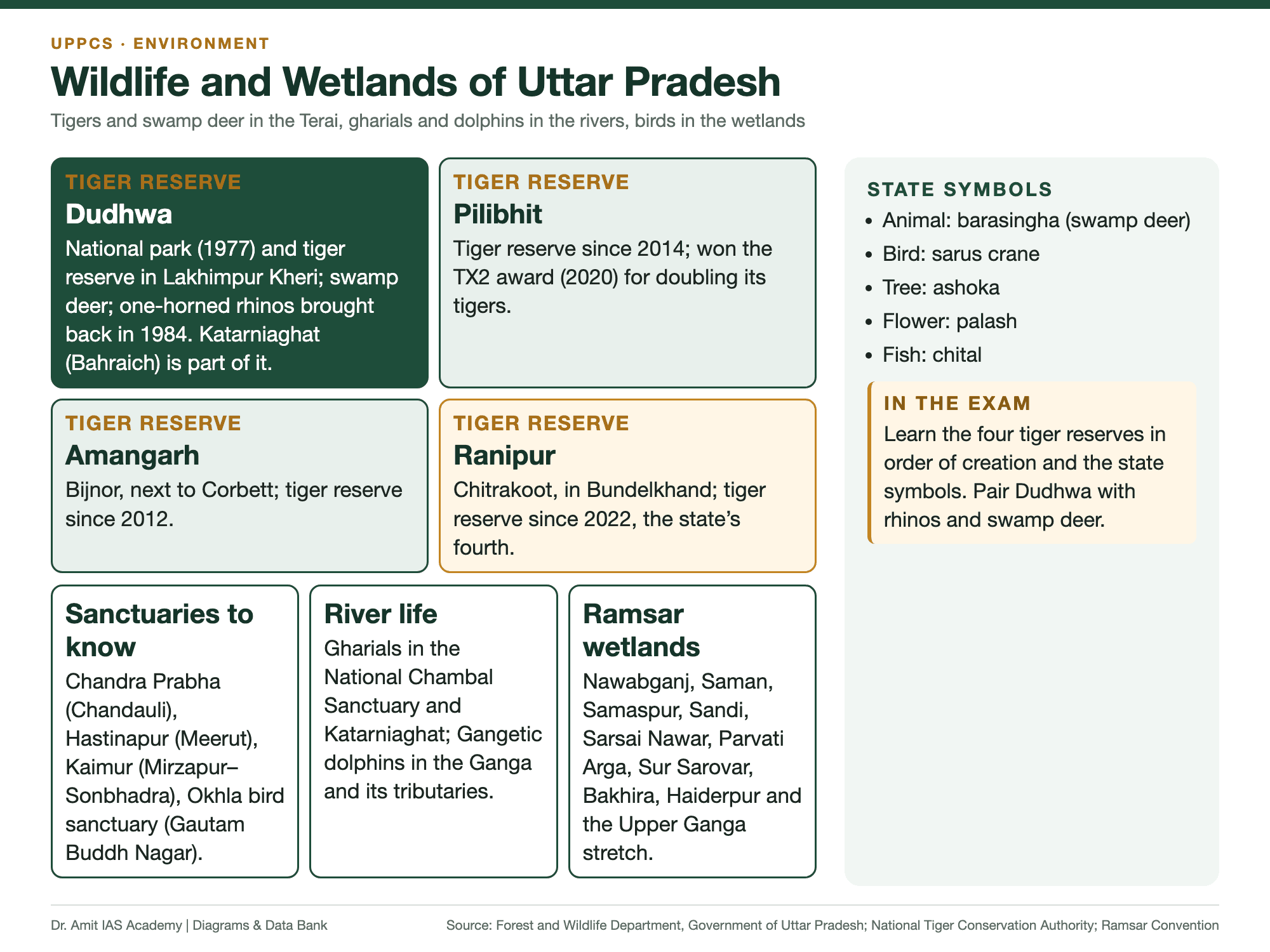
The chart is built around four cards for the tiger reserves of Uttar Pradesh. The dark card at the top left is Dudhwa, followed by Pilibhit, then Amangarh and Ranipur in the second row. Below them, three smaller boxes cover the sanctuaries worth knowing, the wildlife of the rivers and the Ramsar wetlands. A side panel lists the state symbols and adds an exam tip: learn the four tiger reserves in the order they were created, learn the state symbols, and link Dudhwa with rhinos and swamp deer. The subtitle sums up the theme: tigers and swamp deer in the Terai, gharials and dolphins in the rivers, and birds in the wetlands.
The four tiger reserves
- Dudhwa (Lakhimpur Kheri): declared a national park in 1977 and later made a tiger reserve. It is the stronghold of the swamp deer, and one-horned rhinos were brought back here in 1984. Katarniaghat in Bahraich is part of the reserve.
- Pilibhit: a tiger reserve since 2014. It won the international TX2 award in 2020 for doubling its tiger numbers.
- Amangarh (Bijnor): a tiger reserve since 2012, lying next to Corbett in Uttarakhand, so tigers move between the two.
- Ranipur (Chitrakoot): in Bundelkhand, notified in 2022 as the state's fourth tiger reserve and its first outside the Terai belt.
The first three sit along the Terai at the foot of the Himalaya, where tall grasslands, sal forest and marshes support tigers and swamp deer. Ranipur stands apart on the dry, rocky plateau of the south.
Sanctuaries, rivers and wetlands
Among the sanctuaries the chart picks out Chandra Prabha (Chandauli), Hastinapur (Meerut), Kaimur (Mirzapur and Sonbhadra) and the Okhla bird sanctuary (Gautam Buddh Nagar).
The rivers carry their own wildlife. Gharials live in the National Chambal Sanctuary, which UP shares with Madhya Pradesh and Rajasthan, and in the Girwa river at Katarniaghat. The Gangetic river dolphin, India's national aquatic animal, is found in the Ganga and its tributaries.
The chart lists ten Ramsar wetlands: Nawabganj, Saman, Samaspur, Sandi, Sarsai Nawar, Parvati Arga, Sur Sarovar, Bakhira, Haiderpur and the Upper Ganga river stretch. These were the state's sites up to 2025; more wetlands have been added to the list since, so check the latest official count before the exam. Most are shallow lakes and jheels that hold large numbers of wintering waterbirds, and Sarsai Nawar is known for its sarus cranes.
Why it matters for the exam
For UPPCS this topic falls under environment, biodiversity and conservation in the Prelims General Studies paper and in the Mains papers, especially the General Studies papers on Uttar Pradesh. Questions tend to ask which district a reserve or sanctuary lies in, which reserve is the newest, which wetlands are Ramsar sites, or to match animals with protected areas. State symbols are a favourite one-line question, and short Mains answers may ask about rhino reintroduction, dolphin conservation or the value of wetlands.
Quick revision
- Tiger reserves in order: Dudhwa, Amangarh (2012), Pilibhit (2014), Ranipur (2022).
- Dudhwa: national park 1977, rhinos reintroduced 1984, swamp deer, includes Katarniaghat.
- Pilibhit won the TX2 award in 2020 for doubling its tigers.
- State symbols: barasingha, sarus crane, ashoka, palash and the chital fish.
- Gharials in the Chambal and at Katarniaghat; Gangetic dolphins in the Ganga system.
- Ramsar sites include Upper Ganga, Sur Sarovar, Bakhira and Haiderpur; the list keeps growing.