The Mineral Wealth of Rajasthan
Zinc, copper, marble, oil and lignite: what is found where.
What the diagram shows
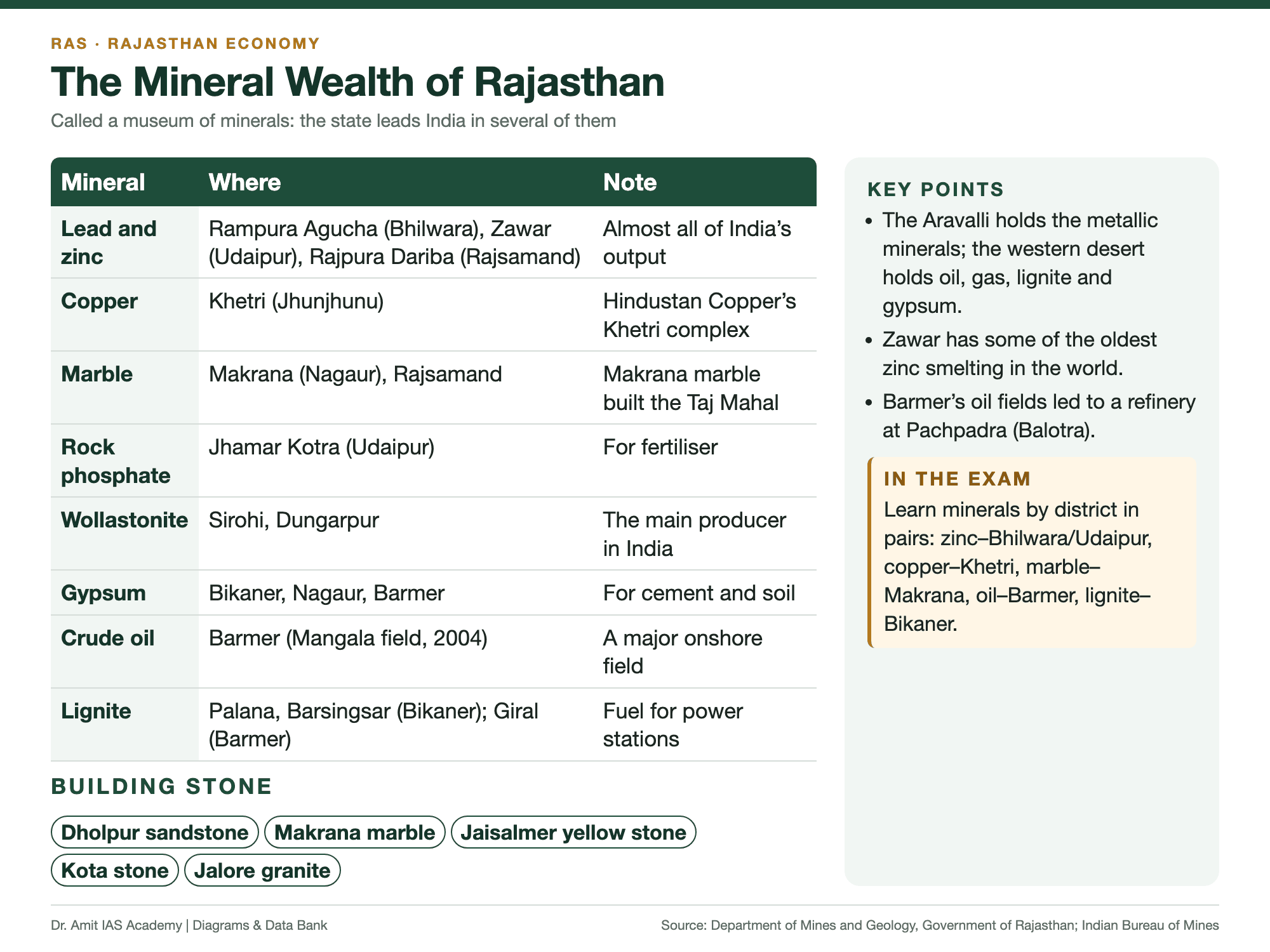
Rajasthan is often called a museum of minerals, and the diagram opens with that idea: the state leads India in several of them. The main part is a table with three columns, Mineral, Where and Note, running through eight minerals: lead and zinc, copper, marble, rock phosphate, wollastonite, gypsum, crude oil and lignite. Below the table, a row of tags names the state's famous building stones. A side panel gives three key points and an exam tip on learning minerals by district in pairs.
Metallic and industrial minerals of the Aravalli
The old, folded rocks of the Aravalli range hold most of the state's metallic minerals. The table places them as follows:
- Lead and zinc: Rampura Agucha (Bhilwara), Zawar (Udaipur) and Rajpura Dariba (Rajsamand). Rajasthan gives almost all of India's output. Zawar is known for some of the oldest zinc smelting in the world.
- Copper: Khetri in Jhunjhunu, home of Hindustan Copper's Khetri complex.
- Rock phosphate: Jhamar Kotra near Udaipur, mined as a raw material for phosphatic fertiliser.
- Wollastonite: Sirohi and Dungarpur; Rajasthan is the main producer in India. The mineral is used in ceramics, paints and fillers.
- Marble: Makrana in Nagaur and the Rajsamand area. Makrana marble was used to build the Taj Mahal.
Fuels and minerals of the western desert
The sedimentary basins of the Thar hold a different set of resources: oil, gas, lignite and gypsum.
- Crude oil: the Mangala field in Barmer, discovered in 2004, is one of India's major onshore fields. The Barmer oil finds led to a refinery at Pachpadra, now in Balotra district.
- Lignite: Palana and Barsingsar in Bikaner and Giral in Barmer, used mainly as fuel for pit-head power stations.
- Gypsum: Bikaner, Nagaur and Barmer. It is used in cement and to reclaim alkaline soils.
Building stones
Rajasthan's dimension stones are known across India: Dholpur sandstone, Makrana marble, Jaisalmer yellow stone, Kota stone and Jalore granite. They support a large quarrying and stone-processing industry in the state.
Why it matters for the exam
Minerals are a regular part of the Rajasthan geography and economy section of the RAS syllabus, in both the Prelims paper and the Mains papers. Questions usually test matching: which mine is in which district, which mineral a place is famous for, or which district leads in a mineral. Mains questions may ask about the role of mining in the state economy, the oil and lignite base for power and refining, or the problems of illegal mining and the environment in the Aravalli. Learning each mineral with its district, as the diagram suggests, makes these questions quick to answer.
Quick revision
- Lead-zinc: Rampura Agucha (Bhilwara), Zawar (Udaipur), Rajpura Dariba (Rajsamand).
- Copper: Khetri (Jhunjhunu); rock phosphate: Jhamar Kotra (Udaipur).
- Wollastonite: Sirohi and Dungarpur; Rajasthan is India's main producer.
- Crude oil: Mangala field, Barmer (2004); refinery at Pachpadra (Balotra).
- Lignite: Palana and Barsingsar (Bikaner), Giral (Barmer).
- Aravalli holds the metallic minerals; the desert holds oil, gas, lignite and gypsum.