Irrigation Projects of Rajasthan
The Indira Gandhi Canal, the Chambal project and main dams.
What the diagram shows
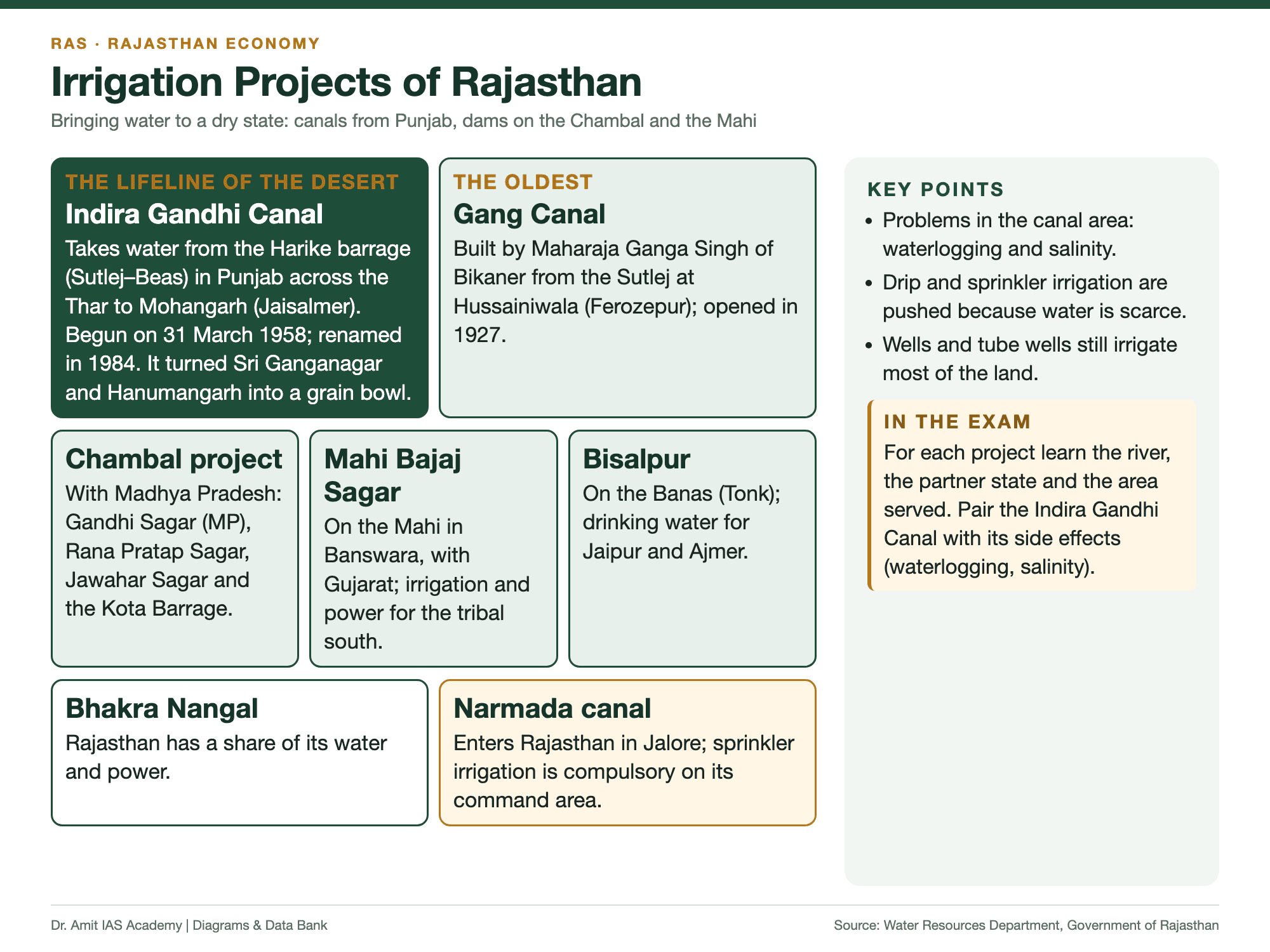
The diagram is a set of labelled boxes, one for each major irrigation project that serves Rajasthan, under the subtitle that sums up the theme: canals from Punjab and dams on the Chambal and the Mahi. The large dark box at the top left gives pride of place to the Indira Gandhi Canal, called the lifeline of the desert. Beside it sits the Gang Canal, marked as the oldest. A middle row covers three river projects in the south and east: the Chambal project, Mahi Bajaj Sagar and Bisalpur. The bottom row adds Bhakra Nangal and the Narmada canal. A side panel lists the key problems and trends, and a short note advises learning each project by its river, partner state and area served.
Canals that bring water from Punjab
- Indira Gandhi Canal: takes water from the Harike barrage, near where the Sutlej and the Beas meet in Punjab, and carries it across the Thar to Mohangarh in Jaisalmer. Work began on 31 March 1958, and the canal, first known as the Rajasthan Canal, was renamed in 1984. Together with the older Gang Canal, it helped turn Sri Ganganagar and Hanumangarh into a grain bowl.
- Gang Canal: built by Maharaja Ganga Singh of Bikaner, it draws water from the Sutlej at Hussainiwala in Ferozepur district and was opened in 1927, long before Independence.
- Bhakra Nangal: a multipurpose project on the Sutlej in which Rajasthan has a share of both water and power, along with other partner states such as Punjab and Haryana.
Dams of the south and east
- Chambal project: a joint venture with Madhya Pradesh, built in stages as a chain of structures: Gandhi Sagar in Madhya Pradesh, then Rana Pratap Sagar, Jawahar Sagar and the Kota Barrage in Rajasthan. It irrigates the Hadoti region and generates hydroelectricity.
- Mahi Bajaj Sagar: on the Mahi in Banswara, shared with Gujarat. It supplies irrigation and power to the tribal south of the state.
- Bisalpur: on the Banas in Tonk district. Its main role is drinking water for Jaipur and Ajmer.
- Narmada canal: enters Rajasthan in Jalore. Sprinkler irrigation is compulsory in its command area, a rule meant to stretch scarce water.
Problems and the way ahead
Canal water has transformed the north-west, but it has side effects. Over-irrigation and seepage in the canal command areas have caused waterlogging and salinity, which reduce soil fertility. Because water is scarce, the state promotes drip and sprinkler irrigation. Even so, wells and tube wells still irrigate most of the land, which puts heavy pressure on groundwater.
Why it matters for the exam
For RAS, this topic belongs to the geography and economy of Rajasthan, covering agriculture, water resources and irrigation, in both Prelims and Mains. Objective questions often ask you to match a project with its river, district or partner state, or to identify the source and end point of a canal. Mains questions tend to ask about the role of the Indira Gandhi Canal in the economy of western Rajasthan, the problems of its command area, or ways to save water through micro-irrigation.
Quick revision
- Indira Gandhi Canal: Harike barrage to Mohangarh (Jaisalmer); begun 1958, renamed 1984.
- Gang Canal: Maharaja Ganga Singh, from the Sutlej at Hussainiwala, opened 1927.
- Chambal: with Madhya Pradesh; Gandhi Sagar, Rana Pratap Sagar, Jawahar Sagar, Kota Barrage.
- Mahi Bajaj Sagar: Banswara, shared with Gujarat; Bisalpur: Banas, Tonk, water for Jaipur and Ajmer.
- Narmada canal: enters at Jalore; sprinkler irrigation compulsory.
- Canal areas face waterlogging and salinity; wells and tube wells irrigate most land.