ISRO's Launch Vehicles and Orbits
PSLV, GSLV, LVM3 and SSLV, and which orbit each one serves.
What the diagram shows
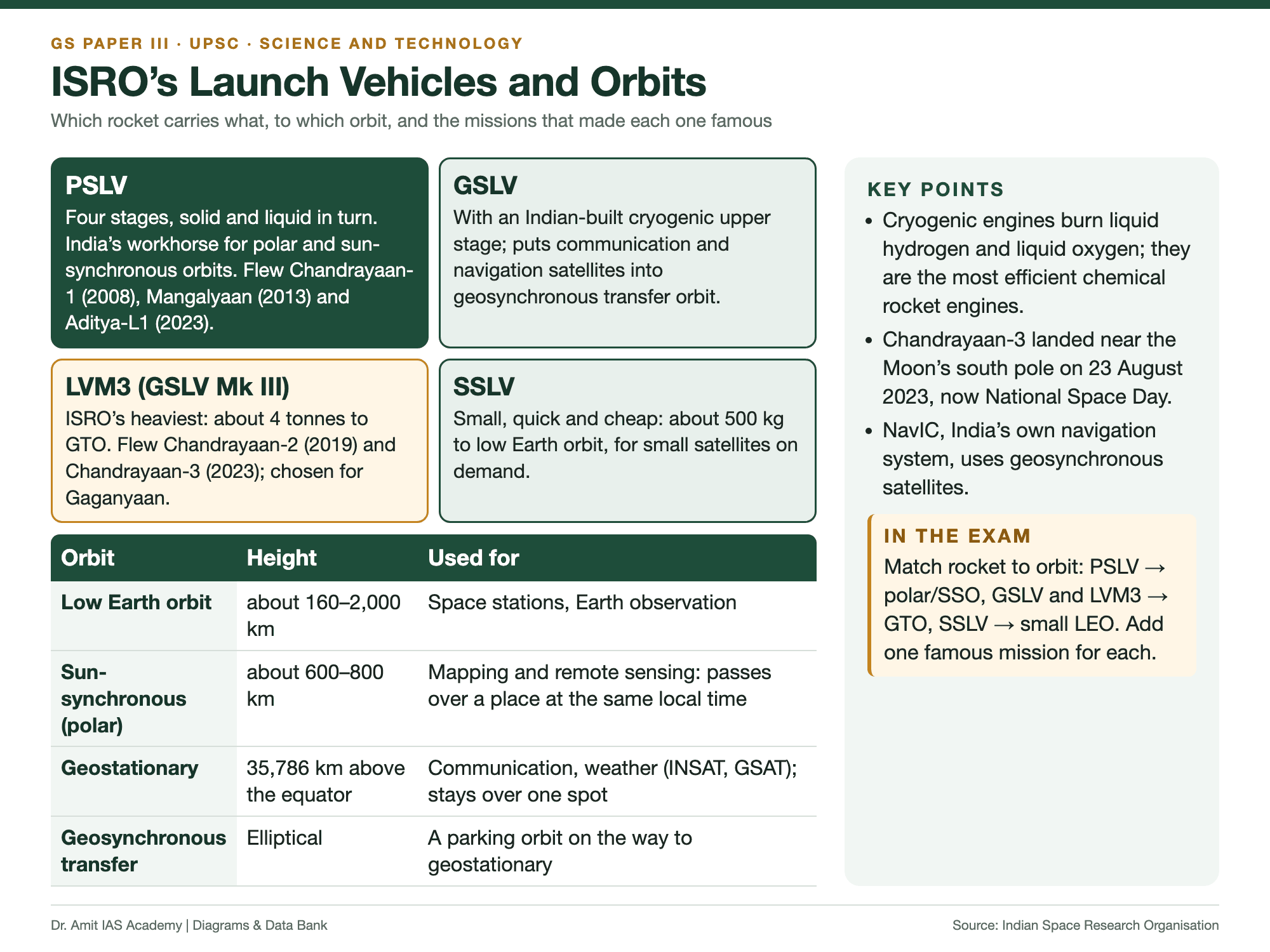
The picture is built in three parts. At the top, four boxes describe ISRO's rockets: PSLV, GSLV, LVM3 (GSLV Mk III) and SSLV, each with what it carries and the missions it flew. Below them, a table lists four orbits (low Earth, sun-synchronous, geostationary and geosynchronous transfer) with their height and what each is used for. On the right, a Key Points panel covers cryogenic engines, Chandrayaan-3 and NavIC, and an In the Exam note gives the one-line rule: match the rocket to the orbit and add one famous mission for each.
The four launch vehicles
- PSLV (Polar Satellite Launch Vehicle): four stages that alternate solid and liquid fuel. It is India's workhorse for polar and sun-synchronous orbits, and also flew Chandrayaan-1 (2008), Mangalyaan, the Mars Orbiter Mission (2013), and Aditya-L1 (2023).
- GSLV (Geosynchronous Satellite Launch Vehicle): has an Indian-built cryogenic upper stage and places communication and navigation satellites in geosynchronous transfer orbit (GTO).
- LVM3 (formerly GSLV Mk III): ISRO's heaviest rocket, able to lift about 4 tonnes to GTO. It flew Chandrayaan-2 (2019) and Chandrayaan-3 (2023), and a human-rated version is chosen for Gaganyaan, India's human spaceflight programme.
- SSLV (Small Satellite Launch Vehicle): small, quick to assemble and cheap, carrying about 500 kg to low Earth orbit. It is meant for launching small satellites on demand.
Orbits and what they are used for
- Low Earth orbit (LEO): roughly 160 to 2,000 km up; used for space stations and Earth observation.
- Sun-synchronous (polar) orbit: roughly 600 to 800 km; the satellite passes over a place at the same local time each day, which keeps lighting uniform for mapping and remote sensing.
- Geostationary orbit: 35,786 km above the equator; the satellite moves with the Earth's rotation and stays over one spot, which suits communication and weather satellites such as INSAT and GSAT.
- Geosynchronous transfer orbit: an elliptical parking orbit; the satellite later uses its own motor to climb to geostationary height.
Why the cryogenic stage matters
Cryogenic engines burn liquid hydrogen with liquid oxygen. They are more efficient (they get more push from each kilogram of propellant) than solid or earth-storable liquid fuels, which is why ISRO uses a cryogenic upper stage to send heavy satellites to GTO. Mastering this technology indigenously made GSLV and LVM3 possible. The panel also records two milestones: Chandrayaan-3 landed near the Moon's south pole on 23 August 2023, now celebrated as National Space Day, and NavIC, India's own regional navigation system, relies on satellites in geosynchronous orbits.
Why it matters for the exam
This topic belongs to UPSC General Studies Paper III under Science and Technology, specifically awareness in the field of space and the achievements of Indians in science and technology, including indigenisation of technology. State commissions such as HCS, RAS, UPPCS and GPSC ask the same material in their general studies papers. Prelims questions usually test matching: which rocket for which orbit, which mission flew on which vehicle, or what makes an orbit sun-synchronous or geostationary. Mains questions ask about India's space programme, its commercial role in launching small satellites, cryogenic self-reliance and human spaceflight.
Quick revision
- PSLV: four stages, solid and liquid alternately; polar and sun-synchronous orbits.
- GSLV: indigenous cryogenic upper stage; communication and navigation satellites to GTO.
- LVM3: heaviest, about 4 tonnes to GTO; Chandrayaan-2, Chandrayaan-3 and Gaganyaan.
- SSLV: about 500 kg to low Earth orbit, small satellites on demand.
- Geostationary orbit: 35,786 km above the equator, fixed over one spot.
- Chandrayaan-3 landed on 23 August 2023, now National Space Day.