Wildlife and Wetlands of Gujarat
Gir lions, the wild ass, coral reefs and the Ramsar sites.
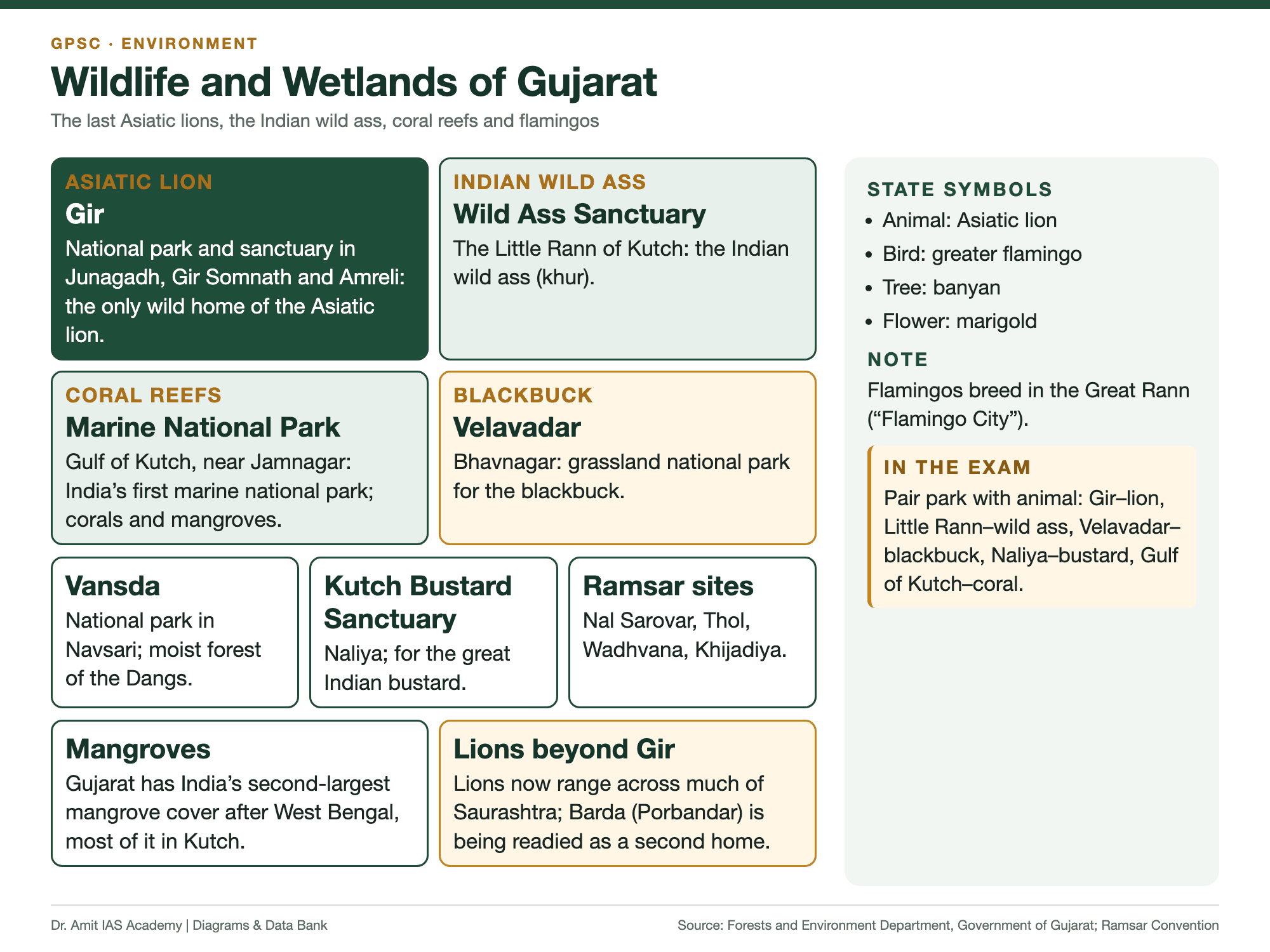
What the diagram shows
The diagram is laid out as a grid of cards, each pairing a protected area or habitat of Gujarat with the species or feature it is known for. The top row gives the two headline animals: the Asiatic lion in Gir, a national park and sanctuary spread over Junagadh, Gir Somnath and Amreli districts, and the Indian wild ass (khur) in the Wild Ass Sanctuary of the Little Rann of Kutch. The second row covers the Marine National Park in the Gulf of Kutch near Jamnagar, with its corals and mangroves, and Velavadar in Bhavnagar, a grassland national park for the blackbuck.
Smaller cards follow: Vansda National Park in Navsari, the Kutch Bustard Sanctuary at Naliya, the Ramsar sites (Nal Sarovar, Thol, Wadhvana and Khijadiya), Gujarat's mangroves, and lions spreading beyond Gir. A side panel lists the state symbols, notes that flamingos breed in the Great Rann at "Flamingo City", and gives an exam tip on pairing parks with animals.
Flagship species and their homes
- Gir and the Asiatic lion: Gir is the only wild home of the Asiatic lion. Lions have now spread across much of Saurashtra, and Barda in Porbandar is being readied as a second home so that a single epidemic or disaster cannot wipe out the whole population.
- Little Rann and the wild ass: the khur survives in the saline desert of the Little Rann of Kutch, a flat landscape that floods in the monsoon and dries into a salt crust.
- Velavadar and the blackbuck: a grassland park near the Gulf of Khambhat.
- Naliya and the great Indian bustard: the Kutch Bustard Sanctuary protects grassland for one of India's most threatened birds.
- Vansda: moist deciduous forest in south Gujarat, adjoining the Dangs, very different from the dry west of the state.
Coasts, wetlands and mangroves
Gujarat has the longest coastline of any Indian state. The Marine National Park in the Gulf of Kutch is described as India's first marine national park, protecting coral reefs, mangroves and the creatures of the intertidal zone. Gujarat also has India's second-largest mangrove cover after West Bengal, most of it in Kutch.
The state's wetlands matter especially for birds. Nal Sarovar, Thol, Wadhvana and Khijadiya are Ramsar sites, wetlands of international importance under the Ramsar Convention; Chhari-Dhand, a seasonal wetland on the edge of the Banni grasslands in Kutch, became the state's fifth in 2026. These wetlands host large numbers of migratory waterbirds in winter. The greater flamingo, the state bird, breeds in the Great Rann of Kutch, where its nesting colony is popularly called Flamingo City.
Why it matters for the exam
For GPSC Class 1 and 2, this topic falls under the geography and environment of Gujarat in the Preliminary General Studies paper and under environment, ecology and biodiversity conservation in the Mains. Questions are commonly of the matching type (park with district or species), statement-based questions on the Ramsar sites or state symbols, and descriptive questions on lion conservation, the case for a second home, mangrove protection and the threats facing the great Indian bustard.
Quick revision
- Gir (Junagadh, Gir Somnath, Amreli) is the only wild home of the Asiatic lion; Barda is being readied as a second home.
- Little Rann of Kutch: Wild Ass Sanctuary for the khur.
- Velavadar (Bhavnagar): blackbuck; Naliya: great Indian bustard; Vansda (Navsari): moist forest.
- Gulf of Kutch: India's first marine national park, with corals and mangroves.
- Ramsar sites: Nal Sarovar, Thol, Wadhvana, Khijadiya and (since 2026) Chhari-Dhand in Kutch.
- State symbols: Asiatic lion, greater flamingo, banyan, marigold.