Uttar Pradesh Polity at a Glance
Two houses, the High Court, the UPPSC and the state’s firsts.
What the diagram shows
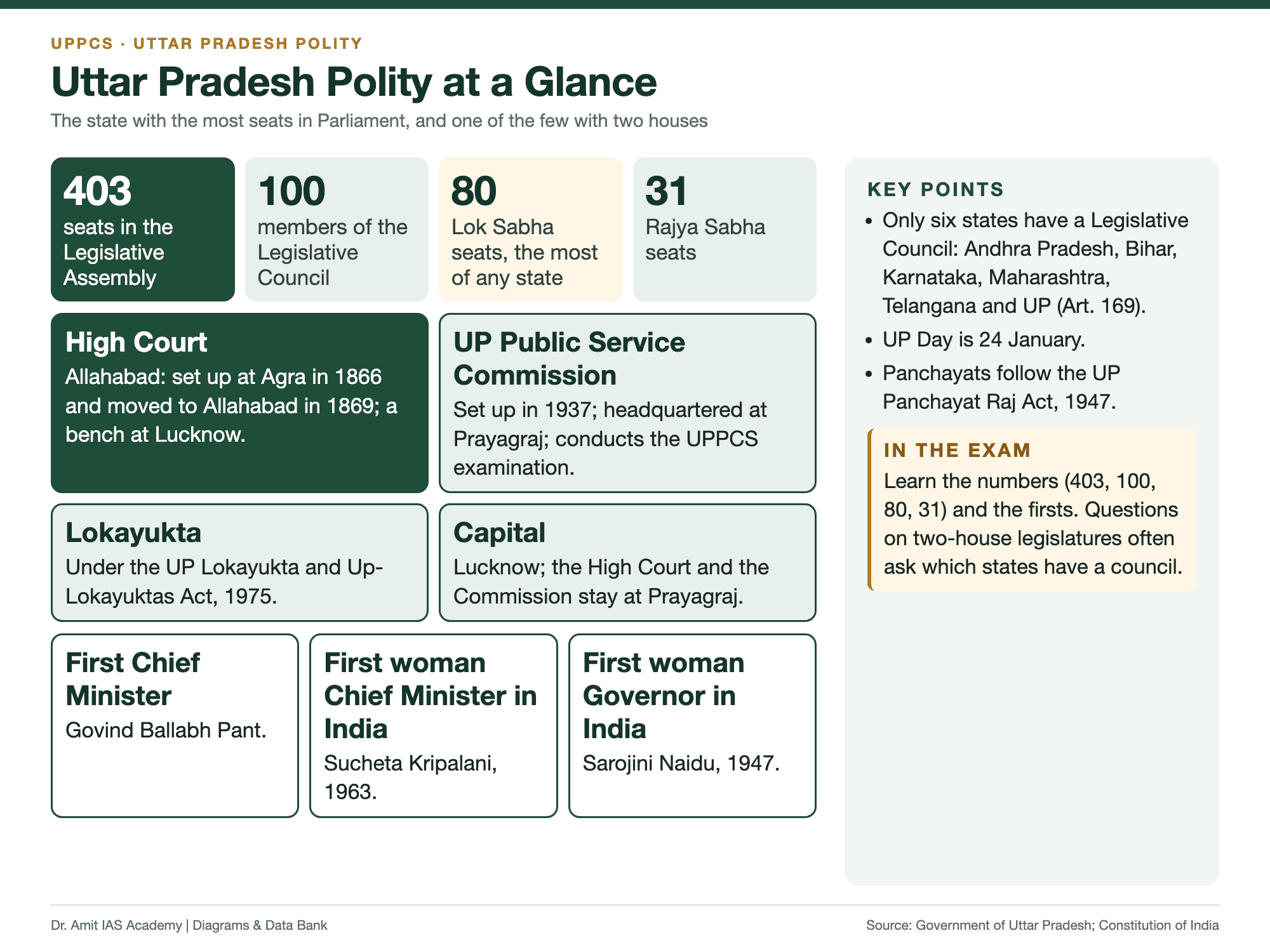
The chart opens with four number tiles across the top: 403 seats in the Legislative Assembly, 100 members of the Legislative Council, 80 Lok Sabha seats (the most of any state) and 31 Rajya Sabha seats. Below them, two large boxes describe the High Court (set up at Agra in 1866, moved to Allahabad in 1869, with a bench at Lucknow) and the UP Public Service Commission (set up in 1937, headquartered at Prayagraj, conducting the UPPCS examination). The next row covers the Lokayukta, created under the UP Lokayukta and Up-Lokayuktas Act, 1975, and the capital, Lucknow, while the High Court and the Commission remain at Prayagraj. The bottom row lists three firsts: Govind Ballabh Pant as the first Chief Minister, Sucheta Kripalani as India's first woman Chief Minister (1963) and Sarojini Naidu as India's first woman Governor (1947). A side panel adds key points on Legislative Councils, UP Day and the panchayat law.
A two-house legislature
Uttar Pradesh is one of only six states with a bicameral legislature. The others are Andhra Pradesh, Bihar, Karnataka, Maharashtra and Telangana. Article 169 lets Parliament create or abolish a Legislative Council when the state Assembly passes a resolution by a special majority.
- Legislative Assembly (Vidhan Sabha): 403 directly elected members, the largest state Assembly in India. Article 170 generally keeps an Assembly between 60 and 500 members.
- Legislative Council (Vidhan Parishad): 100 members. Under Article 171 a Council cannot exceed one-third of the Assembly's strength and cannot have fewer than 40 members, so UP's 100 sits well within the limit of about 134.
- Parliament: 80 Lok Sabha and 31 Rajya Sabha seats, the largest share of both Houses held by any state.
Institutions and firsts
The High Court keeps the name Allahabad High Court even though the city is now called Prayagraj, and its Lucknow bench serves the region around the capital. This split between the political capital at Lucknow and the judicial and recruitment centre at Prayagraj is a frequent point of confusion for candidates.
- The UPPSC is among the oldest state commissions; it recruits for the state civil services, including the PCS.
- The Lokayukta is the state's anti-corruption ombudsman, set up by a state law of 1975.
- Rural local government follows the UP Panchayat Raj Act, 1947, which predates the 73rd Amendment.
- UP Day is observed on 24 January, the date in 1950 when the United Provinces took the name Uttar Pradesh.
Why it matters for the exam
UPPCS Prelims General Studies Paper I covers Indian polity and governance, where questions on Uttar Pradesh also appear, and the Mains General Studies papers, including those focused on the state, ask about its governance and institutions. Expect direct factual questions on seat numbers, the year a body was set up, which states have a Legislative Council, and matching personalities with firsts. Statement-based options can mix up Lucknow and Prayagraj or the years 1866 and 1869, so precise recall pays.
Quick revision
- UP has 403 MLAs, 100 MLCs, 80 Lok Sabha and 31 Rajya Sabha seats.
- Six states have a Legislative Council; Article 169 governs its creation or abolition.
- High Court: Agra 1866, Allahabad 1869, bench at Lucknow.
- UPPSC: set up in 1937, headquartered at Prayagraj.
- Lokayukta Act 1975; Panchayat Raj Act 1947; UP Day on 24 January.
- Firsts: G. B. Pant (first CM), Sucheta Kripalani (1963), Sarojini Naidu (1947).