Constitutional Development, 1773 to 1947
Every major Act from 1773 to 1947, in one line each.
What the diagram shows
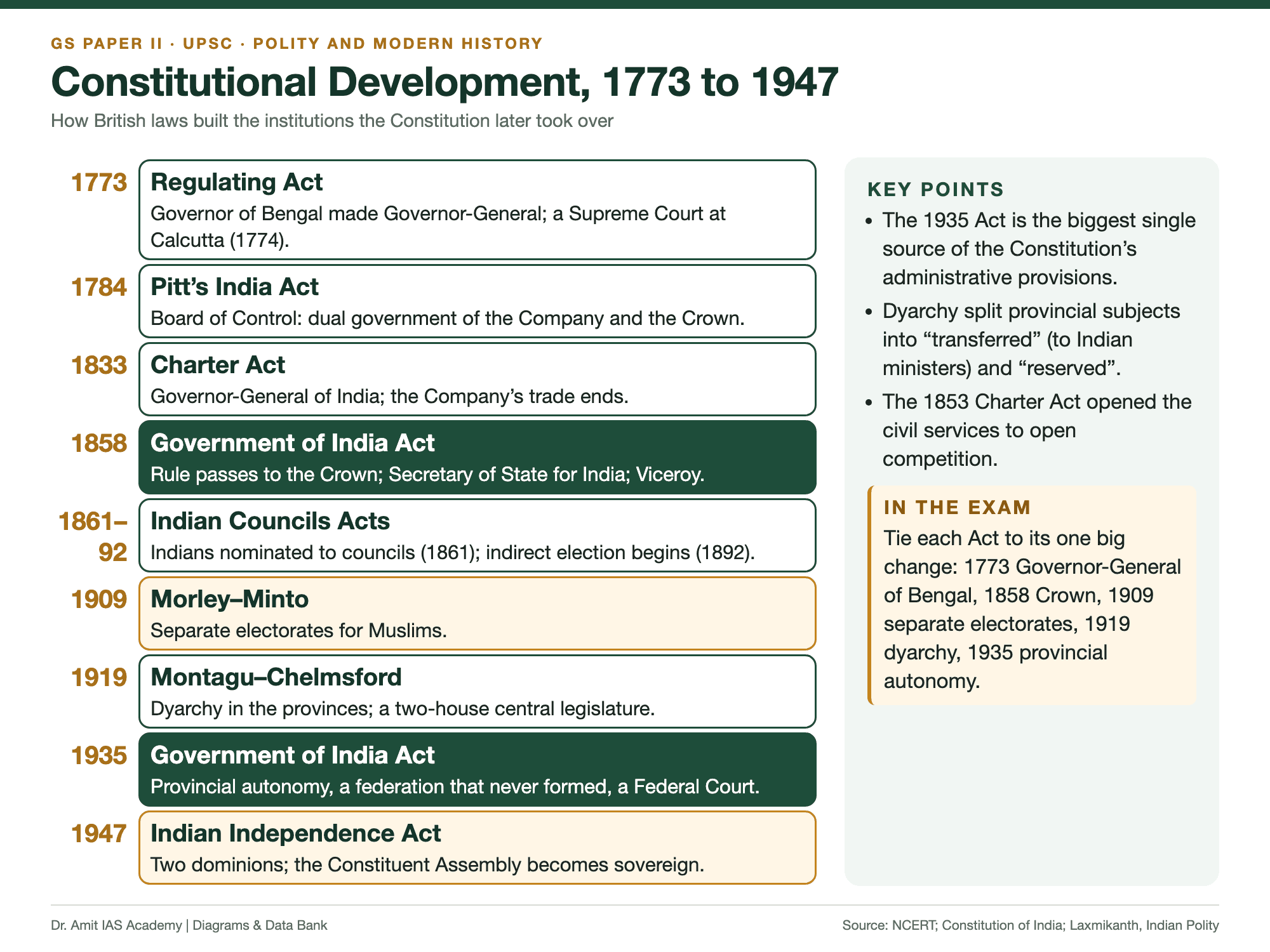
The diagram runs down the left as a timeline of nine boxes, from the Regulating Act of 1773 to the Indian Independence Act of 1947, each with its year and a one-line summary of its main change. Two boxes are shaded dark, the Government of India Acts of 1858 and 1935, because they mark the biggest breaks: the end of Company rule and the blueprint for the later Constitution. The Morley–Minto (1909) and Independence (1947) boxes are tinted for emphasis. A side panel lists three key points and an exam tip that ties each Act to its one big change. The subtitle sums up the idea: British laws built the institutions that the Constitution later took over.
The Company era, 1773 to 1858
Parliament first stepped in to control the East India Company's growing political power.
- Regulating Act, 1773: the Governor of Bengal became the Governor-General of Bengal, and a Supreme Court was set up at Calcutta in 1774. It was the first step towards central administration in India.
- Pitt's India Act, 1784: a Board of Control was created to supervise the Company's political affairs, giving a dual system of government by the Company and the Crown.
- Charter Act, 1833: the Governor-General of Bengal became the Governor-General of India, and the Company ended as a trading body. This was the high point of centralisation.
- Charter Act, 1853: shown in the side panel rather than the timeline, it opened the civil services to open competition.
Crown rule and the slow growth of representation
After the Revolt of 1857, the Government of India Act, 1858 transferred rule to the Crown. A Secretary of State for India took charge in London, and the Governor-General also became the Viceroy. From here, each Act widened Indian participation a little.
- Indian Councils Acts, 1861 and 1892: Indians were nominated to the legislative councils in 1861; an indirect method of election began in 1892.
- Morley–Minto Reforms, 1909: separate electorates for Muslims, the seed of communal representation.
- Montagu–Chelmsford Reforms, 1919: dyarchy in the provinces, with subjects split into "transferred" (run by Indian ministers) and "reserved" (kept with the Governor and his executive council), and a two-house legislature at the Centre.
The 1935 Act and independence
The Government of India Act, 1935 ended dyarchy in the provinces and gave them autonomy. It proposed an All-India Federation, which never came into being, and set up a Federal Court. As the side panel notes, it is the biggest single source of the Constitution's administrative provisions. Finally, the Indian Independence Act, 1947 created two dominions, India and Pakistan, and made the Constituent Assembly a sovereign body.
Why it matters for the exam
This topic sits in the historical underpinnings and evolution of the Constitution, part of Polity in UPSC GS Paper II and in the Prelims, and it overlaps with modern Indian history. State PCS papers of HCS, RAS, UPPCS and GPSC test it the same way. Prelims questions usually match an Act with its provision, or ask which Act first introduced something: separate electorates, dyarchy, a federal court or open competition for the civil services. Mains questions ask how colonial laws shaped Indian institutions, or how far the Constitution borrowed from the 1935 Act.
Quick revision
- 1773: Governor-General of Bengal; Supreme Court at Calcutta (1774).
- 1833: Governor-General of India; 1853: open competition for the civil services.
- 1858: Crown rule, Secretary of State for India and Viceroy.
- 1909: separate electorates; 1919: dyarchy and a two-house central legislature.
- 1935: provincial autonomy, a federation that never formed and a Federal Court.
- 1947: two dominions and a sovereign Constituent Assembly.