The Basic Structure Doctrine: Key Cases
Shankari Prasad to I. R. Coelho, and what each case decided.
What the diagram shows
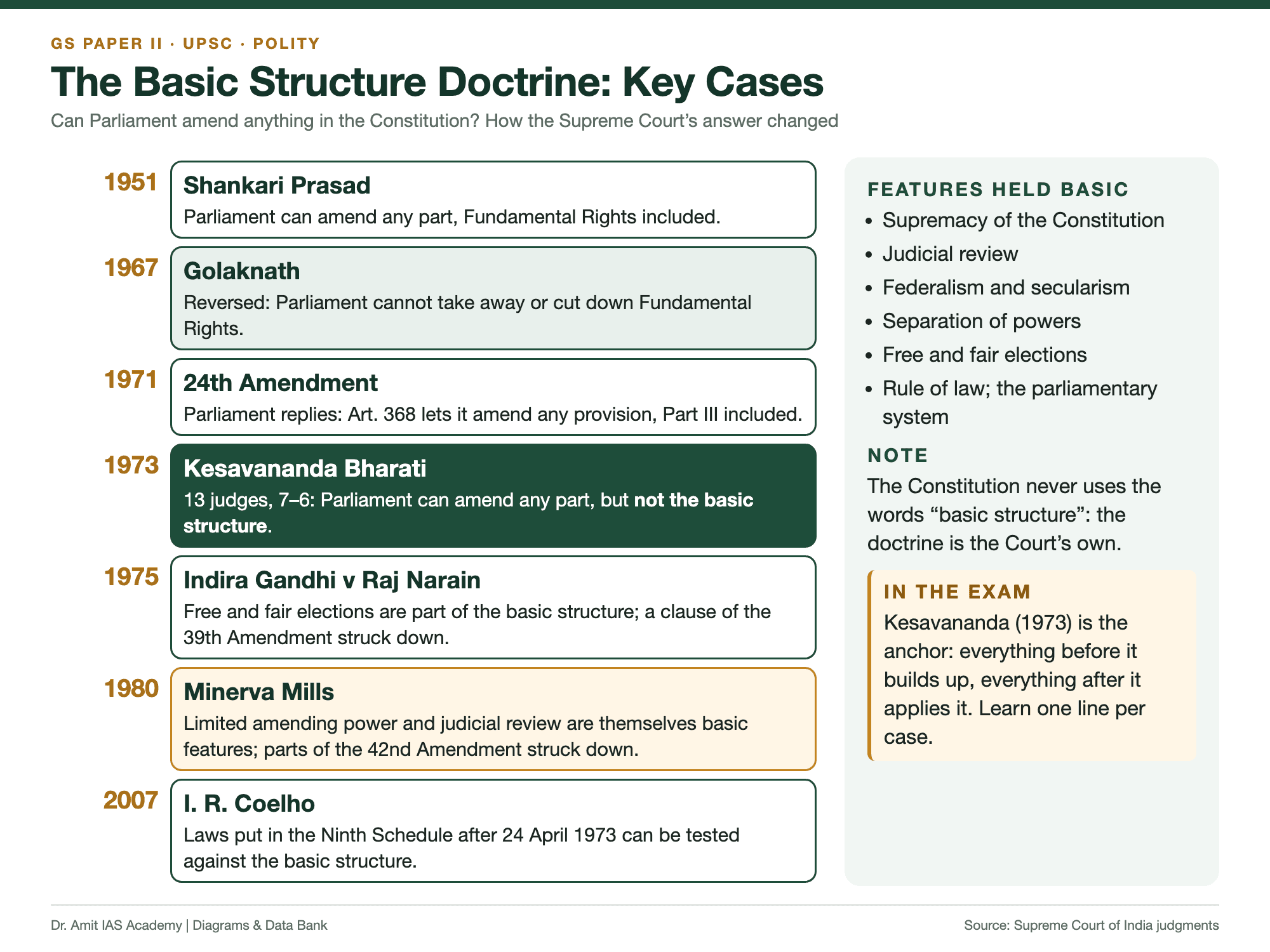
The diagram asks one question: can Parliament amend anything in the Constitution? It answers with a timeline of seven milestones running down the left, from 1951 to 2007, each in its own box with a one-line ruling. The 1973 Kesavananda Bharati box is shaded dark because it is the turning point. A side panel lists the features the Supreme Court has held to be basic, adds a note that the Constitution itself never uses the words “basic structure”, and closes with an exam tip: everything before 1973 builds up to Kesavananda, everything after it applies the doctrine.
From unlimited power to a limited one
- Shankari Prasad (1951): the Court held that Parliament's power under Article 368 covers every part of the Constitution, Fundamental Rights included, and upheld the First Amendment.
- Golaknath (1967): the Court reversed this view and held that Parliament cannot take away or abridge the Fundamental Rights in Part III.
- 24th Amendment (1971): Parliament replied by amending Article 368 to state that it may amend any provision of the Constitution, Part III included.
- Kesavananda Bharati (1973): a 13-judge bench, by a 7–6 majority, upheld the 24th Amendment but laid down that Parliament cannot alter the basic structure of the Constitution. Amending power was wide, but not unlimited.
How later cases applied the doctrine
- Indira Gandhi v Raj Narain (1975): the Court held free and fair elections to be part of the basic structure and struck down a clause of the 39th Amendment that had placed the election of the Prime Minister beyond the courts.
- Minerva Mills (1980): limited amending power and judicial review were themselves declared basic features, and parts of the 42nd Amendment, including the clauses that tried to make amending power unlimited and beyond review, were struck down.
- I. R. Coelho (2007): laws placed in the Ninth Schedule after 24 April 1973, the date of the Kesavananda judgment, can be tested against the basic structure; the Ninth Schedule is not a shield.
The Court has never given a closed list of basic features. The ones the diagram names are supremacy of the Constitution, judicial review, federalism, secularism, separation of powers, free and fair elections, rule of law and the parliamentary system. The doctrine is judge-made, which is why each new case can add to it.
Why it matters for the exam
The doctrine falls under GS Paper II (Indian Constitution: amendments, significant provisions and basic structure) in UPSC Mains, and under the polity part of the Prelims general studies paper. State services such as HCS, RAS, UPPCS and GPSC carry the same topic in their polity syllabus. Prelims questions usually test matching: which case decided what, which amendment followed which judgment, or whether a given feature has been held basic. Mains questions ask candidates to trace how the doctrine evolved, discuss whether it balances parliamentary sovereignty with judicial review, or assess its role in protecting constitutionalism. Citing the right case in one line is often what lifts an answer.
Quick revision
- Shankari Prasad (1951): Parliament can amend any part, Fundamental Rights included.
- Golaknath (1967): Parliament cannot take away or abridge Fundamental Rights.
- Kesavananda Bharati (1973): 13 judges, 7–6; amend anything except the basic structure.
- Indira Gandhi v Raj Narain (1975): free and fair elections are basic; 39th Amendment clause struck down.
- Minerva Mills (1980): limited amending power and judicial review are basic features.
- I. R. Coelho (2007): Ninth Schedule laws after 24 April 1973 open to basic-structure review.