Fundamental Rights at a Glance
The six groups of Part III, their Articles and the five writs.
What the diagram shows
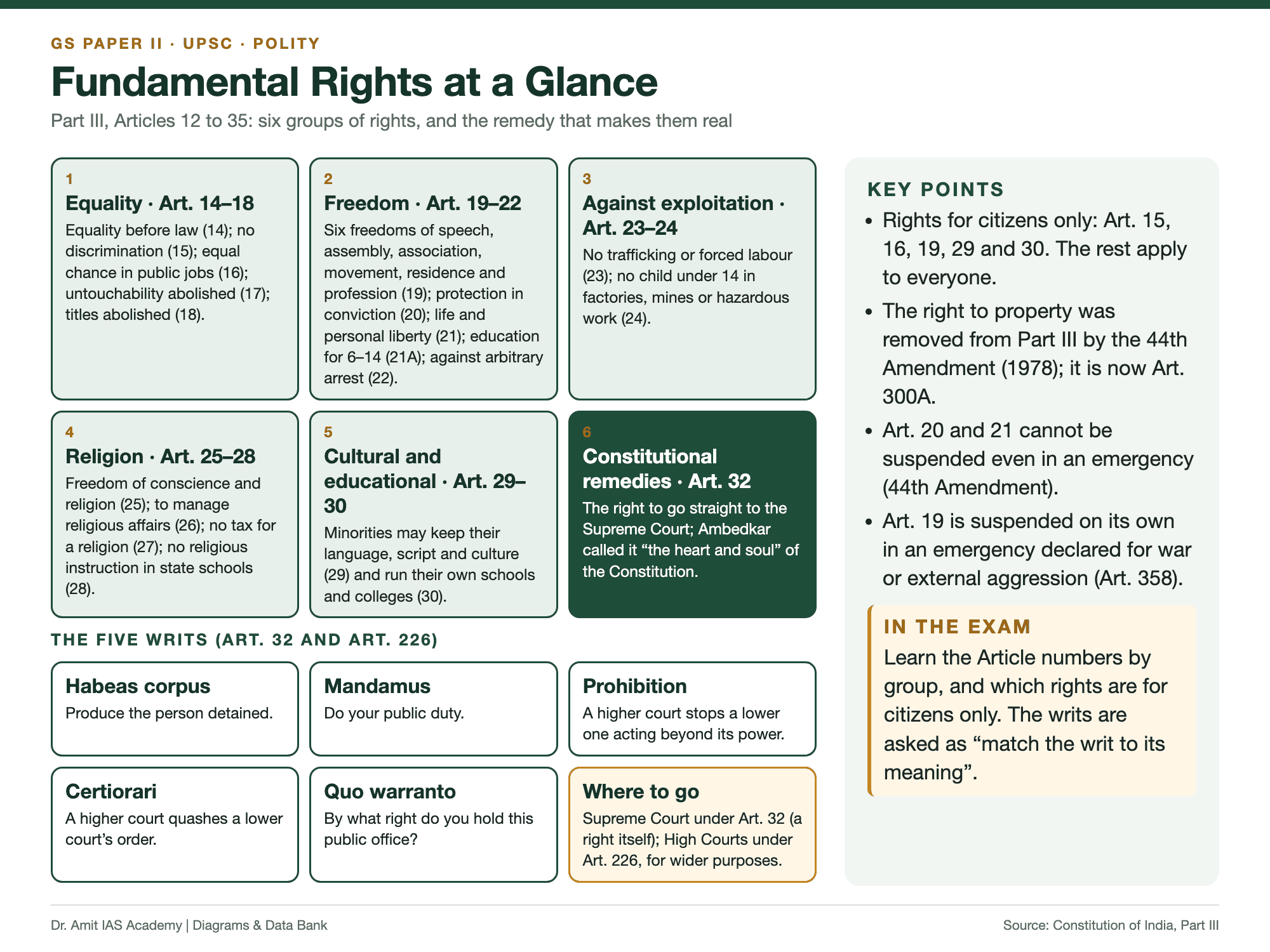
The chart lays out Part III, Articles 12 to 35, as six numbered boxes, one per group of rights. The top row covers equality (Articles 14 to 18), freedom (Articles 19 to 22) and the right against exploitation (Articles 23 and 24). The second row covers freedom of religion (Articles 25 to 28), cultural and educational rights (Articles 29 and 30) and, shaded dark, the right to constitutional remedies under Article 32.
Below them, tiles explain the five writs in one line each and say where to seek them: the Supreme Court under Article 32 or a High Court under Article 226.
The six groups and what they guarantee
- Equality (14 to 18): equality before law, no discrimination, equal opportunity in public employment, abolition of untouchability and titles.
- Freedom (19 to 22): the six freedoms of Article 19, protection in respect of conviction, life and personal liberty, education for children aged 6 to 14 (Article 21A, added by the 86th Amendment, 2002) and protection against arbitrary arrest.
- Against exploitation (23 and 24): a ban on trafficking and forced labour, and on employing children below 14 in factories, mines or other hazardous work.
- Religion (25 to 28): freedom of conscience, freedom to manage religious affairs, no tax to promote a particular religion, no religious instruction in wholly State-funded institutions.
- Cultural and educational (29 and 30): protection of any section's language, script and culture, and the right of minorities to run their own educational institutions.
- Constitutional remedies (32): the right to move the Supreme Court directly; Dr B. R. Ambedkar called it the heart and soul of the Constitution.
Article 12 defines the State and Article 13 voids laws inconsistent with Part III. The original Constitution had seven groups; the 44th Amendment (1978) removed the right to property from Part III and made it a legal right under Article 300A.
Writs, citizens and emergencies
The five writs are habeas corpus (produce the detained person), mandamus (perform a public duty), prohibition (stop a lower court exceeding its jurisdiction), certiorari (quash a lower court's order) and quo warranto (by what authority a person holds a public office). A High Court can issue writs for any other purpose too, so its writ jurisdiction is wider, while Article 32 is itself a Fundamental Right.
Articles 15, 16, 19, 29 and 30 are available only to citizens; the rest extend to foreigners too. During a national emergency declared on grounds of war or external aggression, Article 19 is suspended automatically under Article 358. Under Article 359 the President can suspend the enforcement of other rights, but since the 44th Amendment never that of Articles 20 and 21.
Why it matters for the exam
Fundamental Rights belong to GS Paper II (Indian Constitution) in the UPSC Mains and to Polity in the Prelims; HCS, RAS, UPPCS and GPSC test them in both stages. Prelims questions ask which Article holds a right, which rights are for citizens only, which writ fits a situation and what happens in an emergency. Mains questions ask about the reach of Article 21, writs as a shield for liberty, or rights versus reasonable restrictions.
Quick revision
- Part III: Articles 12 to 35, six groups of rights.
- Citizens only: Articles 15, 16, 19, 29 and 30.
- Right to property left Part III by the 44th Amendment (1978) and is now Article 300A.
- Articles 20 and 21 cannot be suspended even in an emergency.
- Five writs: habeas corpus, mandamus, prohibition, certiorari and quo warranto.
- Writs: Supreme Court under Article 32, High Courts under Article 226.