Union Budget: Receipts, Expenditure and Deficits
The Budget’s layout and the four deficits, worked from their parts.
What the diagram shows
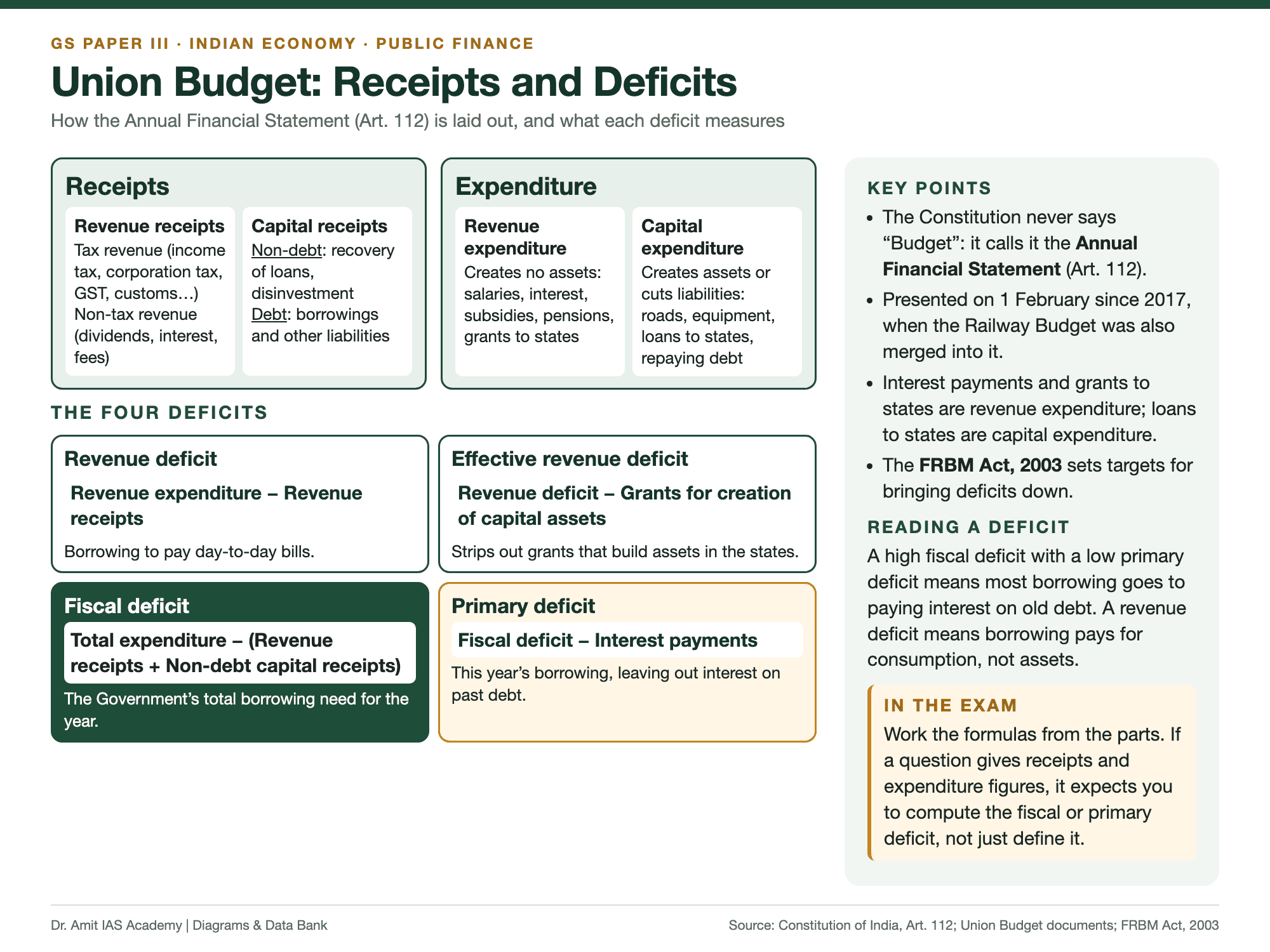
The diagram lays out the Union Budget in the way the Annual Financial Statement under Article 112 sorts money coming in and going out. Two shaded boxes sit at the top. The Receipts box splits into revenue receipts and capital receipts; the Expenditure box splits into revenue expenditure and capital expenditure. Below them, under the heading The four deficits, four cards each give one deficit as a formula built from those parts, with a one-line meaning underneath. A side panel adds key points, a note on reading a deficit and a tip for the exam.
Receipts and expenditure: revenue versus capital
- Revenue receipts neither create a liability nor reduce an asset: tax revenue (income tax, corporation tax, GST, customs and so on) and non-tax revenue such as dividends, interest received and fees.
- Capital receipts either create a liability or reduce an asset. The diagram divides them into non-debt receipts (recovery of loans, disinvestment) and debt receipts (borrowings and other liabilities).
- Revenue expenditure creates no asset for the Union: salaries, interest, subsidies, pensions and grants to states.
- Capital expenditure creates assets or cuts liabilities: roads, equipment, loans to states and repayment of debt.
A common trap: grants to states are revenue expenditure for the Union even when states use them to build assets, while loans to states are capital expenditure because they are to be repaid.
The four deficits, worked from their parts
- Revenue deficit = revenue expenditure minus revenue receipts. It shows borrowing used to pay day-to-day bills.
- Effective revenue deficit = revenue deficit minus grants for creation of capital assets. It strips out grants that build assets in the states.
- Fiscal deficit = total expenditure minus (revenue receipts plus non-debt capital receipts). It equals the Government's total borrowing need for the year.
- Primary deficit = fiscal deficit minus interest payments. It is the year's borrowing leaving out interest on past debt.
Reading them together tells a story. A high fiscal deficit with a low primary deficit means most borrowing goes to paying interest on old debt. A large revenue deficit means borrowing pays for consumption rather than assets. Note that disinvestment proceeds and loan recoveries reduce the fiscal deficit, since they are non-debt receipts, but borrowings do not.
Constitutional and legal frame
The Constitution never uses the word "Budget"; Article 112 calls it the Annual Financial Statement. Since 2017 it has normally been presented on 1 February, and the Railway Budget was merged into it from the same year. The Fiscal Responsibility and Budget Management (FRBM) Act, 2003 sets targets for bringing the deficits down.
Why it matters for the exam
This topic sits in GS Paper III (Indian Economy: government budgeting, fiscal policy and resource mobilisation) for UPSC, and in the economy sections of HCS, RAS, UPPCS and GPSC papers. Prelims questions ask which items count as capital receipts or revenue expenditure, which receipt reduces the fiscal deficit, or ask candidates to compute a deficit from given figures. Mains questions ask about fiscal consolidation, the quality of expenditure and the FRBM framework.
Quick revision
- Article 112: the Budget is the Annual Financial Statement.
- Revenue items create no asset or liability; capital items do.
- Fiscal deficit = total expenditure minus (revenue receipts + non-debt capital receipts).
- Primary deficit = fiscal deficit minus interest payments.
- Grants to states are revenue expenditure; loans to states are capital expenditure.
- FRBM Act, 2003 sets the deficit-reduction targets.