Three Ways to Amend the Constitution
Which provisions need which majority, and the Art. 368 procedure.
What the diagram shows
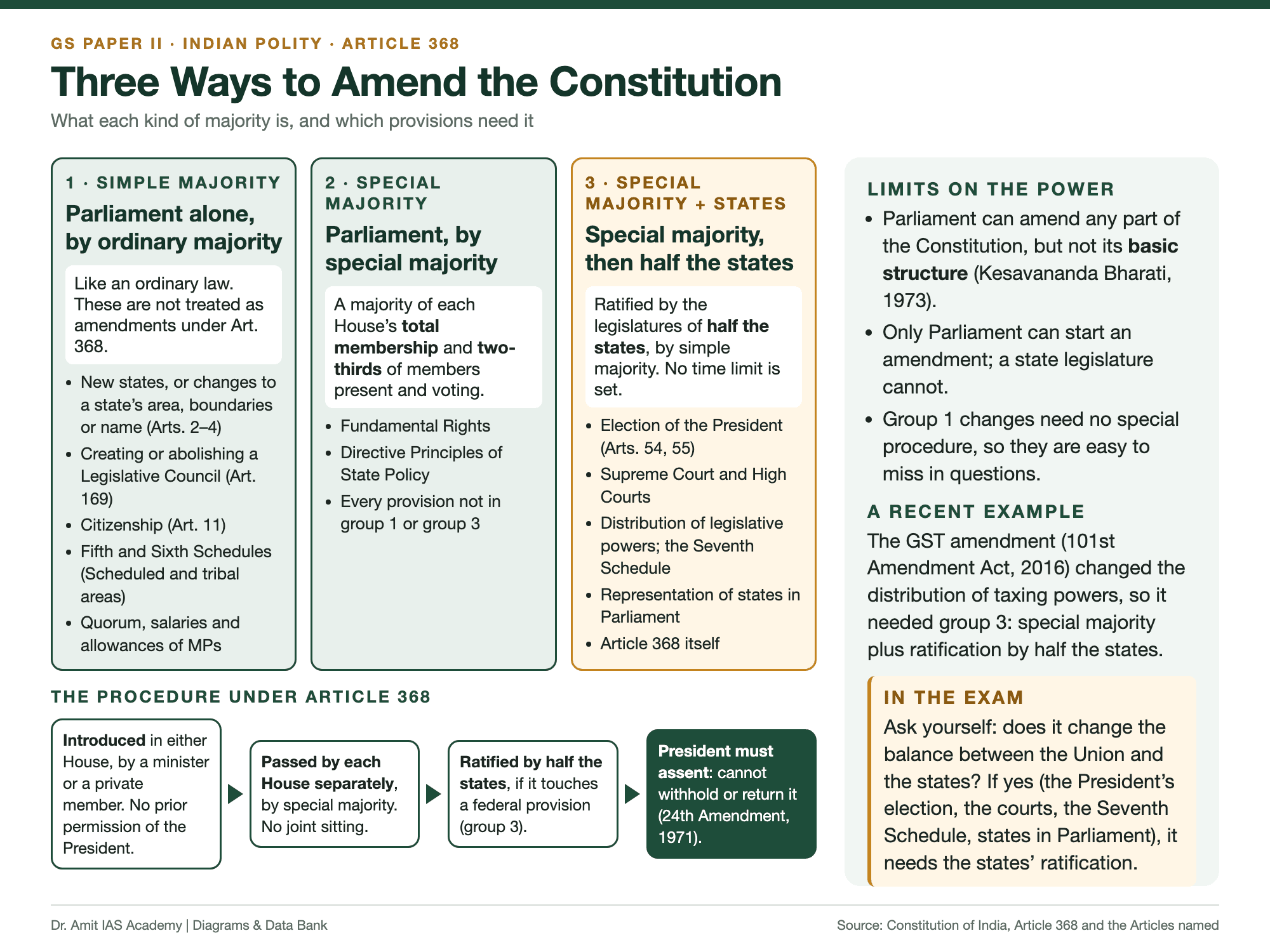
Three boxes across the top sort the provisions of the Constitution by the majority needed to change them: simple majority, special majority and, shaded differently, special majority plus the states. Below the boxes, a four-step strip traces the procedure under Article 368, from introduction to the President's assent. A side panel lists the limits on the amending power, gives the GST amendment as a recent example and ends with a test to use in the exam.
The three groups
- Simple majority: changes made like an ordinary law, not treated as amendments under Article 368. Examples are forming new states or changing a state's area, boundaries or name (Arts. 2 to 4), creating or abolishing a Legislative Council (Art. 169), citizenship (Art. 11), the Fifth and Sixth Schedules on Scheduled and tribal areas, and the quorum, salaries and allowances of MPs.
- Special majority: a majority of each House's total membership and two-thirds of the members present and voting. It covers Fundamental Rights, Directive Principles and every provision not in the other two groups.
- Special majority plus states: after Parliament passes the bill by special majority, the legislatures of half the states must ratify it by a simple majority. The Constitution sets no time limit for this. It applies to federal provisions such as the election of the President (Arts. 54 and 55), the Supreme Court and High Courts, distribution of legislative powers and the Seventh Schedule, representation of states in Parliament, and Article 368 itself.
The procedure under Article 368
- The bill is introduced in either House, by a minister or a private member, without the prior permission of the President.
- Each House passes it separately by special majority. There is no joint sitting if the Houses disagree.
- If it touches a federal provision, half the state legislatures ratify it.
- The President must give assent and can neither withhold it nor return the bill, a rule added by the 24th Amendment of 1971.
Two limits frame this power. Parliament may amend any part of the Constitution but not its basic structure, as the Supreme Court held in Kesavananda Bharati (1973). And only Parliament can begin an amendment; a state legislature cannot. The GST amendment, the 101st Amendment Act of 2016, changed how taxing powers are shared between the Union and the states, so it needed both a special majority and ratification by half the states.
Why it matters for the exam
Article 368 falls under GS Paper II, Indian Constitution and its amendments, in UPSC Mains, and in the polity section of Prelims and of the HCS, RAS, UPPCS and GPSC papers. Prelims questions usually give a list of provisions and ask which need state ratification, or test procedural points such as joint sittings, the President's assent or private members' bills. Mains questions ask how rigid or flexible the amending process is. The diagram's test helps: if a change alters the balance between the Union and the states, it needs ratification by the states.
Quick revision
- Simple-majority changes, such as Arts. 2 to 4 and Art. 169, are not amendments under Article 368.
- Special majority means a majority of total membership plus two-thirds of those present and voting, in each House.
- Federal provisions need ratification by half the states, by simple majority, with no time limit.
- No joint sitting for an amendment bill; a private member may introduce one.
- The President must assent to an amendment bill since the 24th Amendment, 1971.
- The basic structure cannot be amended (Kesavananda Bharati, 1973).