The Nitrogen Cycle
How nitrogen moves from air to soil to living things, and back.
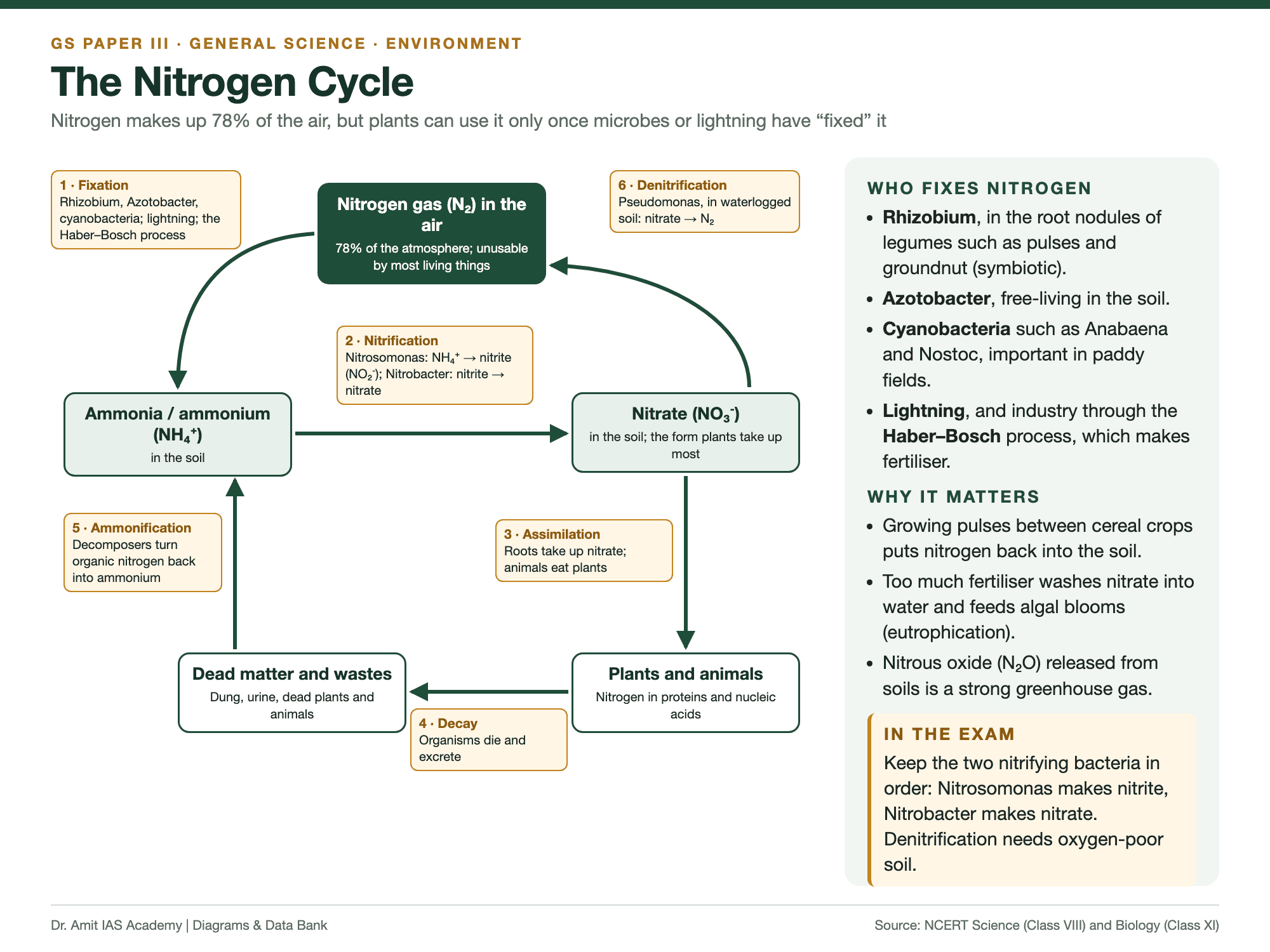
What the diagram shows
The diagram draws the nitrogen cycle as a loop of five boxes joined by arrows, with six numbered steps written beside the arrows. At the top sits the dark box Nitrogen gas (N2) in the air, which makes up 78% of the atmosphere but cannot be used by most living things. An arrow marked 1 · Fixation carries nitrogen down to Ammonia / ammonium (NH4+) in the soil; the label names Rhizobium, Azotobacter, cyanobacteria, lightning and the Haber–Bosch process. A horizontal arrow, 2 · Nitrification, leads to Nitrate (NO3-), the form plants take up most. From nitrate an arrow marked 3 · Assimilation goes down to Plants and animals, where nitrogen sits in proteins and nucleic acids. 4 · Decay moves it to Dead matter and wastes (dung, urine, dead plants and animals), and 5 · Ammonification returns it to ammonium. Finally, 6 · Denitrification by Pseudomonas in waterlogged soil sends nitrate back to the air as N2. A side panel lists who fixes nitrogen, why the cycle matters, and an exam tip.
The steps of the cycle
- Fixation: the strong triple bond of N2 is broken and nitrogen is turned into compounds such as ammonia. Rhizobium does this in the root nodules of legumes (a symbiotic link), Azotobacter does it free-living in soil, and cyanobacteria such as Anabaena and Nostoc do it in water and paddy fields. Lightning and the industrial Haber–Bosch process, which makes fertiliser, also fix nitrogen.
- Nitrification: Nitrosomonas oxidises ammonium to nitrite (NO2-), and Nitrobacter oxidises nitrite to nitrate. The order matters: nitrite first, then nitrate.
- Assimilation: roots absorb nitrate and build it into amino acids, proteins and nucleic acids; animals get their nitrogen by eating plants.
- Decay: organisms excrete wastes and eventually die.
- Ammonification: decomposers break down organic nitrogen in dead matter and wastes and release it as ammonium.
- Denitrification: in oxygen-poor, waterlogged soil, bacteria such as Pseudomonas reduce nitrate back to nitrogen gas, closing the loop.
Why the cycle matters
Nitrogen is a part of every protein and of DNA and RNA, yet the huge store in the air is locked away until it is fixed.
- Crop rotation: growing pulses between cereal crops puts nitrogen back into the soil, cutting the need for urea.
- Biofertilisers: Rhizobium, Azotobacter and blue-green algae are used as biofertilisers; blue-green algae are especially useful in rice fields.
- Pollution: excess fertiliser washes nitrate into rivers and lakes, feeding algal blooms and causing eutrophication.
- Climate: soils release nitrous oxide (N2O), a strong greenhouse gas, especially when they are over-fertilised.
Why it matters for the exam
The nitrogen cycle belongs to the environment and ecology part of General Studies Paper III in the UPSC Mains and to the general science and environment sections of the Prelims. State commissions such as HCS, RAS, UPPCS and GPSC ask it in their general science and environment papers too. Objective questions usually test matching: which organism performs which step, which bacteria are free-living and which are symbiotic, or which process happens in waterlogged soil. Mains questions link the cycle to soil health, biofertilisers, the overuse of urea, eutrophication and greenhouse gas emissions from farming.
Quick revision
- N2 is 78% of the air but must be fixed before plants can use it.
- Fixers: Rhizobium (legume nodules), Azotobacter (free-living), Anabaena and Nostoc (cyanobacteria), lightning, Haber–Bosch.
- Nitrification: Nitrosomonas makes nitrite, Nitrobacter makes nitrate.
- Plants take up nitrogen mostly as nitrate; animals get it by eating plants.
- Decomposers return organic nitrogen as ammonium (ammonification).
- Pseudomonas returns nitrate to the air as N2 in oxygen-poor, waterlogged soil.