Structure of the Indian Judiciary
Supreme Court to magistrate, civil and criminal, and who appoints.
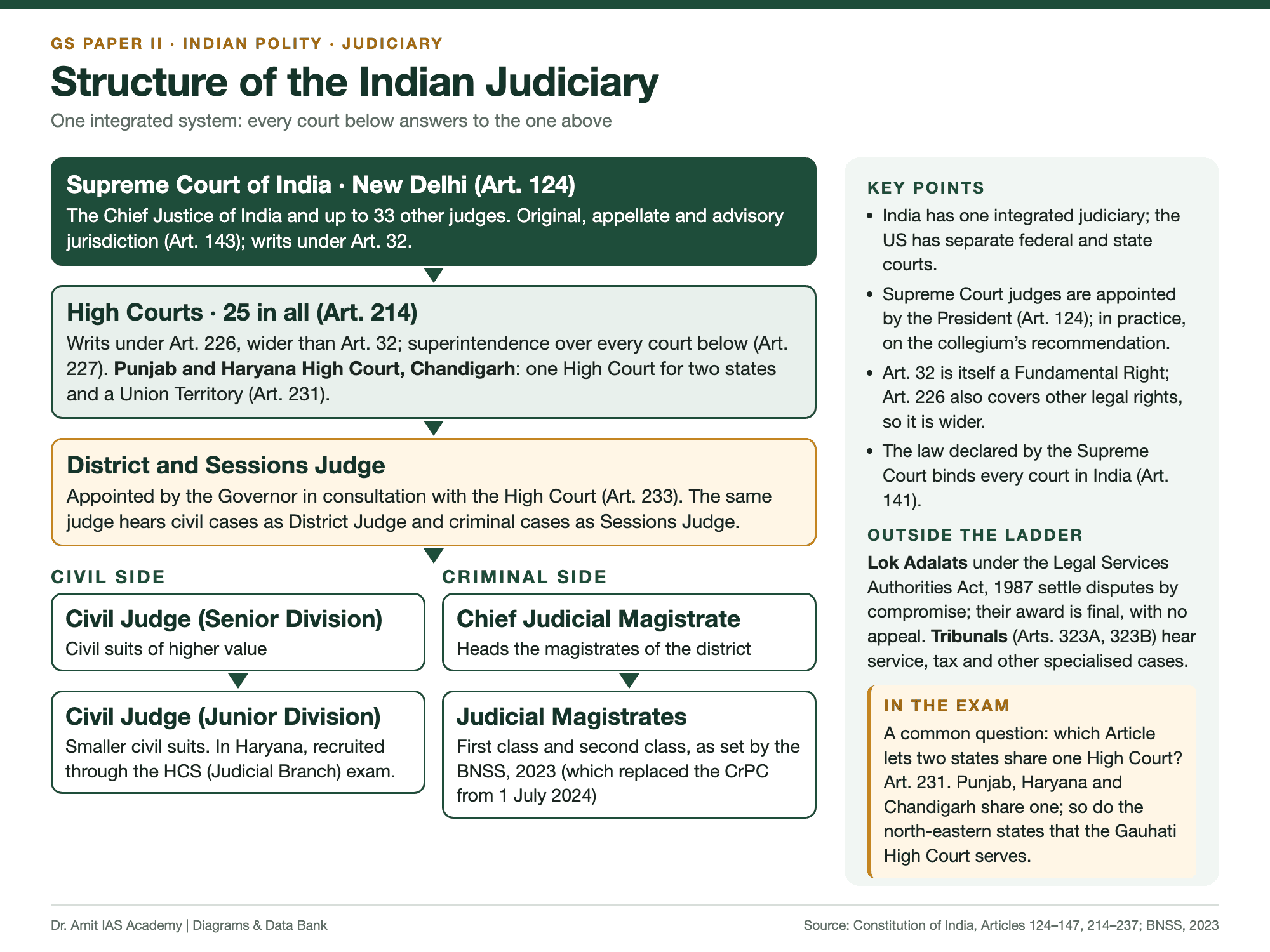
What the diagram shows
The diagram draws the Indian judiciary as a single ladder in which every court answers to the one above it. At the top sits the Supreme Court of India (Art. 124), with the Chief Justice of India and up to 33 other judges. Below it are the High Courts, 25 in all (Art. 214). Below them, in each district, is the District and Sessions Judge. The ladder then splits into two columns. On the civil side, the Civil Judge (Senior Division) hears suits of higher value and the Civil Judge (Junior Division) hears smaller suits. On the criminal side, the Chief Judicial Magistrate heads the magistrates of the district, and below come the Judicial Magistrates of the first and second class.
One integrated judiciary
Unlike the United States, with its separate federal and state courts, India has one integrated hierarchy enforcing both Central and state laws:
- The law declared by the Supreme Court binds every court in India (Art. 141).
- A High Court has superintendence over every court and tribunal in its territory (Art. 227).
- Two or more states may share one High Court (Art. 231): Punjab, Haryana and Chandigarh share one, and the Gauhati High Court serves several north-eastern states.
Writs and who appoints the judges
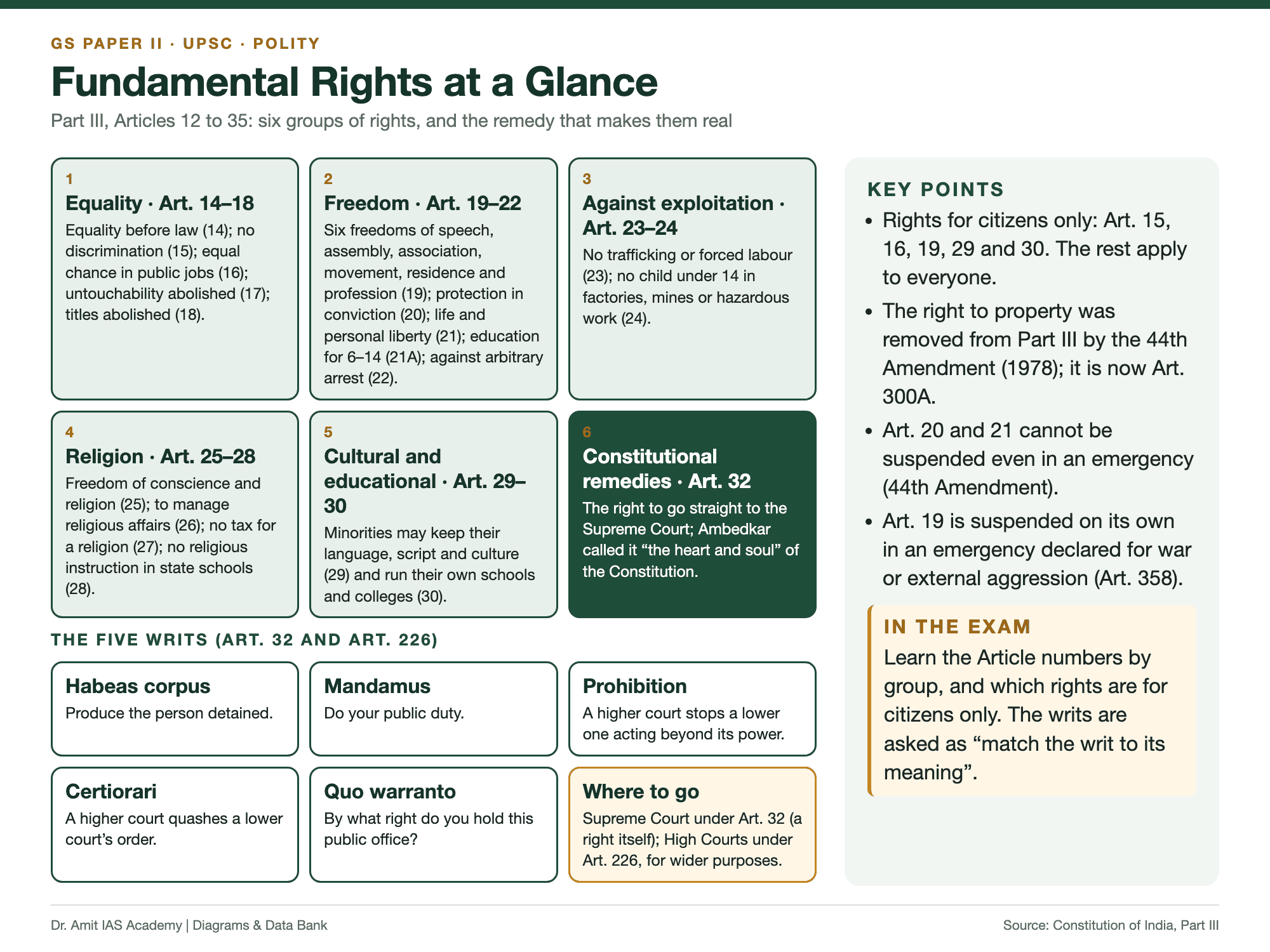
Art. 32, the Supreme Court's writ power, is itself a Fundamental Right. Art. 226 lets a High Court issue writs for other legal rights too, so it is wider in scope.
- Supreme Court and High Court judges are appointed by the President (Arts. 124 and 217); in practice, on the collegium's recommendation.
- District judges are appointed by the Governor in consultation with the High Court (Art. 233).
- Other judicial officers of the state are appointed by the Governor after consulting the State Public Service Commission and the High Court (Art. 234); in Haryana, Civil Judges (Junior Division) come through the HCS (Judicial Branch) exam.
Civil side, criminal side and courts outside the ladder
The same district officer hears civil cases as District Judge and criminal cases as Sessions Judge. Criminal courts are now organised under the Bharatiya Nagarik Suraksha Sanhita (BNSS), 2023, which replaced the Code of Criminal Procedure from 1 July 2024.
Two kinds of bodies stand outside this ladder. Lok Adalats, under the Legal Services Authorities Act, 1987, settle disputes by compromise; their award is final and no appeal lies against it. Tribunals under Arts. 323A and 323B decide service, tax and other specialised matters.
Why it matters for the exam
The judiciary is a core part of Indian Polity in UPSC GS Paper II and in the General Studies papers of HCS, RAS, UPPCS and GPSC. Prelims questions test Article numbers, the Supreme Court's strength and the Art. 32 versus Art. 226 contrast. Mains questions ask about the integrated judiciary, the collegium, pendency in lower courts, and Lok Adalats and tribunals. State papers add local facts such as the shared High Court at Chandigarh.
Quick revision
- Supreme Court: Chief Justice of India and up to 33 other judges (Art. 124).
- High Courts: 25 in all (Art. 214); writs under Art. 226 are wider than under Art. 32.
- Common High Court for two or more states: Art. 231, as at Chandigarh and Guwahati.
- District judges: appointed by the Governor in consultation with the High Court (Art. 233).
- District Judge on the civil side is the Sessions Judge on the criminal side.
- Lok Adalat awards are final with no appeal; tribunals come under Arts. 323A and 323B.