The RBI’s Monetary Policy Toolkit
Repo, SDF, MSF, CRR, SLR, OMOs: what each does, and who decides.
What the diagram shows
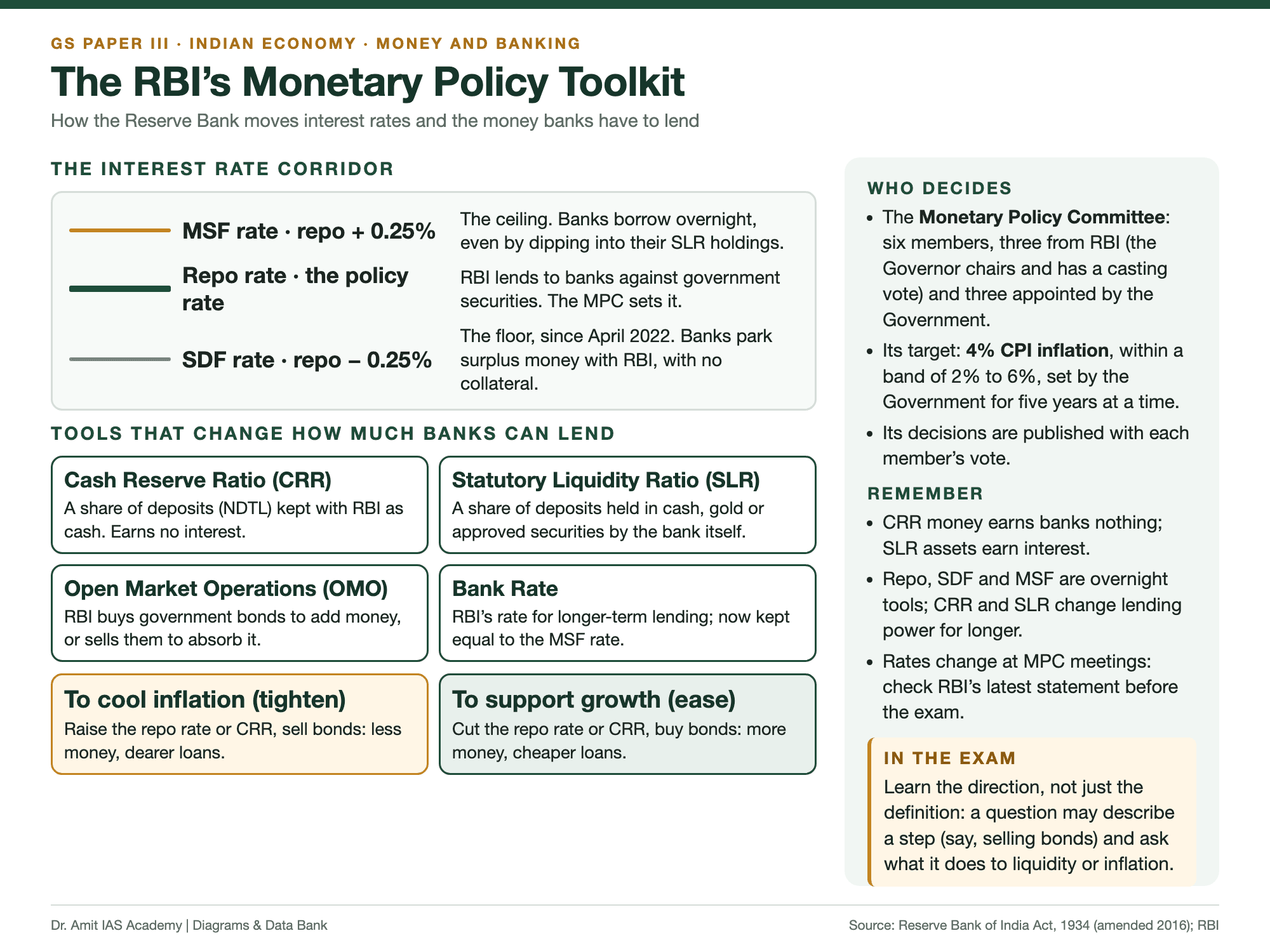
The chart explains how the Reserve Bank moves interest rates and the money banks have to lend.
At the top left, The interest rate corridor draws three horizontal lines. The top line is the MSF rate, set at repo plus 0.25%: the ceiling, at which banks borrow overnight, even by dipping into their SLR holdings. The thick middle line is the repo rate, the policy rate, at which the RBI lends to banks against government securities; the Monetary Policy Committee sets it. The bottom line is the SDF rate, repo minus 0.25%: the floor since April 2022, where banks park surplus money with the RBI without giving collateral.
Below it, Tools that change how much banks can lend sets out four boxes: the Cash Reserve Ratio, the Statutory Liquidity Ratio, Open Market Operations and the Bank Rate. Two coloured boxes show the direction of policy, tighten and ease, and a side panel, Who decides, describes the Monetary Policy Committee.
The corridor and the policy rate
The repo rate is the single signal of the RBI's stance. Because the MSF and SDF rates move with it, the corridor is half a percentage point wide, and the overnight call money rate normally stays inside it. The SDF replaced the fixed-rate reverse repo as the floor and, needing no collateral, lets the RBI absorb surplus money without using up its bonds.
Quantitative tools
- CRR: a share of net demand and time liabilities (NDTL) kept with the RBI as cash. It earns the bank no interest. It flows from the RBI Act, 1934.
- SLR: a share of NDTL held by the bank itself in cash, gold or approved securities, under the Banking Regulation Act, 1949. The government securities that make up most of it earn interest.
- OMOs: the RBI buys government bonds to inject money and sells them to absorb it.
- Bank Rate: the rate for longer-term lending, now kept equal to the MSF rate and used mainly as a reference for penalties.
To tighten, the RBI raises the repo rate or CRR and sells bonds; to ease, it does the reverse.
Who decides
Since the 2016 amendment to the RBI Act, a six-member Monetary Policy Committee fixes the repo rate. Three members come from the RBI, with the Governor in the chair and holding a casting vote, and three are appointed by the Government. Its mandate is flexible inflation targeting: 4% CPI inflation within a band of 2% to 6%, set by the Government for five years at a time. Minutes record each member's vote. CRR, SLR and OMO decisions remain with the RBI itself.
Why it matters for the exam
This topic sits in GS Paper III (Indian economy, money and banking, inflation) for UPSC and in the economy sections of HCS, RAS, UPPCS and GPSC. Prelims questions test definitions, the order of the rates in the corridor and, most often, direction: what a step such as selling bonds or raising CRR does to liquidity and inflation. Mains questions ask about inflation targeting and the transmission of policy to lending rates.
Quick revision
- Corridor: SDF (repo minus 0.25%) at the floor, MSF (repo plus 0.25%) at the ceiling.
- The repo rate is the policy rate, set by the six-member MPC.
- CRR is held with the RBI and earns nothing; SLR is held by banks, mostly in interest-earning government securities.
- Selling bonds absorbs money; buying bonds adds it.
- Inflation target: 4% CPI, band 2% to 6%, fixed by the Government for five years.
- The Bank Rate is kept equal to the MSF rate.