Rajasthan Polity at a Glance
The legislature, the High Court, the RPSC and panchayati raj.
What the diagram shows
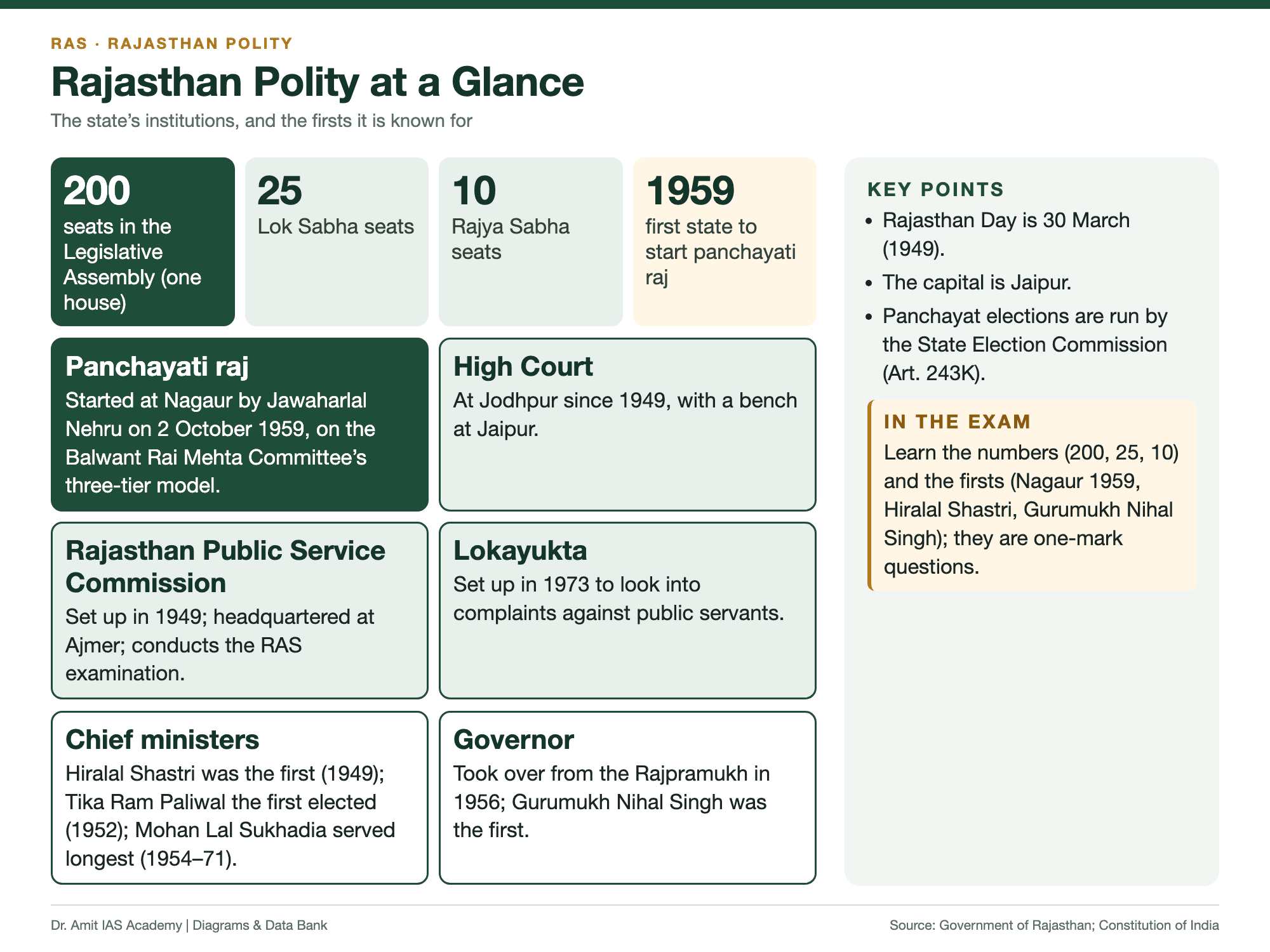
The sheet opens with four number tiles. The first gives 200 seats in the Legislative Assembly and notes that the legislature has only one house. The next two give the state's 25 Lok Sabha and 10 Rajya Sabha seats, and the fourth, 1959, marks Rajasthan as the first state to start panchayati raj. Below them, six cards cover panchayati raj, the High Court, the Rajasthan Public Service Commission, the Lokayukta, the chief ministers and the Governor. A side panel lists key points: Rajasthan Day on 30 March, Jaipur as the capital and the State Election Commission under Article 243K, which runs panchayat elections.
Legislature, executive and judiciary
- Legislature: Rajasthan has a unicameral legislature of 200 members, so there is no Legislative Council.
- Chief ministers: Hiralal Shastri was the first chief minister (1949), Tika Ram Paliwal the first after the 1952 general election, and Mohan Lal Sukhadia held the post the longest, from 1954 to 1971.
- Governor: until 1956 the state had a Rajpramukh. After the Seventh Constitutional Amendment and the reorganisation of states, the office of Governor took over, and Gurmukh Nihal Singh became the first Governor.
- High Court: the principal seat has been at Jodhpur since 1949, and a bench sits at Jaipur.
Commissions and local government
The Rajasthan Public Service Commission, set up in 1949 and now headquartered at Ajmer, recruits for state services and conducts the RAS examination. The Lokayukta, created in 1973, looks into complaints of corruption and maladministration against public servants, well before the Lokpal and Lokayuktas Act, 2013 made such bodies a national expectation.
Rajasthan is best known for panchayati raj. On 2 October 1959 Jawaharlal Nehru launched it at Nagaur, following the three-tier model recommended by the Balwant Rai Mehta Committee: gram panchayat at the village, panchayat samiti at the block and zila parishad at the district. After the 73rd Amendment (1992), panchayats got constitutional status, and elections to them are now held by the State Election Commission.
Why it matters for the exam
The RAS Preliminary examination, a single General Knowledge and General Science paper, has a unit on the political and administrative system of Rajasthan, covering the Governor, Chief Minister, Assembly, High Court, RPSC, Lokayukta and State Election Commission. The same area returns in the Mains General Studies papers. Prelims questions are usually direct one-mark facts: the first of something, a year, a headquarters or a seat count. Mains questions ask how an institution works or why Rajasthan's panchayati raj experiment mattered nationally.
Quick revision
- Unicameral Assembly of 200 seats; 25 Lok Sabha and 10 Rajya Sabha seats.
- Panchayati raj began at Nagaur on 2 October 1959, opened by Nehru.
- High Court at Jodhpur since 1949, with a bench at Jaipur.
- RPSC set up in 1949, now headquartered at Ajmer; Lokayukta set up in 1973.
- First CM Hiralal Shastri; longest-serving CM Mohan Lal Sukhadia (1954-71).
- Rajpramukh replaced by a Governor in 1956; Gurmukh Nihal Singh was the first.