Panchayati Raj after the 73rd Amendment
The three tiers and the 73rd Amendment’s rules, with Haryana’s.
What the diagram shows
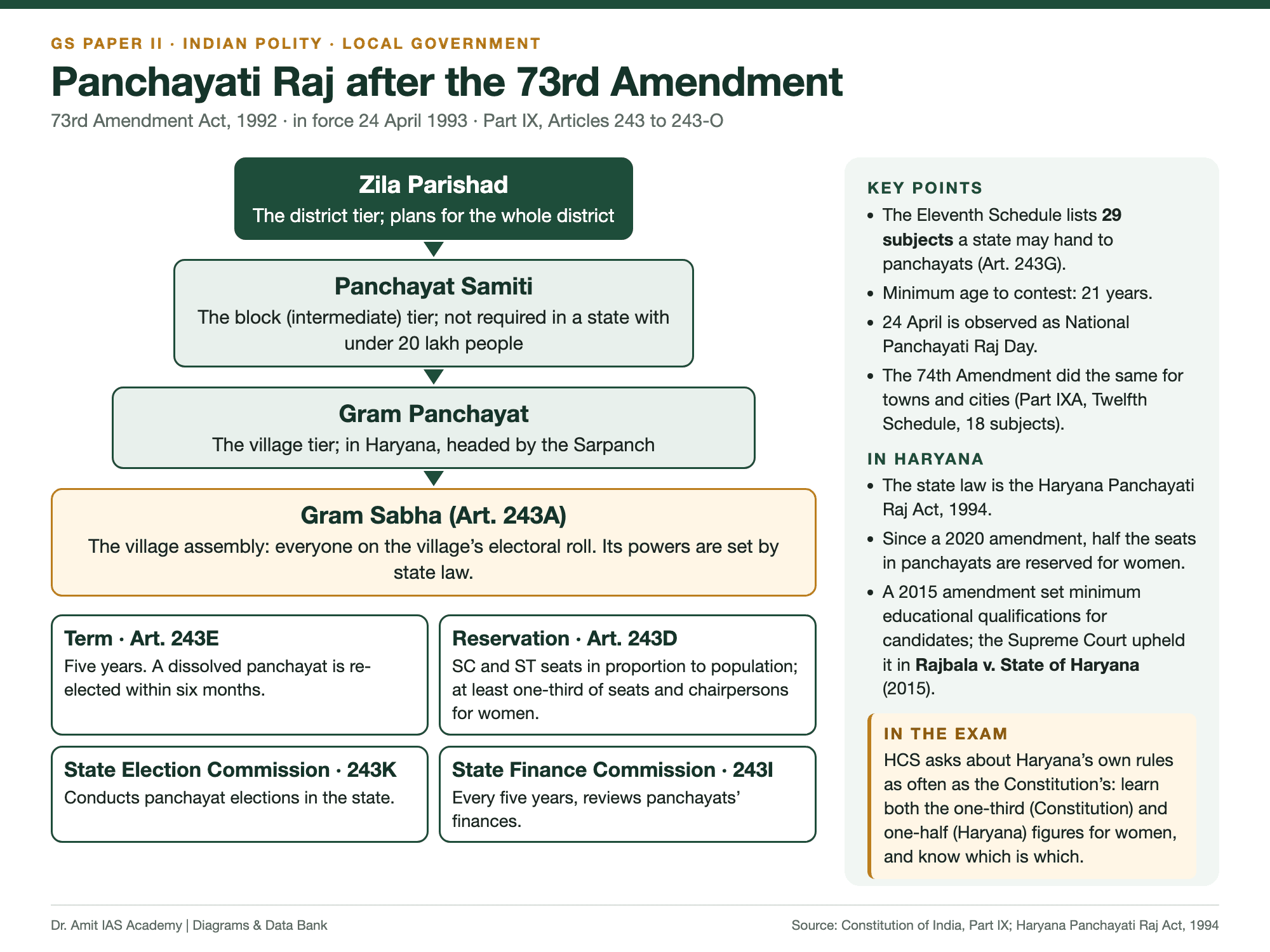
The picture is drawn as a ladder from the district down to the village. At the top sits the Zila Parishad, the district tier that plans for the whole district. Below it is the Panchayat Samiti, the block or intermediate tier, which a state with a population under 20 lakh need not have. Next comes the Gram Panchayat, the village tier, headed in Haryana by the Sarpanch. At the base, set apart in a different colour, is the Gram Sabha (Article 243A): every person on the village's electoral roll, with powers fixed by state law.
Four boxes under the ladder give the core constitutional rules on term, reservation, the State Election Commission and the State Finance Commission. A side panel lists key points, Haryana's own rules and a note on how the exam tests them.
The 73rd Amendment's core rules
The 73rd Amendment Act, 1992 came into force on 24 April 1993 and added Part IX (Articles 243 to 243-O) and the Eleventh Schedule to the Constitution. It turned panchayats from bodies a state could ignore into constitutional institutions with fixed features.
- Term (Art. 243E): five years; a dissolved panchayat must be re-elected within six months.
- Reservation (Art. 243D): seats for SCs and STs in proportion to their population, and at least one-third of seats and chairperson posts for women.
- State Election Commission (Art. 243K): conducts panchayat elections in the state.
- State Finance Commission (Art. 243I): set up every five years to review panchayat finances.
- Eleventh Schedule (Art. 243G): 29 subjects a state may hand over to panchayats.
- Minimum age to contest: 21 years.
The date of commencement, 24 April, is observed as National Panchayati Raj Day. The parallel 74th Amendment did the same for towns and cities through Part IXA and the Twelfth Schedule of 18 subjects.
Panchayati Raj in Haryana
Much of Part IX leaves the details to state legislatures, which is why Haryana's law matters. The state framework is the Haryana Panchayati Raj Act, 1994, which follows the three-tier pattern. Haryana has gone beyond the constitutional minimum in two notable ways:
- A 2020 amendment reserved half the seats in panchayats for women, against the Constitution's floor of one-third.
- A 2015 amendment laid down minimum educational qualifications for candidates. The Supreme Court upheld it in Rajbala v. State of Haryana (2015), accepting that a state may add such conditions for contesting panchayat elections.
Why it matters for the exam
For HCS, this topic belongs to General Studies on Indian polity and local government, with Haryana-specific questions common in both Prelims and Mains. For UPSC, it sits in GS Paper II under devolution of powers and finances to local levels. Prelims questions usually test articles, schedules, the age limit and which body does what, while Mains questions ask how far devolution has worked in practice, the role of finance commissions, or the effect of reservation for women. As the diagram warns, HCS often contrasts Haryana's rules with the Constitution's, so keep the one-third and one-half figures apart.
Quick revision
- 73rd Amendment Act, 1992; in force 24 April 1993; Part IX, Articles 243 to 243-O.
- Three tiers: Zila Parishad, Panchayat Samiti, Gram Panchayat; Gram Sabha under Art. 243A.
- No intermediate tier needed in a state with under 20 lakh people.
- Eleventh Schedule: 29 subjects; Twelfth Schedule (74th Amendment): 18 subjects.
- Women: at least one-third under the Constitution, one-half in Haryana since 2020.
- Rajbala v. State of Haryana (2015) upheld educational qualifications for candidates.