National Income: From GVA and GDP to NNP
GVA to national income step by step, and three ways to measure GDP.
What the diagram shows
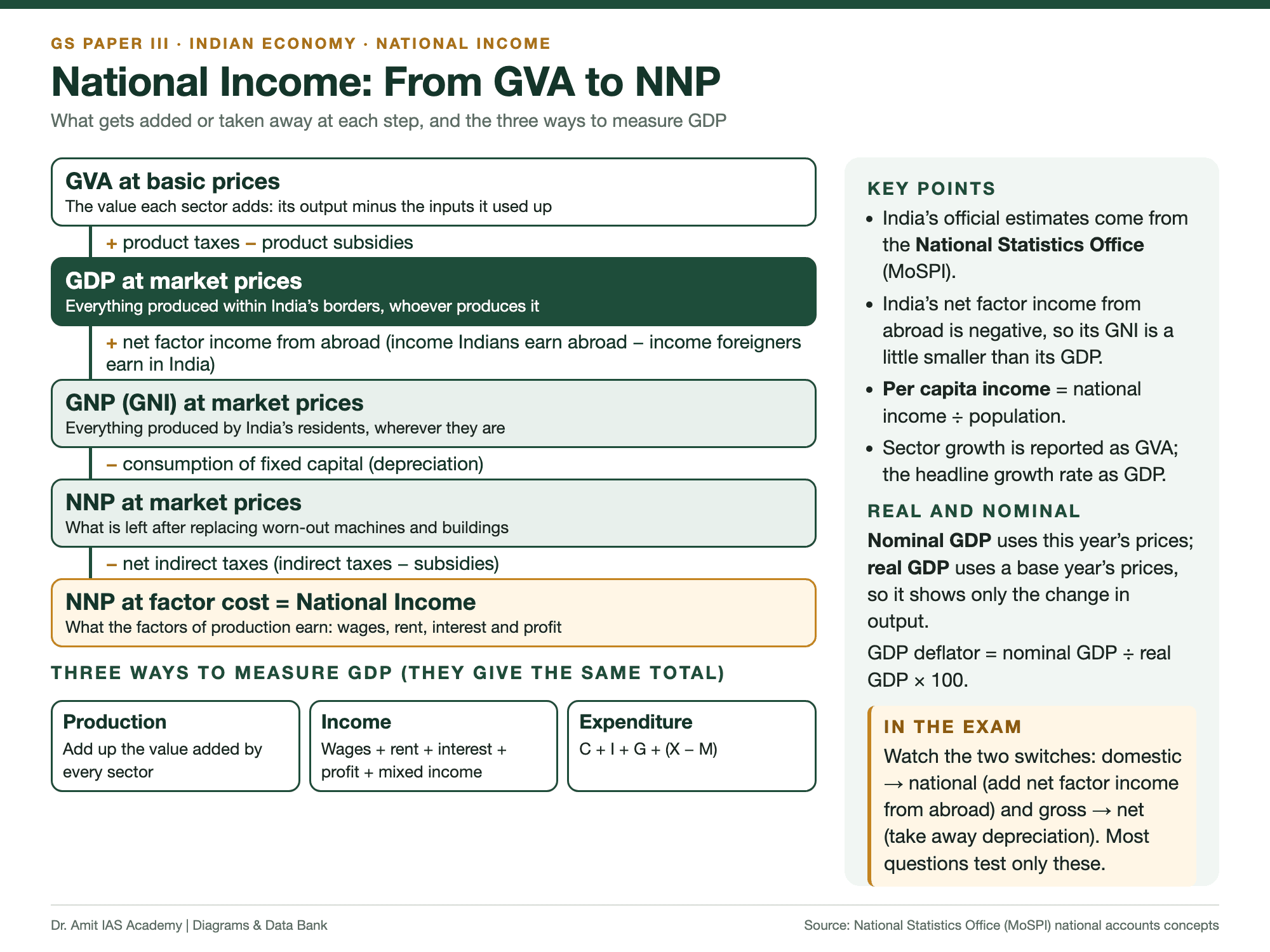
The diagram is a ladder of five boxes joined by a vertical line. It starts at the top with GVA at basic prices, the value each sector adds: its output minus the inputs it used up. Between each pair of boxes a short line says what is added or taken away. Adding product taxes and subtracting product subsidies gives the dark green GDP at market prices box. Adding net factor income from abroad gives GNP (GNI) at market prices. Subtracting consumption of fixed capital, that is depreciation, gives NNP at market prices. Subtracting net indirect taxes gives the highlighted last box, NNP at factor cost = National Income. Below it, three boxes show the three ways to measure GDP; a side panel adds key points and an exam tip.
Each step on the ladder
- GVA to GDP: adding product taxes and removing product subsidies moves the figure from basic prices to market prices, the prices buyers pay.
- Domestic to national: GDP counts everything produced within the country's borders, whoever produces it. GNP counts what the country's residents produce, wherever they are. The bridge is net factor income from abroad: income residents earn abroad minus income foreigners earn in India. The diagram notes that this figure is negative for India, so its GNI is a little smaller than its GDP.
- Gross to net: machines and buildings wear out in production. Taking away depreciation leaves the net product.
- Market prices to factor cost: removing indirect taxes and adding back subsidies leaves what the factors of production earn: wages, rent, interest and profit. This is national income.
Three ways to measure GDP
The three methods look at the same economy from different sides, so in principle they give the same total.
- Production (value added) method: add up the value added by every sector, which avoids counting intermediate goods twice.
- Income method: add up factor incomes: wages, rent, interest, profit and the mixed income of the self-employed.
- Expenditure method: add consumption (C), investment (I), government spending (G) and net exports (X minus M).
India's official estimates come from the National Statistics Office (MoSPI). Sector growth is reported as GVA, the headline growth rate as GDP. Nominal GDP uses the current year's prices; real GDP uses a base year's prices, so it shows only the change in output.
Why it matters for the exam
National income accounting sits in GS Paper III (Indian Economy) of the UPSC Mains and in the economy section of General Studies in Prelims. The state services examinations, HCS, RAS, UPPCS and GPSC, carry it in their economy syllabus too. Prelims questions usually test definitions: which aggregate includes net factor income from abroad, what separates gross from net, why GVA differs from GDP, or what the GDP deflator measures. Mains questions ask why India reports sector growth as GVA, how real and nominal growth differ, or what GDP leaves out as a measure of welfare. Keep the two switches clear: domestic to national, and gross to net.
Quick revision
- GDP at market prices = GVA at basic prices + product taxes minus product subsidies.
- GNP = GDP + net factor income from abroad; India's is negative, so GNI is slightly below GDP.
- NNP = GNP minus depreciation (consumption of fixed capital).
- National income = NNP at factor cost = NNP at market prices minus net indirect taxes.
- GDP can be measured by the production, income and expenditure methods: C + I + G + (X minus M).
- GDP deflator = nominal GDP divided by real GDP, multiplied by 100.