Haryana's Industries by City
What each city makes: cars, textiles, plywood and more.
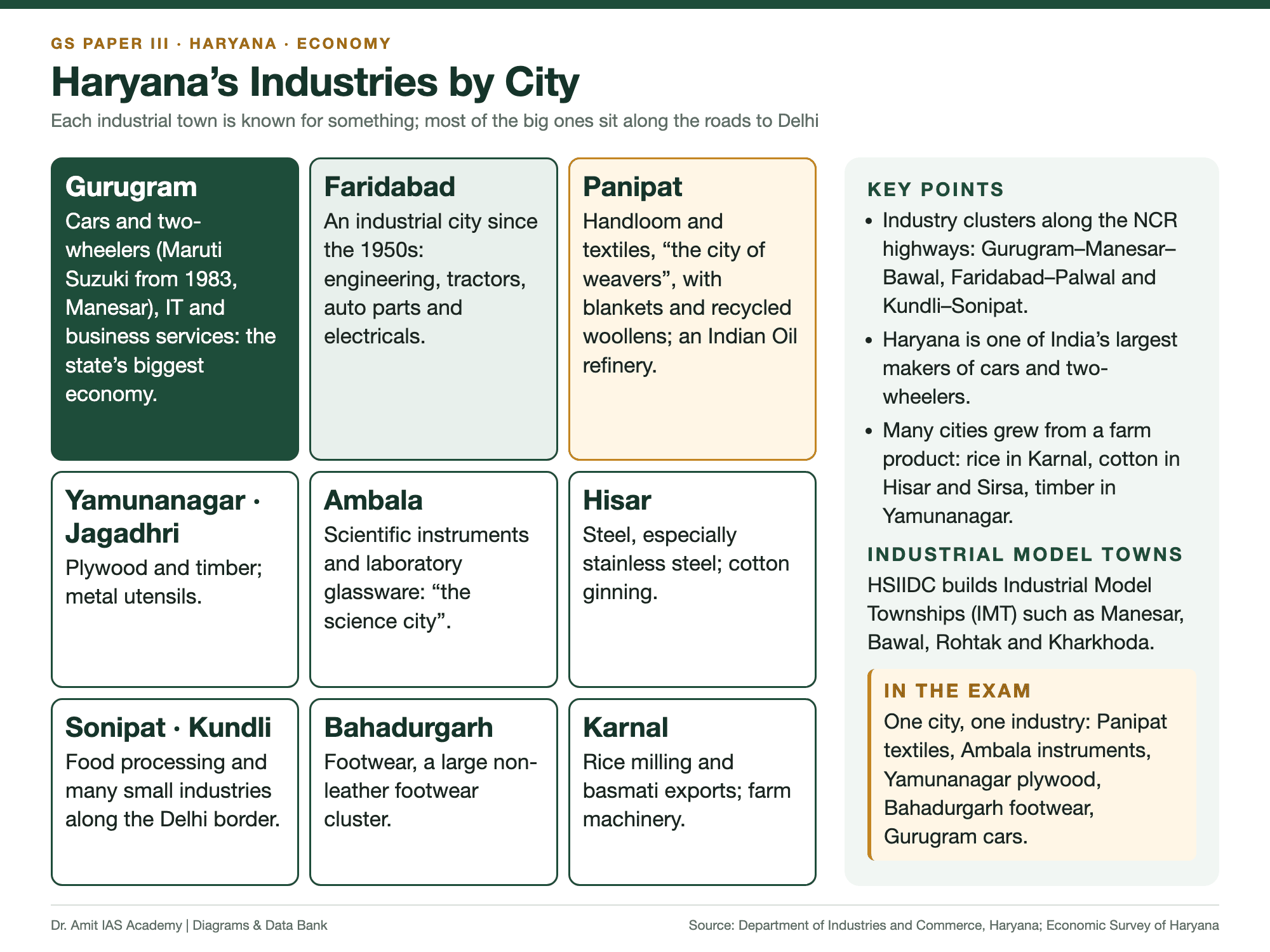
What the diagram shows
The diagram is a grid of nine city cards, each naming the industry a town is best known for. Gurugram, shaded dark, comes first: cars and two-wheelers, with Maruti Suzuki producing there since 1983 and later at Manesar, along with IT and business services, which make it the state's biggest economy. Faridabad has been an industrial city since the 1950s, making engineering goods, tractors, auto parts and electricals. Panipat, "the city of weavers", stands for handloom, textiles, blankets and recycled woollens, and also has an Indian Oil refinery.
The second row covers Yamunanagar–Jagadhri (plywood and timber, metal utensils), Ambala (scientific instruments and laboratory glassware, "the science city") and Hisar (steel, especially stainless steel, and cotton ginning). The third row shows Sonipat–Kundli (food processing and small industries along the Delhi border), Bahadurgarh (a large non-leather footwear cluster) and Karnal (rice milling, basmati exports and farm machinery). A side panel lists key points, the Industrial Model Townships and an exam tip. The subtitle notes that most big centres sit along the roads to Delhi.
Why industry clusters where it does
Two forces explain the map. The first is nearness to Delhi. Industry has gathered along the National Capital Region highways, forming three belts:
- Gurugram–Manesar–Bawal along the Delhi–Jaipur road: automobiles, auto components and services.
- Faridabad–Palwal along the Delhi–Mathura road: engineering and older heavy industry.
- Kundli–Sonipat along the Delhi–Karnal road: food processing and small units.
The second force is agriculture. Many towns grew by processing a local farm product: rice in Karnal, cotton in Hisar and Sirsa, and timber from farm forestry in Yamunanagar. This link between farm and factory is typical of an agriculturally strong state.
Planned industrial townships
The Haryana State Industrial and Infrastructure Development Corporation (HSIIDC) develops Industrial Model Townships, or IMTs, with ready plots, roads and utilities. The diagram names Manesar, Bawal, Rohtak and Kharkhoda. These planned estates are meant to spread industry beyond the crowded Gurugram–Faridabad core and to draw large investors, especially in the automobile sector, where Haryana is among India's leading producers of cars and two-wheelers.
The pattern also brings problems that examiners like to probe: congestion and pollution in the NCR belt, uneven development between the NCR districts and the rest of the state, and the sensitivity of small-unit clusters such as Panipat's woollens or Bahadurgarh's footwear to input costs and labour supply.
Why it matters for the exam
For HCS, this topic falls under the Haryana-specific part of General Studies: the state's economy, industry and geography, and it can also support answers on industrial policy and regional development. Questions are usually of two kinds. Prelims-style questions ask you to match a town with its industry or identify a cluster. Mains-style questions ask why industry is concentrated near Delhi, what role IMTs play, or how agro-based industry links to the farm economy. For UPSC, the same examples serve as illustrations of industrial location and cluster development.
Quick revision
- Gurugram: cars, two-wheelers, IT and services; the state's biggest economy.
- Panipat: textiles and recycled woollens, "city of weavers"; Indian Oil refinery.
- Ambala: scientific instruments, "science city"; Yamunanagar: plywood; Jagadhri: utensils.
- Hisar: stainless steel; Karnal: rice and basmati; Bahadurgarh: non-leather footwear.
- Three NCR belts: Gurugram–Manesar–Bawal, Faridabad–Palwal, Kundli–Sonipat.
- HSIIDC builds IMTs such as Manesar, Bawal, Rohtak and Kharkhoda.