Industry and Ports of Gujarat
Refining, diamonds, textiles, salt and the ports behind them.
What the diagram shows
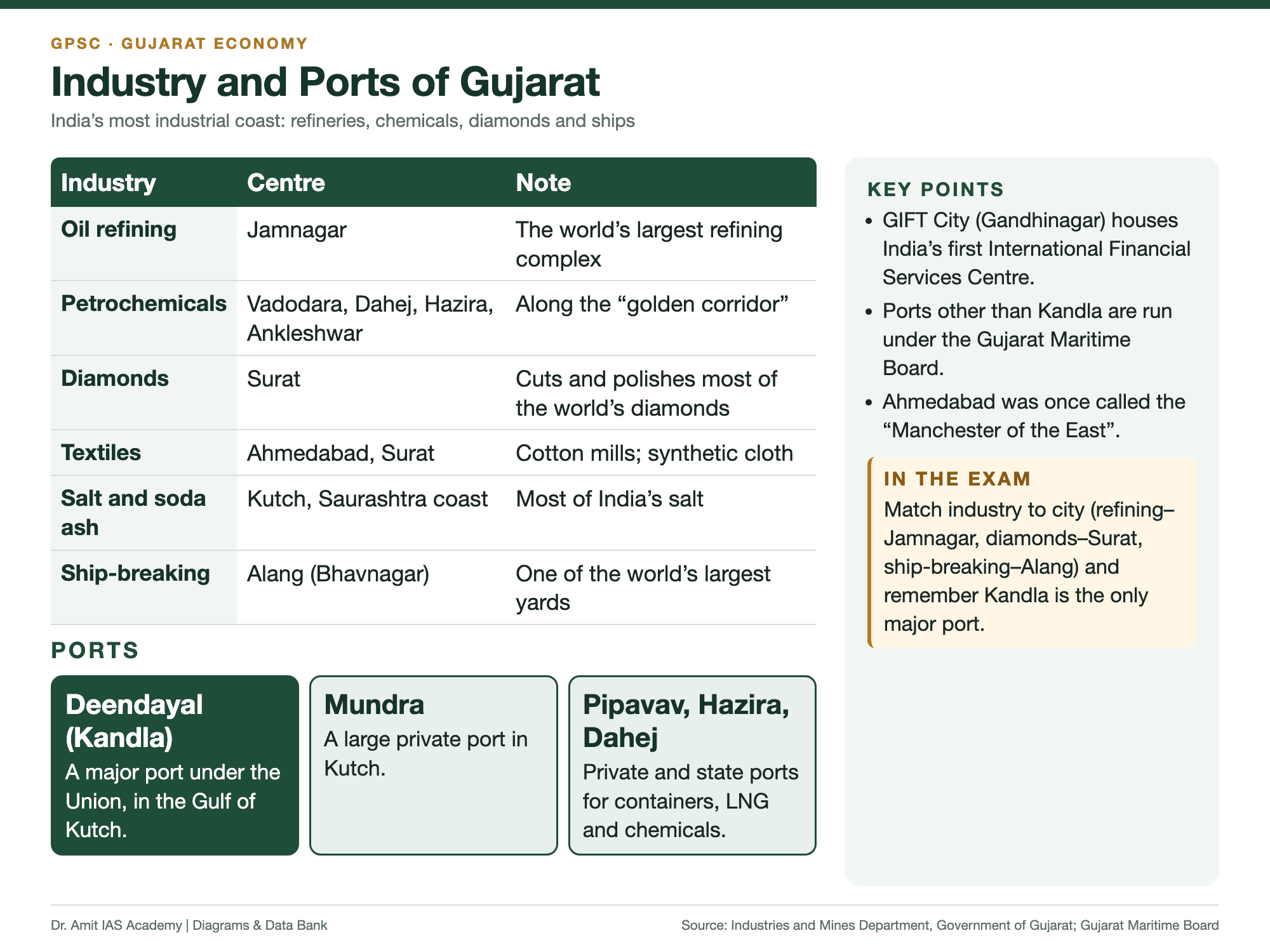
The chart is built around a table with three columns: Industry, Centre and Note. Six rows run down it: oil refining at Jamnagar, petrochemicals at Vadodara, Dahej, Hazira and Ankleshwar, diamonds at Surat, textiles at Ahmedabad and Surat, salt and soda ash along Kutch and the Saurashtra coast, and ship-breaking at Alang in Bhavnagar. Below the table a Ports strip has three cards: Deendayal (Kandla), shaded dark because it is the only major port; Mundra, a large private port in Kutch; and Pipavav, Hazira and Dahej, grouped as private and state ports. A side panel lists key points on GIFT City, the Gujarat Maritime Board and Ahmedabad's old nickname, and ends with an exam tip.
Industrial centres and what they are known for
- Oil refining, Jamnagar: the refinery complex here is described as the largest in the world, making Gujarat a hub for crude processing and fuel exports.
- Petrochemicals, the golden corridor: chemical plants cluster at Vadodara, Ankleshwar, Dahej and Hazira, part of the industrial belt that runs south from Ahmedabad towards Vapi.
- Diamonds, Surat: the city cuts and polishes most of the world's rough diamonds, though the stones themselves are imported.
- Textiles, Ahmedabad and Surat: Ahmedabad grew on cotton mills and was once called the Manchester of the East; Surat is now the leading centre for synthetic (man-made fibre) cloth.
- Salt and soda ash, Kutch and Saurashtra: the flat, dry coast and the Rann give Gujarat most of India's salt, which in turn feeds the soda ash and chemical industry.
- Ship-breaking, Alang: on the Gulf of Khambhat coast in Bhavnagar district, it is one of the largest ship-breaking yards in the world.
Ports and how they are run
Gujarat has the longest coastline of any Indian state, and its ports serve much of north and west India. The key distinction is administrative:
- Deendayal Port (Kandla) in the Gulf of Kutch is a major port under the Union government. It was developed after Partition to make up for the loss of Karachi.
- All other ports are non-major ports, run under the Gujarat Maritime Board, often by private operators.
- Mundra in Kutch is a large private port handling containers, coal and crude.
- Pipavav, Hazira and Dahej handle containers, liquefied natural gas (LNG) and chemicals, serving the industries behind them.
The side panel adds that GIFT City in Gandhinagar houses India's first International Financial Services Centre, extending the state's economy from factories into finance.
Why it matters for the exam
For GPSC, this topic sits in the Gujarat economy and geography parts of the General Studies papers at both the Preliminary and the Mains stage, and it also supports UPSC questions on industrial location and ports. Expect matching questions that pair an industry with its city, statements on which port is major and which body administers the rest, and descriptive questions on why industry concentrates along the coast and the golden corridor.
Quick revision
- Refining: Jamnagar; diamonds: Surat; ship-breaking: Alang (Bhavnagar).
- Petrochemicals: Vadodara, Ankleshwar, Dahej, Hazira on the golden corridor.
- Deendayal (Kandla) is Gujarat's only major port, in the Gulf of Kutch.
- Other ports, including Mundra and Pipavav, come under the Gujarat Maritime Board.
- Gujarat produces most of India's salt, from Kutch and the Saurashtra coast.
- GIFT City, Gandhinagar, has India's first International Financial Services Centre.