How Haryana Is Governed
Governor, CM, Vidhan Sabha and the chain down to the village.
What the diagram shows
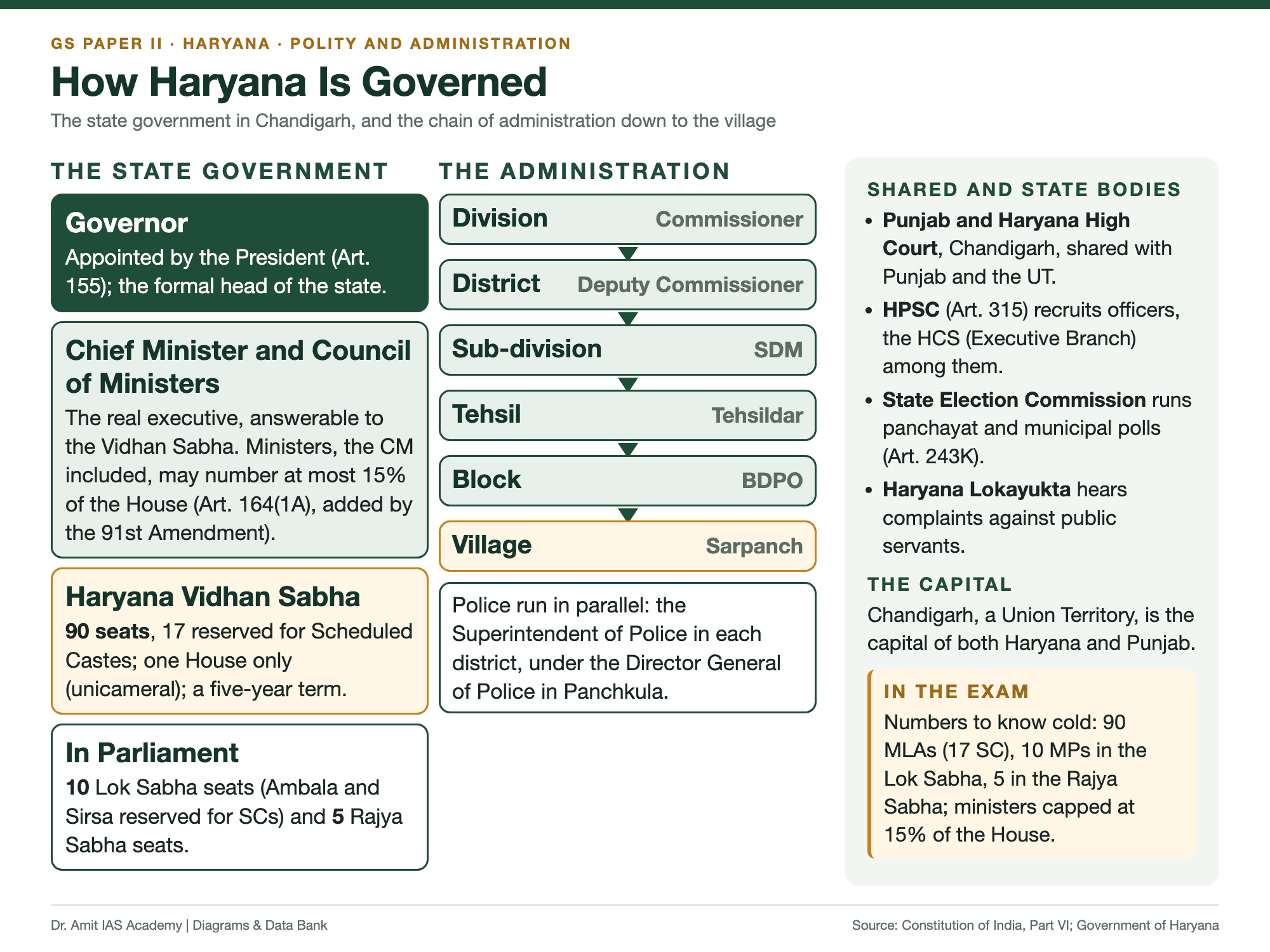
The chart is laid out in three columns. The left column, The State Government, stacks four boxes: the Governor, the Chief Minister and Council of Ministers, the Haryana Vidhan Sabha and Haryana's seats in Parliament. The middle column, The Administration, is a chain of arrows running from Division (Commissioner) to District (Deputy Commissioner), Sub-division (SDM), Tehsil (Tehsildar), Block (BDPO) and finally Village (Sarpanch). A note below adds the police. The right panel lists Shared and State Bodies, names the capital and ends with an “In the exam” box.
The state government
Haryana follows the parliamentary pattern that Part VI of the Constitution lays down for every state.
- Governor: appointed by the President under Article 155 and the formal head of the state.
- Chief Minister and Council of Ministers: the real executive, collectively responsible to the Vidhan Sabha. Under Article 164(1A), added by the 91st Amendment, the ministers, the Chief Minister included, may not exceed 15 per cent of the House.
- Haryana Vidhan Sabha: 90 seats, 17 of them reserved for Scheduled Castes. The legislature is unicameral, with no Legislative Council, and the House has a normal term of five years.
- In Parliament: Haryana elects 10 members to the Lok Sabha, with Ambala and Sirsa reserved for Scheduled Castes, and sends 5 members to the Rajya Sabha.
The chain of administration
Field administration in Haryana descends through territorial units, each with a familiar officer. A division groups several districts under a Divisional Commissioner. The district is the pivot of the whole system; its Deputy Commissioner is also the District Magistrate and the Collector. Districts are split into sub-divisions under SDMs, and then into tehsils under Tehsildars, who oversee land revenue work. The block is the unit for rural development, run by the Block Development and Panchayat Officer. At the bottom is the village, where the elected Sarpanch heads the gram panchayat.
Policing runs alongside this civil chain: a Superintendent of Police in each district reports up to the Director General of Police, whose headquarters is in Panchkula.
Shared and state bodies
- The Punjab and Haryana High Court at Chandigarh serves Punjab, Haryana and the Union Territory of Chandigarh.
- The Haryana Public Service Commission, set up under Article 315, recruits officers, including the HCS (Executive Branch).
- The State Election Commission conducts panchayat and municipal elections.
- The Haryana Lokayukta hears complaints against public servants.
- Chandigarh, a Union Territory, is the capital of both Haryana and Punjab.
Why it matters for the exam
For HCS this sits in General Studies, under Indian polity and the Haryana-specific portion of the syllabus. Prelims questions test the numbers directly: seats in the Vidhan Sabha, SC-reserved seats, Lok Sabha and Rajya Sabha members, and the 15 per cent ministerial cap. Mains questions may ask about the role of the Deputy Commissioner, the difference between the nominal and the real executive, or why Haryana shares a High Court and a capital with Punjab. For UPSC, the Governor and Article 164(1A) are core GS Paper II topics.
Quick revision
- Governor: appointed by the President (Article 155); the formal head of the state.
- Council of Ministers capped at 15 per cent of the House (Article 164(1A), 91st Amendment).
- Vidhan Sabha: 90 seats, 17 reserved for SCs, unicameral, five-year term.
- Parliament: 10 Lok Sabha seats (Ambala and Sirsa SC) and 5 Rajya Sabha seats.
- Chain: Division, District, Sub-division, Tehsil, Block, Village.
- Shared with Punjab: the High Court and the capital, Chandigarh.