How a Bill Becomes an Act
First reading to Act in eight steps, with the Money Bill rules.
What the diagram shows
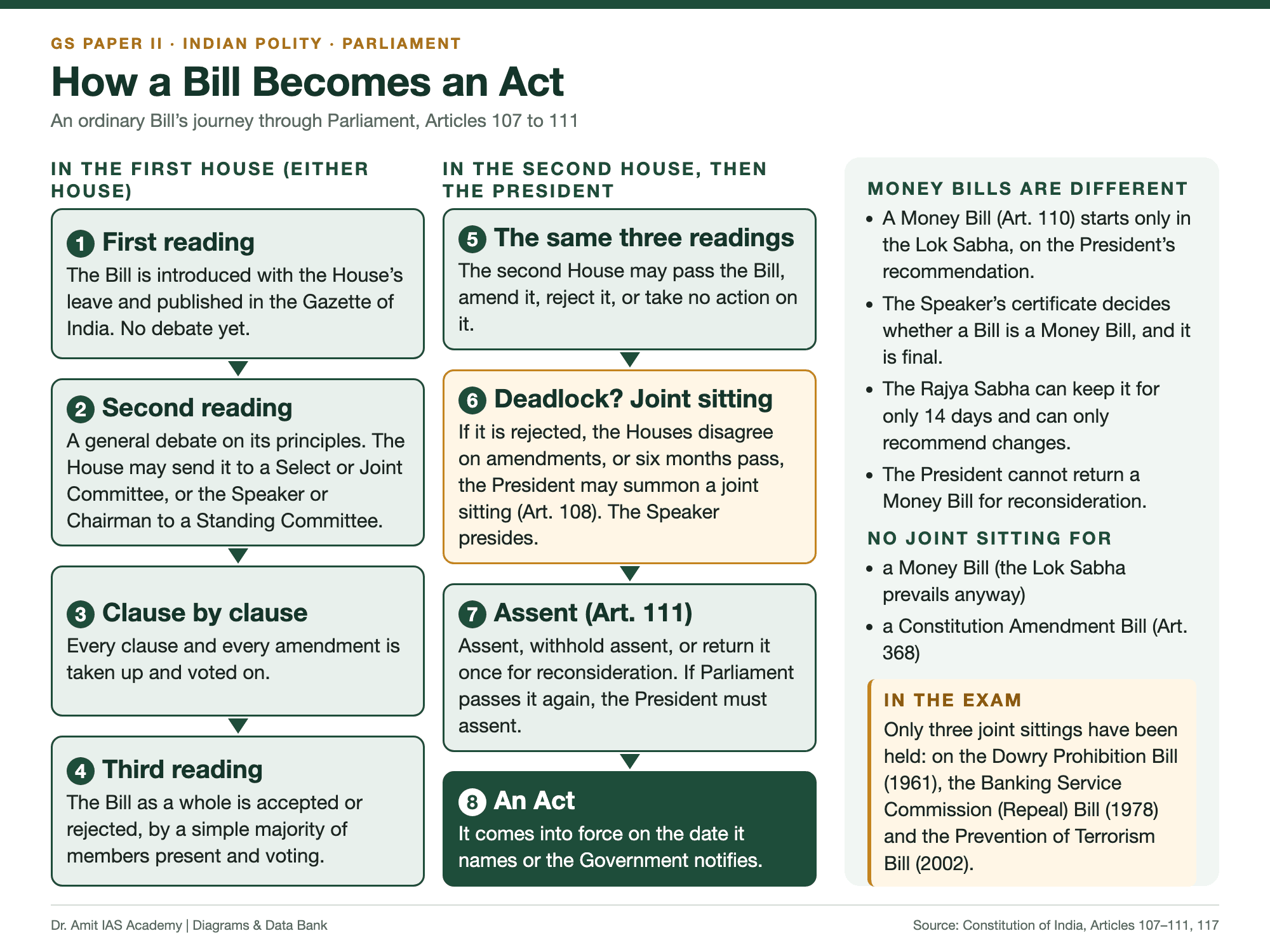
The chart follows an ordinary Bill through Parliament under Articles 107 to 111 in eight numbered steps, set out in two columns, with a side panel on Money Bills.
The left column covers the first House, which can be either House. In the first reading the Bill is introduced with the House's leave and published in the Gazette of India, with no debate. The second reading is a general debate on its principles; the House may send it to a Select or Joint Committee, or the Speaker or Chairman may refer it to a Standing Committee. Next comes the clause-by-clause stage, where every clause and amendment is voted on. In the third reading the Bill as a whole is accepted or rejected by a simple majority of members present and voting.
The right column covers the second House and the President. The second House goes through the same three readings and may pass, amend, reject or simply sit on the Bill. A deadlock can end in a joint sitting (Article 108). The President then acts under Article 111, and the Bill finally becomes an Act, coming into force on the date it names or the Government notifies.
Deadlock and the joint sitting
Article 108 lets the President summon both Houses to a joint sitting in three situations:
- the other House rejects the Bill;
- the Houses disagree on the amendments to be made; or
- more than six months pass without the other House passing it.
The Speaker of the Lok Sabha presides. A joint sitting is not available for a Money Bill or a Constitution Amendment Bill (Article 368). Only three have ever been held: on the Dowry Prohibition Bill (1961), the Banking Service Commission (Repeal) Bill (1978) and the Prevention of Terrorism Bill (2002).
Assent and the Money Bill exception
Under Article 111 the President may give assent, withhold it, or return a Bill once for reconsideration. If Parliament passes it again, the President must assent. This is the suspensive veto.
A Money Bill, defined in Article 110, follows stricter rules:
- it can be introduced only in the Lok Sabha, and only on the President's recommendation;
- the Speaker certifies whether a Bill is a Money Bill, and that decision is final;
- the Rajya Sabha can keep it for only 14 days, after which it is deemed passed, and can only recommend changes, which the Lok Sabha may accept or reject;
- the President cannot return it for reconsideration.
Why it matters for the exam
The topic belongs to GS Paper II (Polity: Parliament, its functioning and the conduct of business), and it is part of the polity section of the general studies papers of HCS, RAS, UPPCS and GPSC. Prelims questions test the details: which Bills cannot go to a joint sitting, who presides, the 14-day limit, who certifies a Money Bill and which veto applies to which Bill. Mains questions ask about the role of the Rajya Sabha, the use of the Money Bill route, the decline of committee scrutiny and the President's options on a Bill.
Quick revision
- Ordinary Bill: Articles 107 to 111; three readings in each House.
- Joint sitting (Article 108): rejection, disagreement on amendments or six months' delay; the Speaker presides.
- No joint sitting for a Money Bill or a Constitution Amendment Bill.
- Only three joint sittings so far: 1961, 1978 and 2002.
- Money Bill: Lok Sabha only, President's recommendation, Speaker's certificate final, Rajya Sabha has 14 days.
- The President can return an ordinary Bill once, but never a Money Bill.