Haryana's Protected Areas and State Symbols
National parks, Ramsar sites, sanctuaries and state symbols.
What the diagram shows
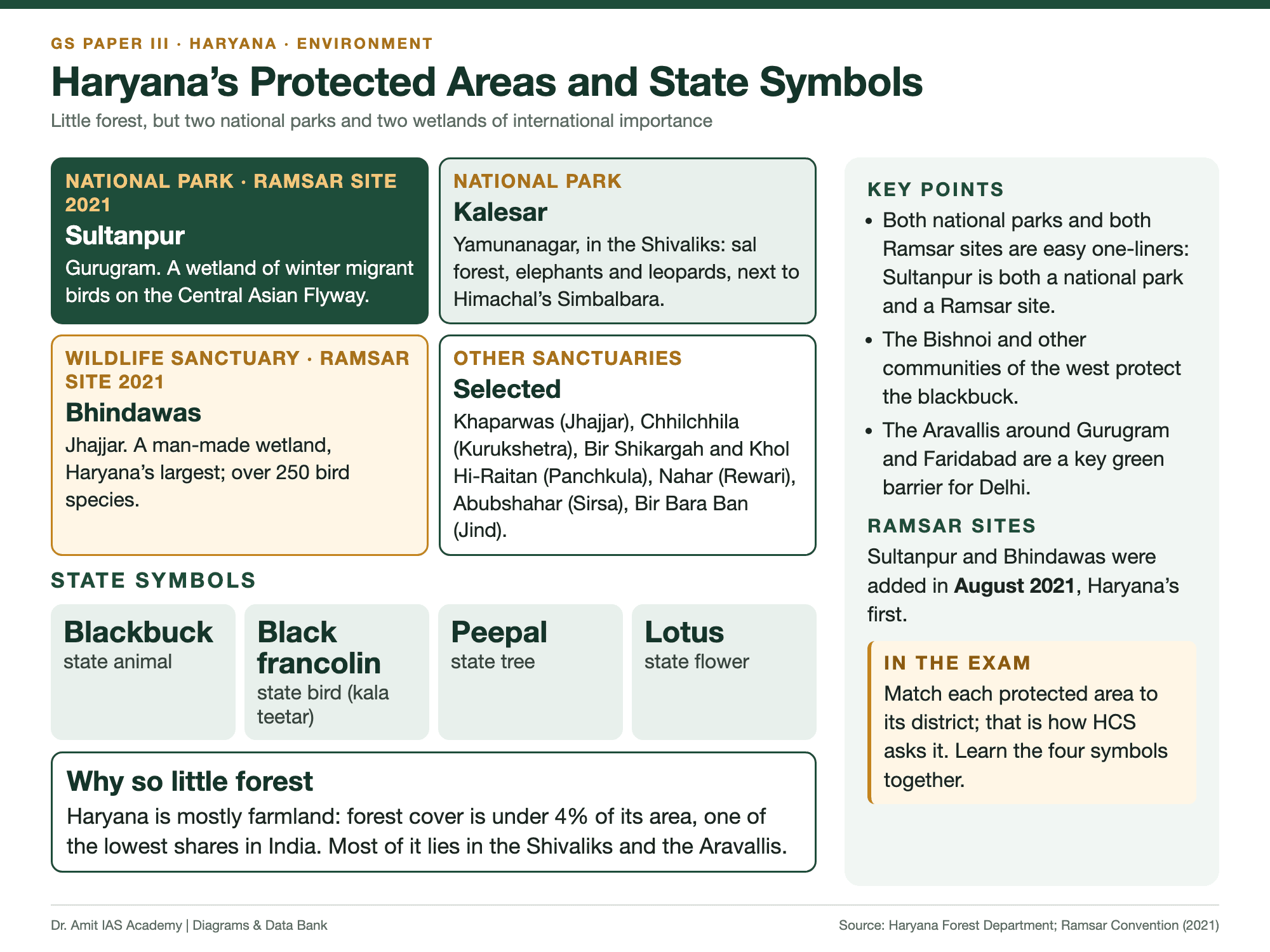
The chart sums up Haryana's natural heritage in one line: little forest, but two national parks and two wetlands of international importance. Four boxes at the top describe the protected areas. The dark green box is Sultanpur, tagged both national park and Ramsar site; next to it is Kalesar National Park. Below them, an amber box shows Bhindawas, a wildlife sanctuary and Ramsar site, and a fourth box lists other selected sanctuaries with their districts. A row of four tiles gives the state symbols, and a bottom panel explains why the state has so little forest. A side panel adds key points, a note on the Ramsar sites and an exam tip.
National parks and Ramsar wetlands
- Sultanpur National Park (Gurugram): a shallow wetland that fills with winter migrant birds arriving along the Central Asian Flyway. It is Haryana's only protected area that is both a national park and a Ramsar site.
- Kalesar National Park (Yamunanagar): sal forest in the Shivalik hills, home to leopards and visited by elephants. It adjoins Simbalbara in Himachal Pradesh, so wildlife moves across the state border.
- Bhindawas Wildlife Sanctuary (Jhajjar): a man-made wetland, described as Haryana's largest, that records over 250 bird species.
Sultanpur and Bhindawas were added to the Ramsar list of wetlands of international importance in 2021. They were Haryana's first Ramsar sites, which makes them a favourite one-liner.
Other sanctuaries and the state symbols
The chart picks out a set of smaller sanctuaries, each worth learning with its district:
- Khaparwas – Jhajjar
- Chhilchhila – Kurukshetra
- Bir Shikargah and Khol Hi-Raitan – Panchkula
- Nahar – Rewari
- Abubshahar – Sirsa
- Bir Bara Ban – Jind
The four state symbols are the blackbuck (state animal), the black francolin or kala teetar (state bird), the peepal (state tree) and the lotus (state flower). The blackbuck survives in the open farmland of western Haryana largely because the Bishnoi and other communities there protect it, a fine example of community-led conservation.
Why Haryana has so little forest
Haryana is overwhelmingly agricultural, and its recorded forest cover is under 4 per cent of its area, among the lowest shares of any state in India. What forest remains lies mainly in two hill belts: the Shivaliks in the north-east, around Kalesar and Morni, and the Aravallis in the south. The Aravalli ridge around Gurugram and Faridabad acts as a green barrier for Delhi, checking dust from the west and recharging groundwater, which is why mining and construction there are constantly debated.
Why it matters for the exam
For HCS, this topic sits in the Haryana-specific part of the General Studies syllabus, under the state's geography and environment, and in the environment and ecology portion of General Studies. Questions are usually factual: match each protected area to its district, identify which wetland is a Ramsar site, name the state animal or bird, or pick the odd one out from a list of sanctuaries. Mains answers on wetland conservation, the Aravallis or community conservation can use Sultanpur, Bhindawas and the Bishnoi as examples. For UPSC, the Ramsar sites and the Central Asian Flyway connect to the national topic of wetlands and migratory birds.
Quick revision
- National parks: Sultanpur (Gurugram) and Kalesar (Yamunanagar).
- Ramsar sites (2021): Sultanpur and Bhindawas (Jhajjar), Haryana's first.
- Bhindawas is a man-made wetland with over 250 bird species.
- Symbols: blackbuck, black francolin, peepal and lotus.
- Forest cover is under 4 per cent, mostly in the Shivaliks and Aravallis.