Haryana's Energy and Infrastructure
Power plants, the nuclear project, expressways and freight.
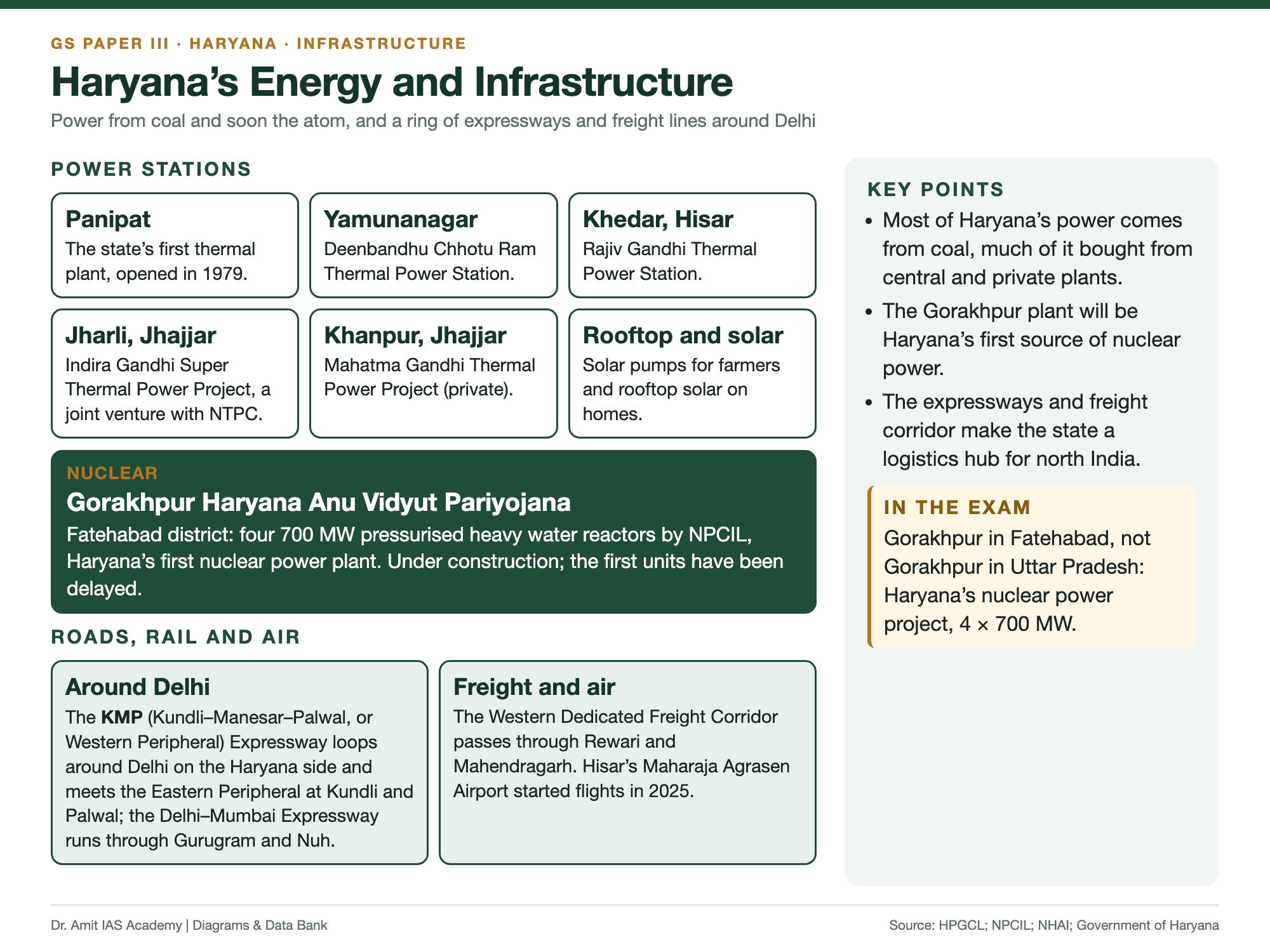
What the diagram shows
The diagram has three bands and a key-points panel. The first band, Power stations, has six boxes: Panipat, described as an early thermal plant whose first unit opened in 1979; the Deenbandhu Chhotu Ram Thermal Power Station at Yamunanagar; the Rajiv Gandhi Thermal Power Station at Khedar in Hisar; the Indira Gandhi Super Thermal Power Project at Jharli in Jhajjar, a joint venture with NTPC; the privately owned Mahatma Gandhi Thermal Power Project at Khanpur in Jhajjar; and a box on rooftop solar and solar pumps for farmers.
The second band, in dark green, is given to nuclear power: the Gorakhpur Haryana Anu Vidyut Pariyojana in Fatehabad district. The third band, Roads, rail and air, covers the expressways around Delhi and the freight corridor and airport. The side panel sums up the picture and adds an exam warning about the two Gorakhpurs.
Thermal power and the shift to clean energy
Haryana has no coal of its own, yet coal still supplies most of its electricity. A large share of the state's power is bought from central and private plants rather than produced by its own stations.
- State-run plants at Panipat, Yamunanagar and Khedar are operated by the Haryana Power Generation Corporation (HPGCL).
- Jharli is run by a joint venture in which NTPC is the main partner along with Haryana and Delhi utilities.
- Khanpur shows the role of private investment in power generation.
- Solar grows through solar pumps for farmers, which cut diesel use, and rooftop systems on homes.
Gorakhpur nuclear project
The Gorakhpur Haryana Anu Vidyut Pariyojana, at Gorakhpur village in Fatehabad district, is being built by the Nuclear Power Corporation of India Limited (NPCIL). It is planned as four pressurised heavy water reactors of 700 MW each, a total of 2,800 MW, an indigenous design fuelled by natural uranium. When its first units start, it will be Haryana's first source of nuclear power. Construction has taken longer than first planned.
Expressways, freight and air links
- KMP Expressway (Kundli-Manesar-Palwal), also called the Western Peripheral Expressway, loops around Delhi on the Haryana side and meets the Eastern Peripheral Expressway at Kundli and Palwal.
- Delhi-Mumbai Expressway passes through Gurugram and Nuh districts.
- Western Dedicated Freight Corridor crosses southern Haryana, including Rewari and Mahendragarh, linking the National Capital Region to the ports of western India.
- Maharaja Agrasen Airport, Hisar has begun commercial passenger flights.
Together these links make Haryana a logistics hub for north India.
Why it matters for the exam
For HCS, this topic falls under the Haryana-specific part of General Studies and the infrastructure and energy portion of the Mains GS paper. Prelims questions usually test matching: plant with district, project with agency, or expressway with the places it joins. The Gorakhpur trap is common, since a Gorakhpur also exists in Uttar Pradesh. Mains questions can ask how expressways and freight corridors shape industrial growth, or how the state can reduce its dependence on coal. For UPSC, PHWR technology, NPCIL and dedicated freight corridors are part of GS3 energy and infrastructure.
Quick revision
- Thermal plants: Panipat, Yamunanagar (DCRTPP), Khedar in Hisar (RGTPS), Jharli and Khanpur in Jhajjar.
- Jharli (IGSTPP) is a joint venture with NTPC; Khanpur (MGTPP) is private.
- Gorakhpur nuclear project is in Fatehabad district, Haryana: 4 x 700 MW PHWRs by NPCIL.
- KMP Expressway is the Western Peripheral; it meets the Eastern Peripheral at Kundli and Palwal.
- Delhi-Mumbai Expressway crosses Gurugram and Nuh; the Western DFC crosses Rewari and Mahendragarh.
- Hisar's Maharaja Agrasen Airport now has commercial flights.