Haryana's 23 Districts and 6 Divisions
Every district by division and year, with Hansi, the newest.
What the diagram shows
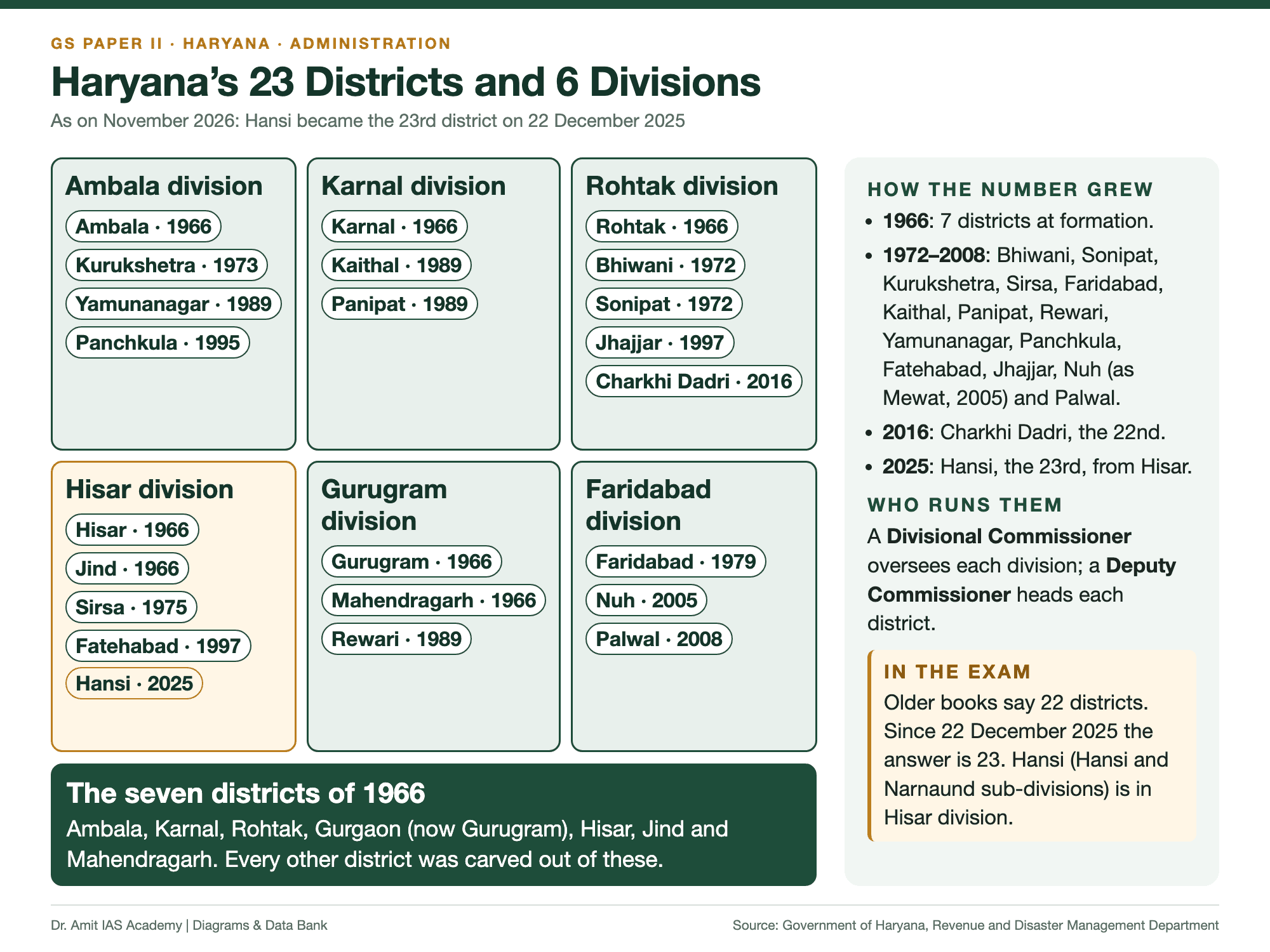
The diagram arranges Haryana's districts in six boxes, one for each administrative division: Ambala, Karnal and Rohtak on the top row, and Hisar, Gurugram and Faridabad below. Inside each box every district carries the year it became a district. The Hisar box is highlighted in amber because it holds the newest district, Hansi, marked 2025. A dark band at the foot names the seven districts Haryana began with in 1966. A side panel traces how the number grew, explains who runs a division and a district, and adds an exam note: older books say 22 districts, while the diagram, dated November 2026, gives the current answer as 23.
Divisions and their districts
- Ambala division: Ambala (1966), Kurukshetra (1973), Yamunanagar (1989), Panchkula (1995).
- Karnal division: Karnal (1966), Kaithal (1989), Panipat (1989).
- Rohtak division: Rohtak (1966), Bhiwani (1972), Sonipat (1972), Jhajjar (1997), Charkhi Dadri (2016).
- Hisar division: Hisar (1966), Jind (1966), Sirsa (1975), Fatehabad (1997), Hansi (2025).
- Gurugram division: Gurugram (1966), Mahendragarh (1966), Rewari (1989).
- Faridabad division: Faridabad (1979), Nuh (2005), Palwal (2008).
How the number grew
When Haryana was carved out of Punjab on 1 November 1966, it had seven districts: Ambala, Karnal, Rohtak, Gurgaon (now Gurugram), Hisar, Jind and Mahendragarh. Every later district was cut out of these. Between 1972 and 2008 fourteen more were added, among them Bhiwani and Sonipat in 1972, Kurukshetra in 1973, Sirsa in 1975 and Faridabad in 1979. The year 1989 alone brought four: Kaithal, Panipat, Rewari and Yamunanagar. Panchkula followed in 1995, Fatehabad and Jhajjar in 1997, Mewat in 2005 and Palwal in 2008. Mewat district was later renamed Nuh, and Gurgaon became Gurugram, both in 2016. Charkhi Dadri, carved from Bhiwani in 2016, was the 22nd district. Hansi was separated from Hisar district as the 23rd in December 2025, made up of the Hansi and Narnaund sub-divisions; the diagram shows it in Hisar division.
Who runs them
A division is a group of districts supervised by a Divisional Commissioner, who oversees revenue administration and coordinates the work of the districts under it. Each district is headed by a Deputy Commissioner, who is also the District Magistrate and the Collector, responsible for revenue, law and order, elections and disaster response. Below the district come sub-divisions under Sub-Divisional Officers (Civil), and then tehsils and sub-tehsils.
Why it matters for the exam
The HCS Preliminary examination tests Haryana-specific general knowledge, and the Mains General Studies paper on governance and administration covers the state's administrative set-up. Typical questions ask for the number of districts or divisions, the newest district, the district a new one was carved from, the division a district belongs to, the original districts of 1966, or the correct order of creation of a set of districts. Renamings such as Mewat to Nuh and Gurgaon to Gurugram are favourite traps, and so is the outdated figure of 22 districts.
Quick revision
- Haryana has 23 districts in 6 divisions: Ambala, Karnal, Rohtak, Hisar, Gurugram and Faridabad.
- The seven districts of 1966: Ambala, Karnal, Rohtak, Gurgaon, Hisar, Jind and Mahendragarh.
- Four districts were created in 1989: Kaithal, Panipat, Rewari and Yamunanagar.
- Charkhi Dadri (2016) was the 22nd district; Hansi, from Hisar, is the 23rd.
- Mewat became Nuh and Gurgaon became Gurugram in 2016.
- A Divisional Commissioner heads a division; a Deputy Commissioner heads a district.