Haryana's Agriculture and Crops
Crops by region, the Green Revolution and the water crisis.
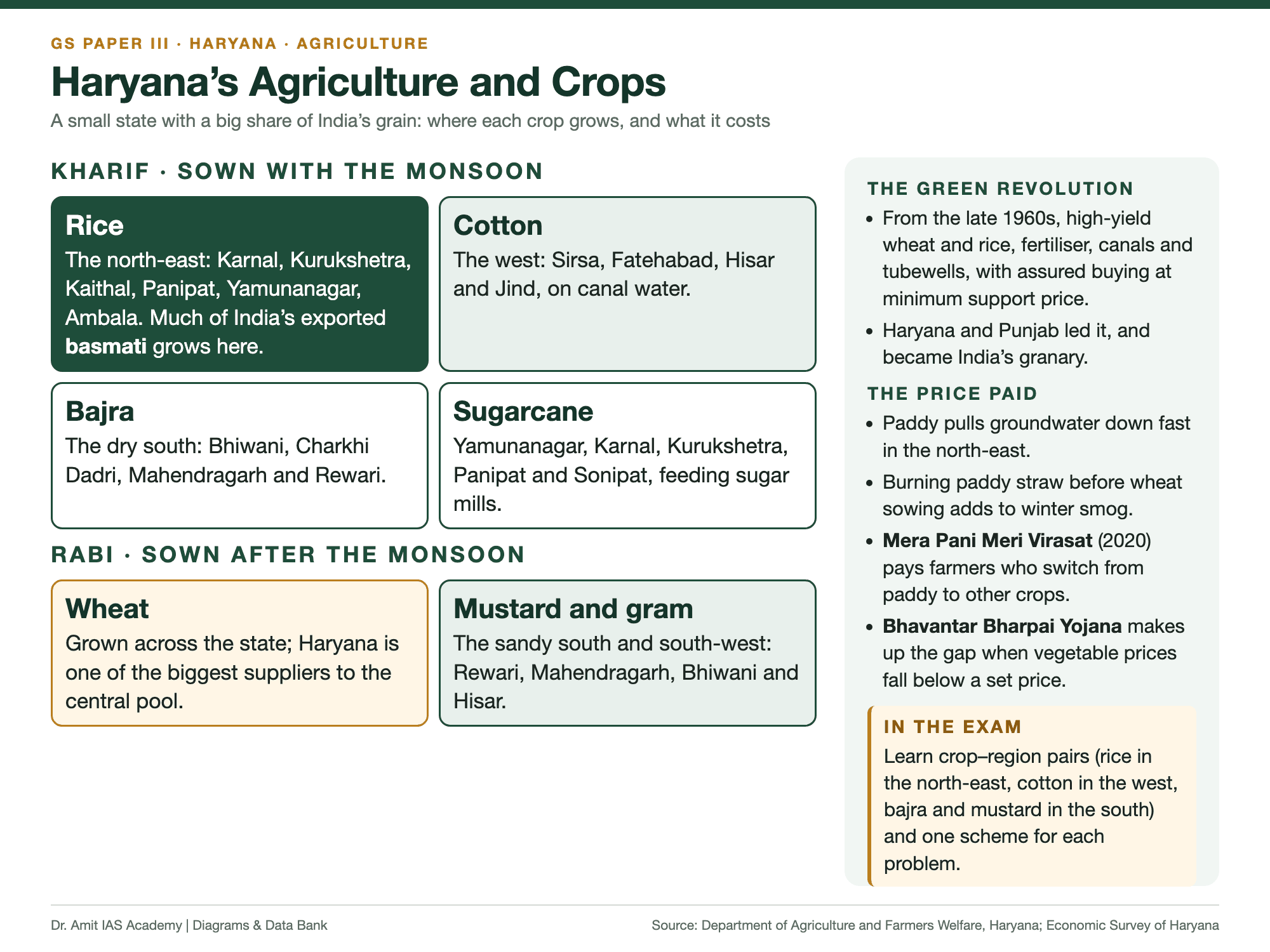
What the diagram shows
The picture is a crop map in words. On the left, it splits Haryana's farming into two seasons. Under Kharif, sown with the monsoon, four boxes place rice in the north-east, cotton in the west, bajra in the dry south and sugarcane in the Yamuna belt. Under Rabi, sown after the monsoon, two boxes show wheat grown across the state and mustard and gram in the sandy south and south-west. A side panel on the right tells the story behind these patterns: the Green Revolution, the price the state is now paying for it, and two state schemes meant to ease that cost. A boxed note at the foot of the side panel advises learning crop-region pairs and one scheme for each problem.
Where each crop grows
- Rice: Karnal, Kurukshetra, Kaithal, Panipat, Yamunanagar and Ambala in the well-watered north-east. This belt grows much of the basmati that India exports.
- Cotton: Sirsa, Fatehabad, Hisar and Jind in the west, depending on canal irrigation.
- Bajra: Bhiwani, Charkhi Dadri, Mahendragarh and Rewari, where rainfall is low and soils are light.
- Sugarcane: Yamunanagar, Karnal, Kurukshetra, Panipat and Sonipat, supplying the state's sugar mills.
- Wheat: grown in almost every district; Haryana is among the largest contributors of wheat to the central pool.
- Mustard and gram: Rewari, Mahendragarh, Bhiwani and Hisar, hardy rabi crops suited to sandy soil and scarce water.
The pattern follows water. Where rivers, canals and tubewells are plentiful, farmers grow thirsty crops such as paddy and sugarcane; where water is scarce, they grow millets, pulses and oilseeds.
The Green Revolution and its price
From the late 1960s, high-yielding varieties of wheat and rice, chemical fertiliser, canals and tubewells transformed farming in the region. Assured government buying at the minimum support price gave farmers a safe market. Haryana and Punjab led this change and became the granary of the country.
The same success created new problems:
- Falling groundwater: paddy needs standing water, so the north-eastern districts draw heavily on tubewells and the water table keeps dropping.
- Stubble burning: farmers burn paddy straw to clear fields quickly before sowing wheat, adding to winter smog across the region.
- Narrow cropping pattern: the wheat-paddy cycle strains soil health and leaves farmers dependent on two crops.
The state's response
Two schemes on the diagram show how Haryana is trying to change course. Mera Pani Meri Virasat, launched in 2020, gives a financial incentive to farmers who move from paddy to other crops, aiming to save groundwater. Bhavantar Bharpai Yojana protects vegetable growers: when market prices fall below a set price, the state pays the difference, reducing the risk of shifting away from cereals.
Why it matters for the exam
For HCS, this topic falls under the Haryana-specific part of the general studies papers and under agriculture in GS Paper III. Prelims questions often ask which district is known for a crop or match crops with regions and schemes. Mains questions ask candidates to assess the Green Revolution's legacy, explain the groundwater and stubble-burning crisis, or suggest ways to diversify crops. For UPSC, the same themes appear under cropping patterns, irrigation, minimum support prices and environmental effects of farming.
Quick revision
- Rice and basmati: the north-east (Karnal, Kurukshetra, Kaithal belt).
- Cotton: the west (Sirsa, Fatehabad, Hisar, Jind) on canal water.
- Bajra, mustard and gram: the dry, sandy south and south-west.
- Green Revolution from the late 1960s made Haryana and Punjab India's granary.
- Costs: falling groundwater, stubble burning and wheat-paddy dependence.
- Mera Pani Meri Virasat (2020) for crop diversification; Bhavantar Bharpai Yojana for vegetable prices.