Gujarat Polity at a Glance
The Assembly, the High Court, the GPSC and the state’s firsts.
What the diagram shows
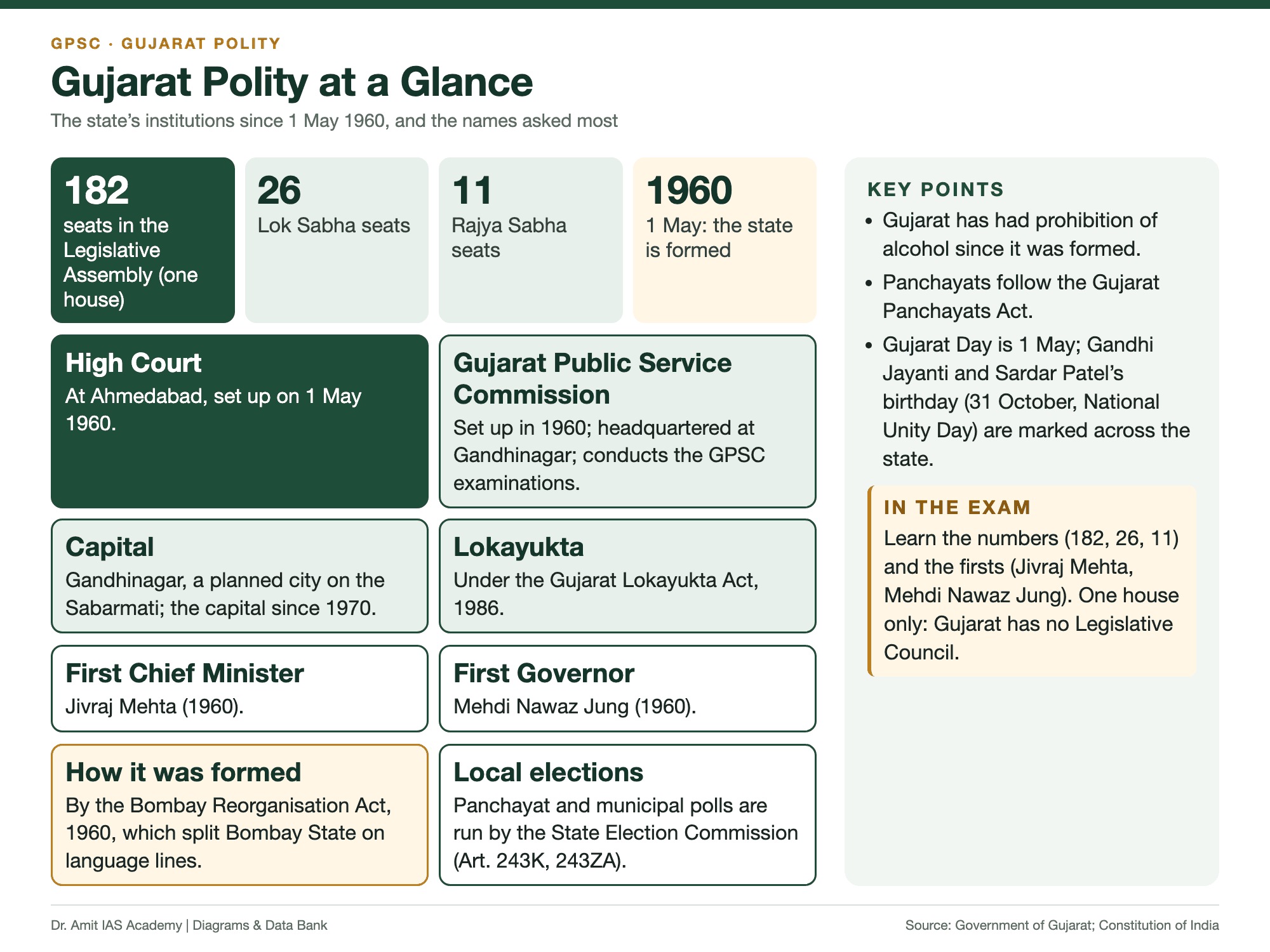
The diagram sets out Gujarat's political institutions since the state was formed on 1 May 1960. A row of four number tiles across the top gives the figures asked most often: 182 seats in the Legislative Assembly, which has one house; 26 Lok Sabha seats; 11 Rajya Sabha seats; and 1960, the year the state was formed on 1 May. Below them, eight cards cover the High Court, the Gujarat Public Service Commission, the capital, the Lokayukta, the first Chief Minister, the first Governor, how the state was formed and who runs local elections. A Key Points panel on the right covers prohibition, the panchayat law and the days marked across the state. An "In the exam" note at the bottom of the panel picks out what to memorise.
Formation and the state's firsts
The Bombay Reorganisation Act, 1960 divided the bilingual Bombay State along language lines. The Gujarati-speaking areas became Gujarat and the Marathi-speaking areas became Maharashtra, and both states came into being on 1 May 1960, the day still celebrated as Gujarat Day. The first institutions were set up straight away:
- First Chief Minister: Dr Jivraj Mehta (1960).
- First Governor: Mehdi Nawaz Jung (1960).
- High Court: at Ahmedabad, set up on 1 May 1960.
- Gujarat Public Service Commission: set up in 1960 and now headquartered at Gandhinagar. It conducts the state's civil services examinations under Article 315 of the Constitution.
Ahmedabad served as the first seat of government. Gandhinagar, a planned city on the banks of the Sabarmati and named after Mahatma Gandhi, has been the capital since 1970.
Legislature, representation and accountability
Gujarat has a unicameral legislature. Its Vidhan Sabha has 182 elected seats, and the state has no Legislative Council. Under Article 169, a council can be created or abolished only by an Act of Parliament, after the Assembly passes a resolution by a special majority. In Parliament the state elects 26 members to the Lok Sabha, and its Assembly members elect 11 members to the Rajya Sabha.
The Lokayukta, which looks into complaints of corruption against public servants, works under the Gujarat Lokayukta Act, 1986. At the local level:
- Panchayats are governed by the Gujarat Panchayats Act, framed under Part IX of the Constitution.
- Panchayat and municipal elections are run by the State Election Commission (Articles 243K and 243ZA), not by the Election Commission of India.
- Prohibition of alcohol has been in force since the state was formed.
Why it matters for the exam
For GPSC Class 1 and 2, this topic falls under Indian polity with special reference to Gujarat. It comes up in the Preliminary general studies paper and in the Mains general studies paper on polity and governance. Questions are usually short factual ones: the number of Assembly or parliamentary seats, the first Chief Minister or Governor, where the High Court sits, the year Gandhinagar became the capital, or the Act under which the Lokayukta works. Statement-based questions often test whether Gujarat has a Legislative Council and which body conducts local elections. Mains answers on state institutions are stronger when they cite the relevant Article and Gujarat's own Acts.
Quick revision
- Gujarat was formed on 1 May 1960 by the Bombay Reorganisation Act, 1960.
- Assembly 182 seats (one house); Lok Sabha 26; Rajya Sabha 11.
- First Chief Minister Jivraj Mehta; first Governor Mehdi Nawaz Jung.
- High Court at Ahmedabad; GPSC headquartered at Gandhinagar.
- Gandhinagar has been the capital since 1970, and the Lokayukta Act dates from 1986.
- Local polls are run by the State Election Commission under Articles 243K and 243ZA.