Emergency Provisions Compared: Articles 352, 356 and 360
Articles 352, 356 and 360 compared: grounds, rules, effects.
What the diagram shows
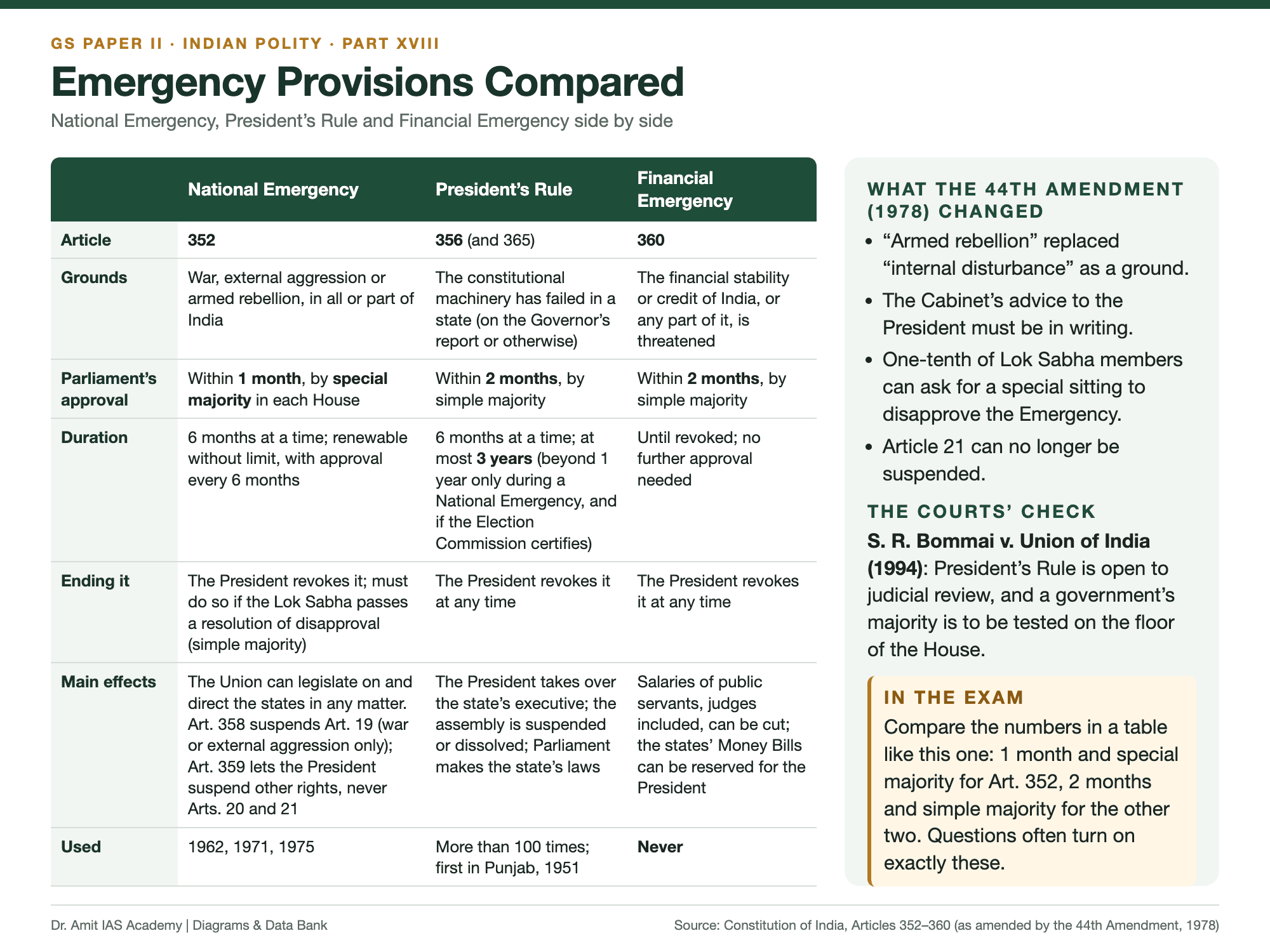
The diagram sets the three emergencies of Part XVIII side by side in one table. Its columns are National Emergency, President's Rule and Financial Emergency; its rows compare the article, grounds, Parliament's approval, duration, how each ends, main effects and how often each has been used. A side panel lists what the 44th Amendment of 1978 changed, a second names the S. R. Bommai case as the courts' check, and an exam box advises learning the numbers.
Grounds, approval and duration
- National Emergency (Article 352): war, external aggression or armed rebellion, in all or part of India. Each House must approve it within one month by a special majority. It lasts six months at a time and can be renewed without limit, with approval every six months.
- President's Rule (Article 356, with Article 365): failure of the constitutional machinery in a state, on the Governor's report or otherwise. Approval within two months by a simple majority; six months at a time, three years at most. Going beyond one year needs a National Emergency in force and the Election Commission's certificate that elections cannot be held.
- Financial Emergency (Article 360): a threat to the financial stability or credit of India or any part of it. Approval within two months by a simple majority; it then continues until revoked.
Ending and effects
The President can revoke any of the three at any time, and must revoke a National Emergency if the Lok Sabha disapproves it by a simple majority.
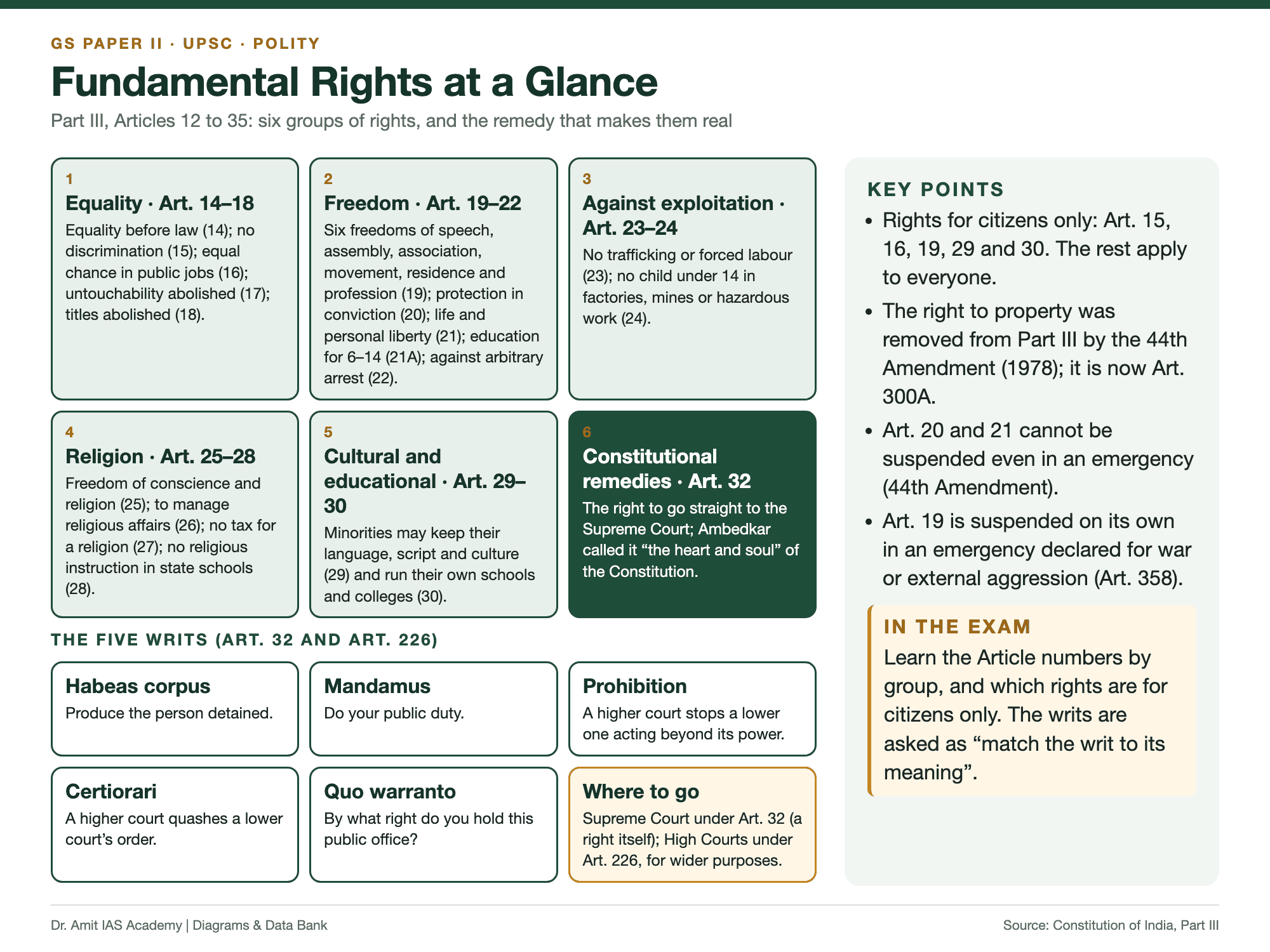
- National Emergency: the Union can legislate on any matter and direct the states. Article 358 suspends Article 19, only when the ground is war or external aggression; Article 359 lets the President suspend the enforcement of other rights, never Articles 20 and 21.
- President's Rule: the President takes over the state's executive, the assembly is suspended or dissolved, and Parliament makes the state's laws.
- Financial Emergency: salaries of public servants, judges included, can be cut, and state Money Bills can be reserved for the President.
National Emergency was proclaimed in 1962, 1971 and 1975. President's Rule has been used more than a hundred times, first in Punjab in 1951. A Financial Emergency has never been declared.
The 44th Amendment and the courts
After 1975, the 44th Amendment replaced "internal disturbance" with "armed rebellion", required the Cabinet's advice to the President to be in writing, let one-tenth of Lok Sabha members seek a special sitting to disapprove the emergency, and put Articles 20 and 21 beyond suspension. In S. R. Bommai v. Union of India (1994) the Supreme Court held that President's Rule is open to judicial review and that a government's majority must be tested on the floor of the House.
Why it matters for the exam
Emergency provisions are part of Indian Polity in GS Paper II of the UPSC Mains and the polity section of Prelims, and they recur in HCS, RAS, UPPCS and GPSC papers. Prelims questions test the numbers: one month or two, special or simple majority, which rights can never be suspended, which emergency has never been used. Mains questions ask about the misuse of Article 356, the Bommai judgment and federalism, and the 1978 safeguards.
Quick revision
- Article 352: approval within one month by special majority.
- Articles 356 and 360: approval within two months by simple majority.
- President's Rule: six months at a time, three years at most.
- Articles 20 and 21 cannot be suspended even in a National Emergency.
- Financial Emergency has never been declared.
- Bommai (1994): President's Rule is open to judicial review.