Biodiversity Conservation in India
In-situ and ex-situ, protected area types and the IUCN Red List.
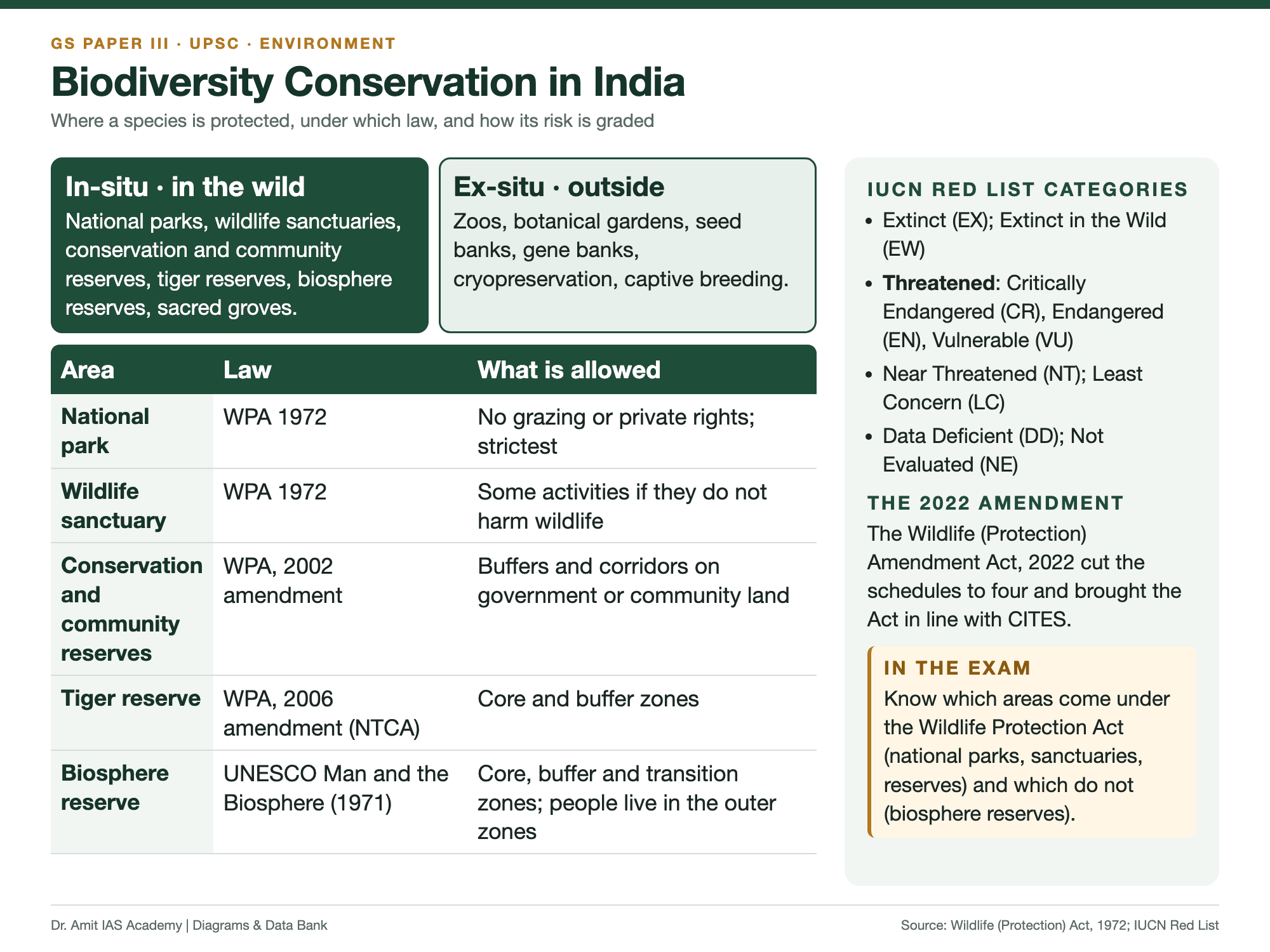
What the diagram shows
The chart answers three questions about any species: where it is protected, under which law, and how its risk of extinction is graded. Two boxes at the top split conservation into in-situ (in the wild) and ex-situ (outside the natural home). Below them a table lists five kinds of protected area, the law behind each and what activity is allowed inside. The right-hand panel lists the IUCN Red List categories, notes the 2022 amendment to the Wildlife (Protection) Act and ends with an exam tip.
In-situ and ex-situ conservation
In-situ conservation protects a species together with its habitat, so the whole ecosystem and its natural processes survive. The chart lists national parks, wildlife sanctuaries, conservation and community reserves, tiger reserves, biosphere reserves and sacred groves, the last being patches of forest protected by local communities for religious reasons.
Ex-situ conservation takes plants, animals or genetic material out of the wild for safe keeping: zoos, botanical gardens, seed banks, gene banks, cryopreservation (storing material at very low temperatures) and captive breeding. It is a back-up for species whose wild populations are too small to survive alone, and captive-bred animals can later be reintroduced.
Protected areas and the laws behind them
- National park (Wildlife (Protection) Act, 1972): the strictest category; no grazing and no private rights are allowed.
- Wildlife sanctuary (WPA, 1972): some activities are permitted if they do not harm wildlife.
- Conservation and community reserves (added by the 2002 amendment): act as buffers and corridors between protected areas; conservation reserves are on government land and community reserves on community or private land.
- Tiger reserve (2006 amendment, which also set up the National Tiger Conservation Authority): divided into a core and a buffer zone.
- Biosphere reserve (UNESCO Man and the Biosphere programme, 1971): core, buffer and transition zones, with people living in the outer zones. It is not a category under the WPA.
The Wildlife (Protection) Amendment Act, 2022 reduced the schedules of the Act to four and brought the law in line with CITES, the convention on international trade in endangered species.
The IUCN Red List
The Red List grades the risk of extinction. From most to least severe: Extinct (EX) and Extinct in the Wild (EW); the three threatened categories, Critically Endangered (CR), Endangered (EN) and Vulnerable (VU); then Near Threatened (NT) and Least Concern (LC). Data Deficient (DD) and Not Evaluated (NE) mean the evidence is too thin or the species has not been assessed.
Why it matters for the exam
In UPSC Mains the topic sits in GS Paper III under conservation, environmental pollution and degradation and environmental impact assessment; it also falls in the environment and ecology part of the Prelims syllabus of UPSC, HCS, RAS, UPPCS and GPSC. Prelims often tests which protected areas are created under the WPA and which are not, which activities are allowed where, and the order of Red List categories. Mains questions ask for comparisons of in-situ and ex-situ methods or an assessment of how far protected areas balance conservation with the rights of local people.
Quick revision
- In-situ protects species in their habitat; ex-situ protects them outside it.
- National parks are the strictest: no grazing, no private rights.
- Conservation and community reserves came with the 2002 amendment; tiger reserves and the NTCA with the 2006 amendment.
- Biosphere reserves come from UNESCO's MAB programme (1971), not the WPA.
- Threatened = CR, EN and VU on the IUCN Red List.
- The 2022 amendment cut the WPA schedules to four and aligned the Act with CITES.