Balance of Payments Explained
Current account, capital account and reserves: what goes where.
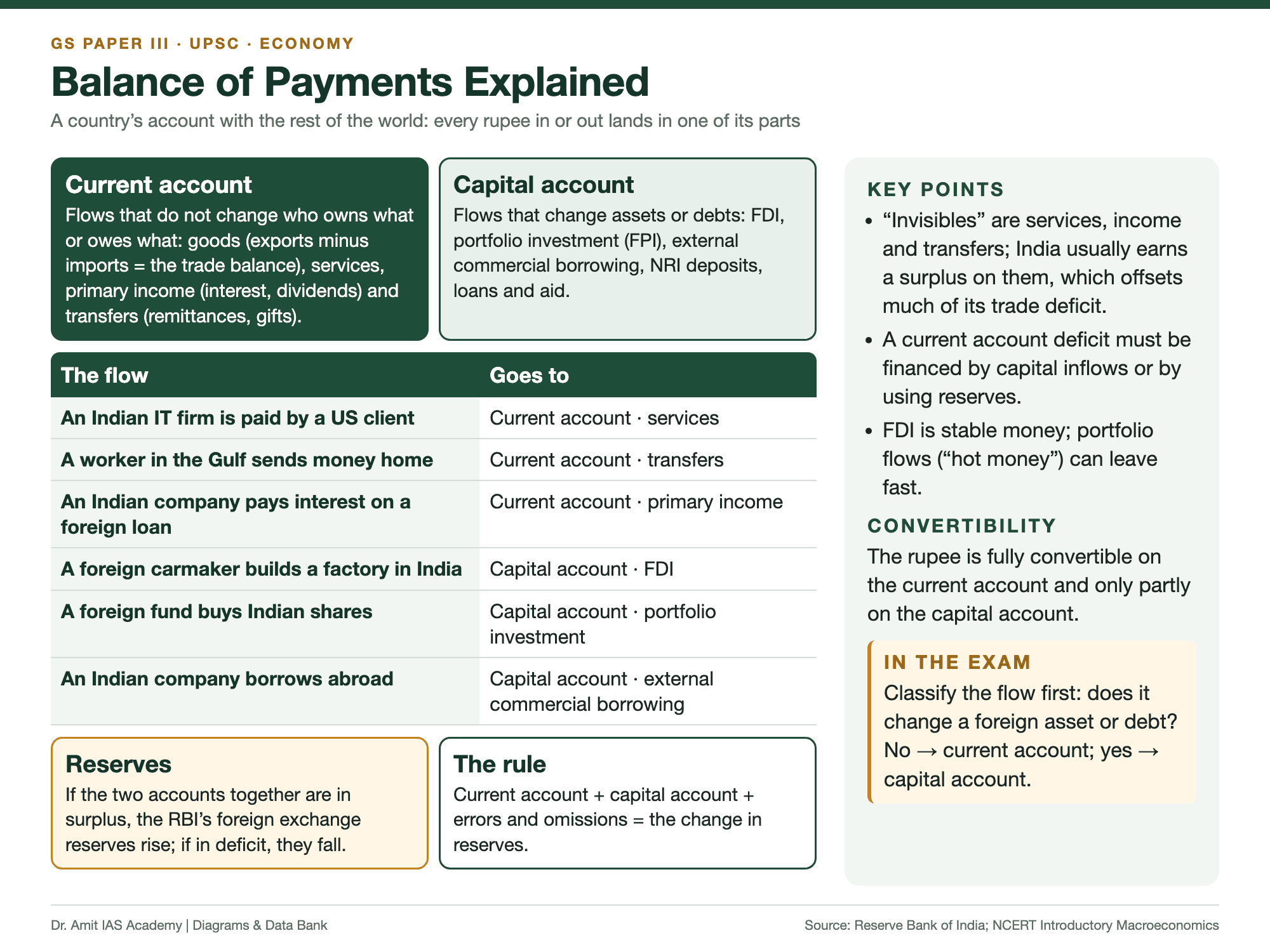
What the diagram shows
The diagram treats the balance of payments as a country's account with the rest of the world. Two boxes at the top define the two accounts. The dark green Current account box holds flows that do not change who owns or owes what; the lighter Capital account box holds flows that change assets or debts. Below them a two-column table, "The flow" and "Goes to", sorts six everyday transactions. At the bottom, a Reserves box and a box headed The rule show how the accounts close. A side panel gives key points, a note on convertibility and an "In the exam" tip.
The current account
The current account records transactions in goods, services and income. Its parts are:
- Goods: merchandise exports minus imports, which gives the trade balance.
- Services: software, travel, transport and similar earnings; the diagram's example is an Indian IT firm paid by a US client.
- Primary income: interest and dividends, such as an Indian company paying interest on a foreign loan.
- Transfers: remittances and gifts, such as a worker in the Gulf sending money home.
Services, income and transfers together are called invisibles. India's surplus on invisibles, chiefly from software exports and remittances, offsets much of its goods trade deficit.
The capital account and reserves
The capital account records flows that create or settle claims between residents and the rest of the world. A foreign carmaker building a factory in India is foreign direct investment; a foreign fund buying Indian shares is portfolio investment; an Indian company borrowing abroad is external commercial borrowing. FDI is long-term and stable, while portfolio flows, often called hot money, can leave quickly when sentiment turns.
A current account deficit has to be financed, either by net capital inflows or by drawing down reserves. If the two accounts taken together are in surplus, the foreign exchange reserves held by the Reserve Bank of India rise; if they are in deficit, the reserves fall. The diagram states the closing identity: current account plus capital account plus errors and omissions equals the change in reserves. Errors and omissions is a balancing item for unrecorded flows.
On convertibility, the rupee is fully convertible on the current account but only partly on the capital account, where limits on foreign investment and borrowing remain.
Why it matters for the exam
The balance of payments belongs to GS Paper III (Indian economy, external sector) in the UPSC Mains and to the economy section of the Prelims general studies paper; the state services of HCS, RAS, UPPCS and GPSC test it in their economy portions too. Prelims questions usually ask the candidate to place a transaction in the right account, to identify what counts as invisibles, or to say what full capital account convertibility would mean. Mains questions ask about the causes and financing of the current account deficit and the risk of volatile portfolio flows. The diagram's tip helps: first ask whether the flow changes a foreign asset or debt; if not, it is current account, if yes, capital account.
Quick revision
- Current account: goods, services, primary income and transfers; no change in ownership of assets or debts.
- Capital account: FDI, portfolio investment, ECB, NRI deposits, loans and aid.
- Invisibles are services, income and transfers; India's surplus on them offsets much of its trade deficit.
- Current account + capital account + errors and omissions = change in reserves.
- FDI is stable money; portfolio flows are hot money that can leave fast.
- The rupee is fully convertible on the current account, only partly on the capital account.