Agriculture of Uttar Pradesh
Crops by season, the sugar and potato belts, where UP leads.
What the diagram shows
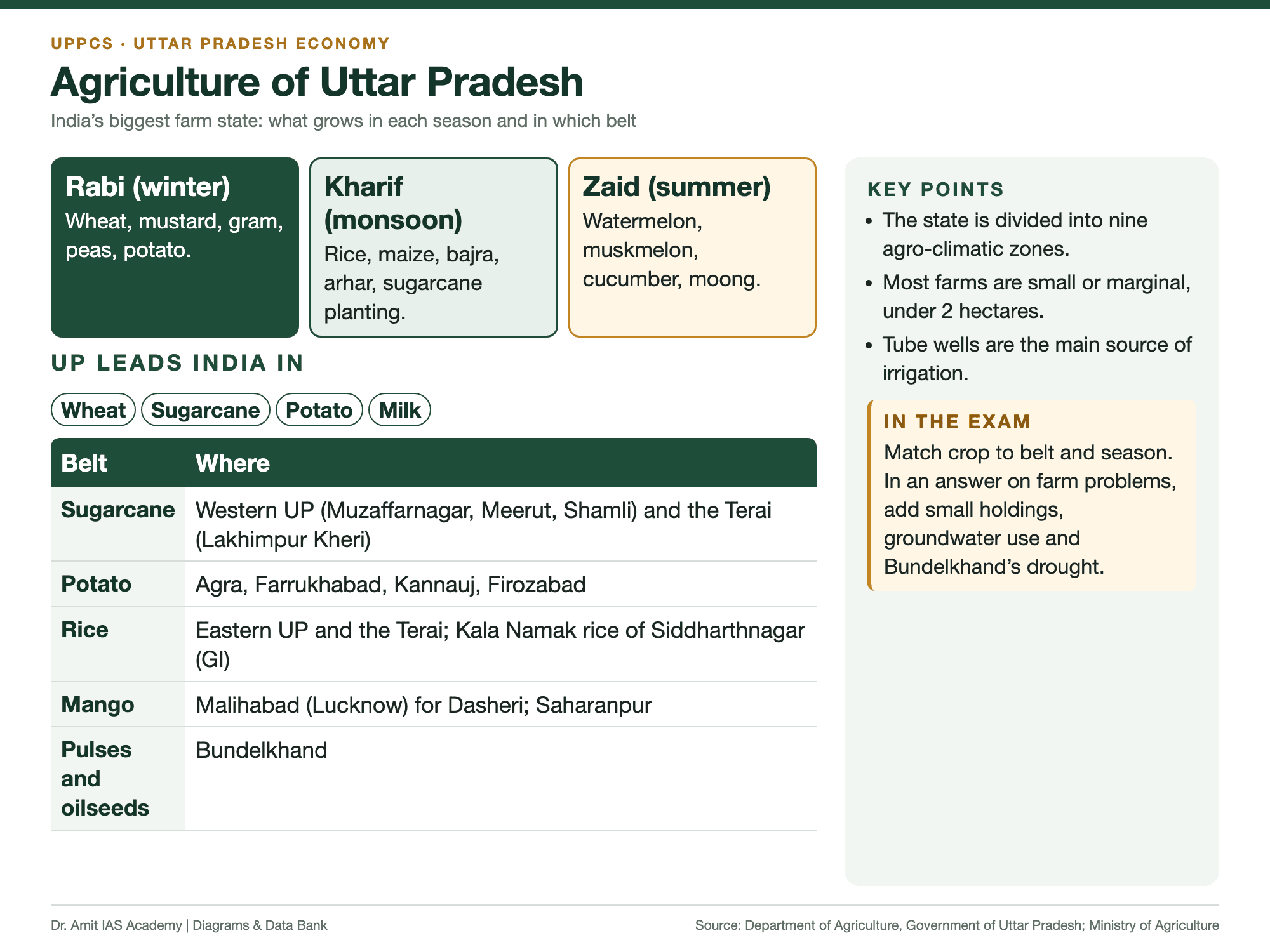
The picture describes Uttar Pradesh as India's biggest farm state and sorts its farming in three ways. Across the top, three boxes give the crop seasons: Rabi (winter) with wheat, mustard, gram, peas and potato; Kharif (monsoon) with rice, maize, bajra, arhar and sugarcane planting; and Zaid (summer) with watermelon, muskmelon, cucumber and moong. Below them, a row of four labels names what UP leads India in: wheat, sugarcane, potato and milk. A table then ties each major crop to its belt, from the sugarcane districts of the west to the pulses of Bundelkhand. A side panel lists three key points about zones, farm size and irrigation, and a short exam note suggests matching each crop to its belt and season.
Seasons and belts
UP's farming follows the plains: fertile alluvium of the Ganga, Yamuna and Ghaghra basins, a moist Terai strip along the Nepal border, and the dry, rocky Bundelkhand region in the south. The table maps crops onto this ground.
- Sugarcane: Western UP (Muzaffarnagar, Meerut, Shamli) and the Terai (Lakhimpur Kheri). Assured canal and tube-well water and a dense network of sugar mills keep cane dominant here.
- Potato: Agra, Farrukhabad, Kannauj and Firozabad, a belt across western and central UP backed by many cold storages.
- Rice: Eastern UP and the Terai, where rainfall is higher. Kala Namak rice of Siddharthnagar, an aromatic variety, carries a Geographical Indication tag.
- Mango: Malihabad near Lucknow for the Dasheri variety, and Saharanpur in the west.
- Pulses and oilseeds: Bundelkhand, where poor soils and low, uncertain rain favour hardy, less thirsty crops.
Structure of UP farming
The side panel names three features that shape every policy debate on the state's agriculture.
- Nine agro-climatic zones: the state is divided into nine zones for planning, so crop advice and research differ from the Terai to Bundelkhand.
- Small holdings: most farms are small or marginal, under 2 hectares. This limits mechanisation, investment and bargaining power, and makes farm incomes fragile.
- Tube wells: groundwater lifted by tube wells is the main source of irrigation, ahead of canals. It made the high yields of wheat and cane possible, but it also drives falling water tables in parts of the west.
UP's lead in wheat, sugarcane, potato and milk follows from its large cultivated area, alluvial soils and big farming population. Milk is on the list because dairying is a key second income for small farm households.
Why it matters for the exam
For UPPCS, this topic belongs to the economy, agriculture and geography of Uttar Pradesh, which the UP-specific General Studies papers of Mains cover and which Prelims also tests. Prelims questions usually test matching: a crop with its belt or district, a crop with its season, or a GI product with its district. Mains questions ask about the problems of UP agriculture and ways to raise farm incomes. A good answer brings in the points the diagram flags: small holdings, heavy groundwater use and Bundelkhand's recurring drought, along with regional contrasts between the west, the east and the south.
Quick revision
- Rabi: wheat, mustard, gram, peas, potato; Kharif: rice, maize, bajra, arhar; Zaid: melons, cucumber, moong.
- UP leads India in wheat, sugarcane, potato and milk.
- Sugarcane: Muzaffarnagar, Meerut, Shamli and Lakhimpur Kheri; potato: Agra, Farrukhabad, Kannauj, Firozabad.
- Kala Namak rice of Siddharthnagar has a GI tag; Malihabad is known for Dasheri mango.
- Bundelkhand grows pulses and oilseeds and faces recurring drought.
- Nine agro-climatic zones; mostly small and marginal farms; tube wells are the main irrigation source.