Agriculture and Dairy of Gujarat
Cotton, groundnut, castor and spices, Amul and the breeds.
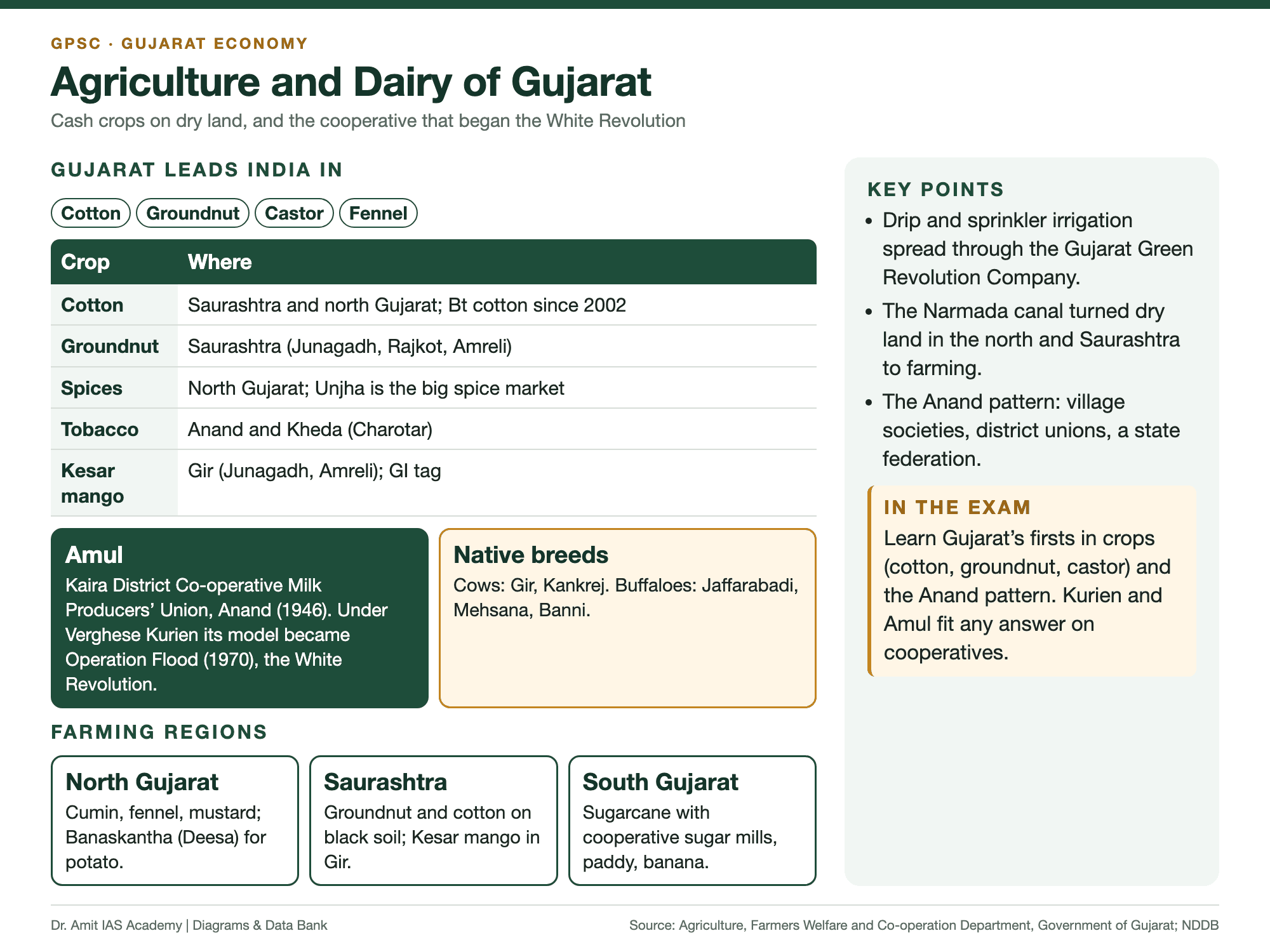
What the diagram shows
The chart opens with the four crops in which Gujarat leads the country: cotton, groundnut, castor and fennel. Below them a table pairs five crops with the places that grow them. Two boxes then cover dairy: one on Amul and the White Revolution, the other on the native cattle and buffalo breeds. The bottom row divides the state into three farming regions, North Gujarat, Saurashtra and South Gujarat. A side panel lists the key points on irrigation, the Narmada canal and the Anand pattern, with a note on how the topic appears in the exam.
Crops and where they grow
Much of Gujarat is semi-arid, so its farming leans on hardy cash crops rather than water-hungry cereals.
- Cotton: grown across Saurashtra and north Gujarat on black soil; Bt cotton has been grown since 2002, when it was approved for commercial cultivation in India.
- Groundnut: the main oilseed of Saurashtra, especially Junagadh, Rajkot and Amreli.
- Spices: cumin and fennel are grown widely in north Gujarat, and Unjha in Mehsana district is the big spice market.
- Tobacco: concentrated in the Charotar tract of Anand and Kheda.
- Kesar mango: grown around Gir in Junagadh and Amreli; it carries a Geographical Indication tag.
Castor, where Gujarat dominates national output, rounds off the list of oilseeds. Water is the binding constraint. The Gujarat Green Revolution Company spread drip and sprinkler irrigation among farmers, and the Narmada canal network brought water to dry land in the north and Saurashtra.
Three farming regions
- North Gujarat: cumin, fennel and mustard; Banaskantha, around Deesa, is known for potato.
- Saurashtra: groundnut and cotton on black soil, and Kesar mango in Gir.
- South Gujarat: the wettest part, with sugarcane processed by cooperative sugar mills, along with paddy and banana.
Amul and the dairy cooperatives
The Kaira District Co-operative Milk Producers' Union was registered at Anand in 1946 so that farmers could sell milk without depending on private traders. Under Verghese Kurien the union grew into the Amul model, and its success led to Operation Flood, launched in 1970, which made India a leading milk producer and is called the White Revolution. The Anand pattern has three tiers: village milk societies, district unions and a state federation, which in Gujarat markets the Amul brand.
Gujarat also keeps strong native breeds. The Gir and Kankrej are its cattle breeds, and the Jaffarabadi, Mehsana and Banni are its buffalo breeds.
Why it matters for the exam
For GPSC Class 1 and 2, this topic sits in the Gujarat economy and agriculture parts of the General Studies papers, and it also supports answers on cooperatives and rural development. Prelims questions usually test matching: a crop to its region, a breed to its type, a market such as Unjha to its produce, or the year Amul's union was formed. Mains questions ask why cash crops suit dry land, how micro-irrigation and the Narmada canal changed farming, or what the Anand pattern teaches about cooperatives.
Quick revision
- Gujarat leads India in cotton, groundnut, castor and fennel.
- Unjha is the major spice market; Charotar grows tobacco; Deesa is known for potato.
- Gir Kesar mango has a GI tag.
- Kaira union, Anand, 1946; Operation Flood began in 1970 under Verghese Kurien.
- Anand pattern: village society, district union, state federation.
- Cattle: Gir, Kankrej. Buffaloes: Jaffarabadi, Mehsana, Banni.