
Power of an IAS, IPS and State Civil Services Officer: Real Role, Powers and Career Ladder
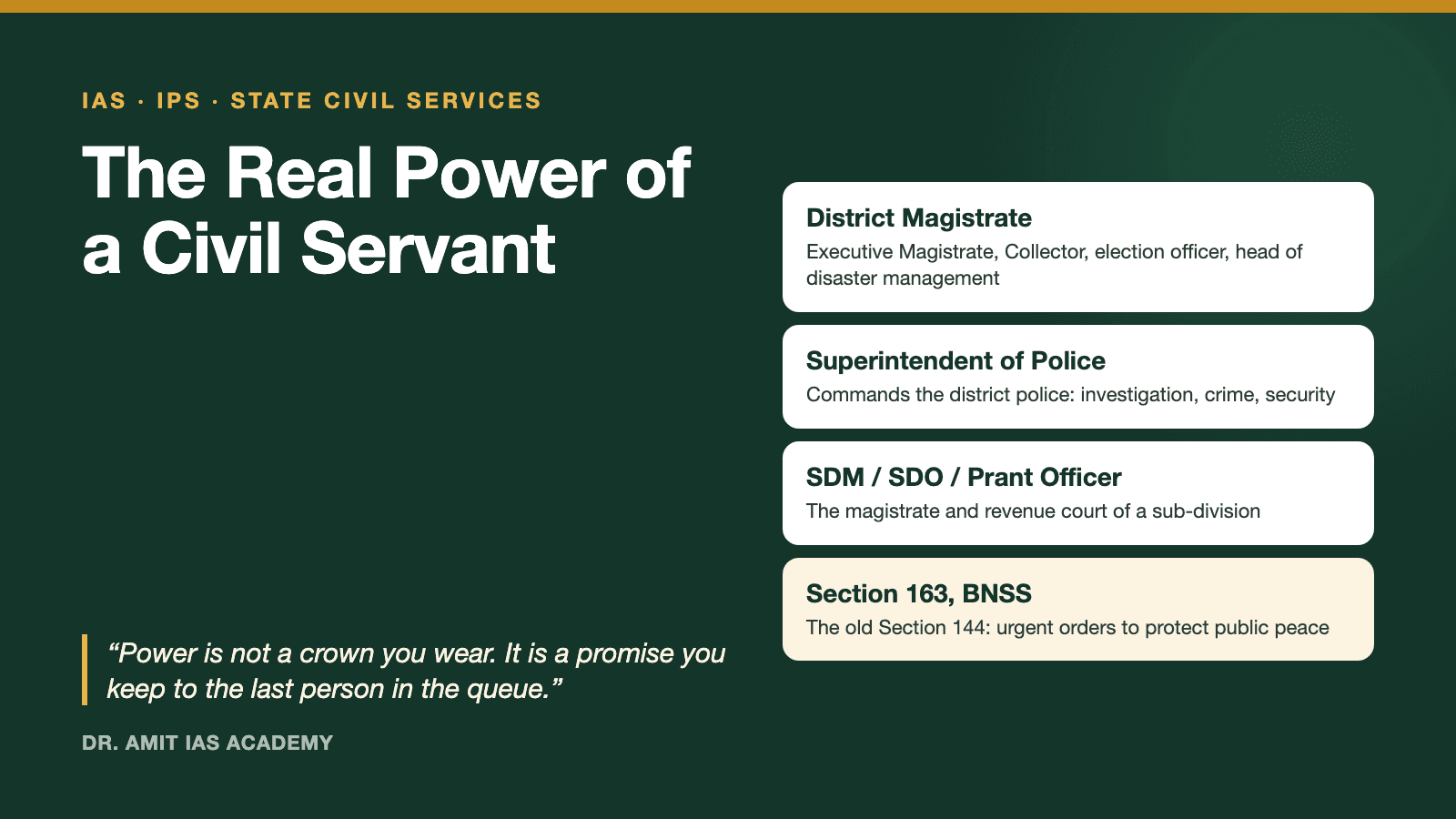
"Power in civil services is not a crown you wear. It is a promise you keep to the last person in the queue."
There is a moment many officers remember from their first posting. A woman walks into the office with a file that has been stuck for years: a pension, a land record, a ration card. She has been to every desk. The new officer reads it, makes two phone calls and signs one order. The next week, the problem that had stood still for years is solved.
That is what "power" in the civil services really looks like. Not the red light on the car, not the salute, but the ability to make the system work for someone it had forgotten.
This post explains where that power comes from, what an IAS officer, an IPS officer and a state civil services officer can actually do, and where their power ends.
Where the Power Comes From
The Constitution
- Article 312 allows Parliament to create All India Services, and the Constitution itself treats the IAS and the IPS as created by Parliament. Their recruitment and service conditions are governed by the All India Services Act, 1951 and the rules made under it.
- Article 311 protects civil servants: an officer cannot be dismissed or removed by an authority lower than the one that appointed them, and not without an inquiry and a fair chance to be heard. This protection lets officers take hard decisions without fear of losing their jobs overnight.
The laws they enforce
Most of an officer's day-to-day power comes from ordinary laws: the criminal procedure code, the land revenue laws of each state, the election laws, the disaster management law and many more. The most important of these is the Bharatiya Nagarik Suraksha Sanhita, 2023 (BNSS), which replaced the Code of Criminal Procedure (CrPC) on 1 July 2024.
The District Magistrate: The Most Powerful Chair in a District
In most districts the IAS officer posted as District Magistrate (DM), also called the Collector or Deputy Commissioner, is the head of the district administration. The DM wears several hats at once.
1. As District Magistrate: law and order
Under the BNSS, the DM is the senior-most Executive Magistrate in the district. The key powers:
| Power | BNSS section | Old CrPC section |
|---|---|---|
| Executive Magistrates for the district | 14 | 20 |
| Security for keeping the peace | 126 | 107 |
| Security for good behaviour from habitual offenders | 129 | 110 |
| Dispersal of an unlawful assembly | 148 | 129 |
| Use of the armed forces to disperse an assembly | 149 | 130 |
| Removal of a public nuisance | 152 | 133 |
| Urgent orders in cases of nuisance or apprehended danger | 163 | 144 |
| Disputes over land or water likely to breach the peace | 164 | 145 |
Section 163 is the one you see in the news. It is the old Section 144: the power to stop gatherings, close an area or ban an activity when public peace is at risk. An order under it can last up to two months, and the state government can extend it to six months.
2. As Collector: land and revenue
The DM is also the Collector, the head of the revenue administration. Land records, mutation of land, land acquisition, collection of land revenue and many land disputes run through the Collector's office and the revenue courts below it, under each state's land revenue law.
3. As District Election Officer
During elections, the DM is usually the District Election Officer, responsible for conducting free and fair elections in the district.
4. As head of disaster management
Under the Disaster Management Act, 2005, the Collector or DM chairs the District Disaster Management Authority. In a flood, an earthquake or a pandemic, the DM coordinates every department in the district.
5. As the government's face in the district
Schemes for health, education, rural development and social welfare reach the district through the DM. Much of a DM's real influence comes from coordinating departments that do not report to them, simply because the district looks to the DM to get things done.
The Superintendent of Police: Command of the District Police
The IPS officer posted as Superintendent of Police (SP) commands the police in a district: the police stations, investigations, crime control, traffic and the security of important events.
Under the old Police Act, 1861, still followed in some states, the district police work under the "general control and direction" of the District Magistrate. Many states have their own police laws now, and in big cities with a police commissionerate, a Commissioner of Police holds magisterial powers that would otherwise lie with the DM.
IAS vs IPS in one line: the IAS officer runs the administration and holds the magistrate's powers; the IPS officer leads the police force that enforces the law. In a crisis, the DM and the SP work as one team.
State Civil Services: Where Most of the Ground Work Happens
Officers recruited through state exams (HCS in Haryana, RAS in Rajasthan, UPPCS in Uttar Pradesh, GPSC in Gujarat) hold many of the same powers at a smaller scale.
- The Sub-Divisional Magistrate (SDM), called the SDO in Rajasthan and the Prant Officer in Gujarat, is an Executive Magistrate for the sub-division and uses the same BNSS sections, including Section 163.
- The SDM is also a revenue court for land disputes in the sub-division.
- A Deputy SP from the state police service leads police work in a sub-division.
- Officers such as the Tehsildar, Mamlatdar and Block Development Officer run the revenue and development work closest to the people.
And the road goes up: under the IAS (Appointment by Promotion) Regulations, 1955, a state civil service officer can be promoted to the IAS after at least eight years of service, and a state police officer to the IPS in the same way.
The Career Ladder at a Glance
| Stage | IAS | IPS | State civil services (e.g. HCS, RAS, UPPCS, GPSC) |
|---|---|---|---|
| First field post | SDM / Assistant Collector | ASP | SDM / SDO / Prant Officer, Deputy SP |
| Middle | ADM, CEO Zila Parishad, District Magistrate | SP, SSP, DIG | ADM / Additional Collector, Additional SP |
| Senior | Divisional Commissioner, Secretary, Principal Secretary | IG, ADGP | Joint or Special Secretary |
| Top | Chief Secretary; Secretary to the Government of India; Cabinet Secretary | DGP | Promotion to the IAS or IPS |
For pay at each of these levels, read IAS and IPS salary 2026, and for the state services, our guides to HCS, RAS, UPPCS and GPSC.
Where the Power Ends
Real power always comes with limits, and good officers respect them:
- The law. Every order can be challenged in court. A magistrate's order that is not reasoned and lawful does not survive.
- Elected governments. Officers carry out the policies of the elected government. They advise, they implement, but they do not decide policy.
- Transfers. An officer can be moved at short notice. Power is tied to the chair, not the person.
- Accountability. RTI, audits, inquiries, the media and the public all watch how power is used.
The officers people remember are not the ones who used the most power. They are the ones who used it most fairly.
Frequently Asked Questions
Who is more powerful, an IAS or an IPS officer?
They have different kinds of power. In a district, the DM (IAS) heads the administration and holds the magistrate's powers, while the SP (IPS) commands the police. In most districts the DM is the senior coordinating authority, but in commissionerate cities the Commissioner of Police holds magisterial powers too.
What powers does an SDM have?
An SDM is an Executive Magistrate for the sub-division, with powers under the BNSS such as Section 163 (the old Section 144) and the power to bind people to keep the peace. An SDM is also a revenue court for land disputes.
What is Section 163 of the BNSS?
Section 163 of the Bharatiya Nagarik Suraksha Sanhita, 2023 replaced Section 144 of the CrPC. It lets a District Magistrate, SDM or other empowered Executive Magistrate pass urgent orders to prevent danger to public peace, for up to two months.
Can a state civil services officer become an IAS officer?
Yes. A state civil service officer can be promoted to the IAS after at least eight years of service, under the IAS (Appointment by Promotion) Regulations, 1955.
The Chair Is Waiting
Every district in India has a chair where decisions are made that change thousands of lives. Someone will sit in it. It might as well be someone who prepared for it with honesty and purpose.
"Don't chase the power of the post. Chase the purpose of it, and the post will find you."
Start with a clear plan: read what decides your rank in UPSC, HCS, RAS, UPPCS and GPSC, and explore Dr. Amit IAS Academy's courses.