
GPSC Class 1 and Class 2 Officer: Posts, Salary, Career Ladder and Powers (2026)
"Gujarat built its name on hard work and enterprise. Bring both to your preparation, and the chair will follow."
Ask anyone in a Gujarat taluka who settles a dispute over a land record, who stands at the riverbank during a flood alert, or who signs the order that lets a farmer build on his field, and you will hear two names: the Mamlatdar and the Prant Officer. Both posts, and many more, are filled through one exam: the GPSC combined examination for Gujarat Administrative Service Class 1, Gujarat Civil Services Class 1 and Class 2, and Gujarat Municipal Chief Officer Service Class 2.
This post explains what that exam can give you: the posts, the pay, the powers and the path to the IAS.
GPSC 2026 at a Glance
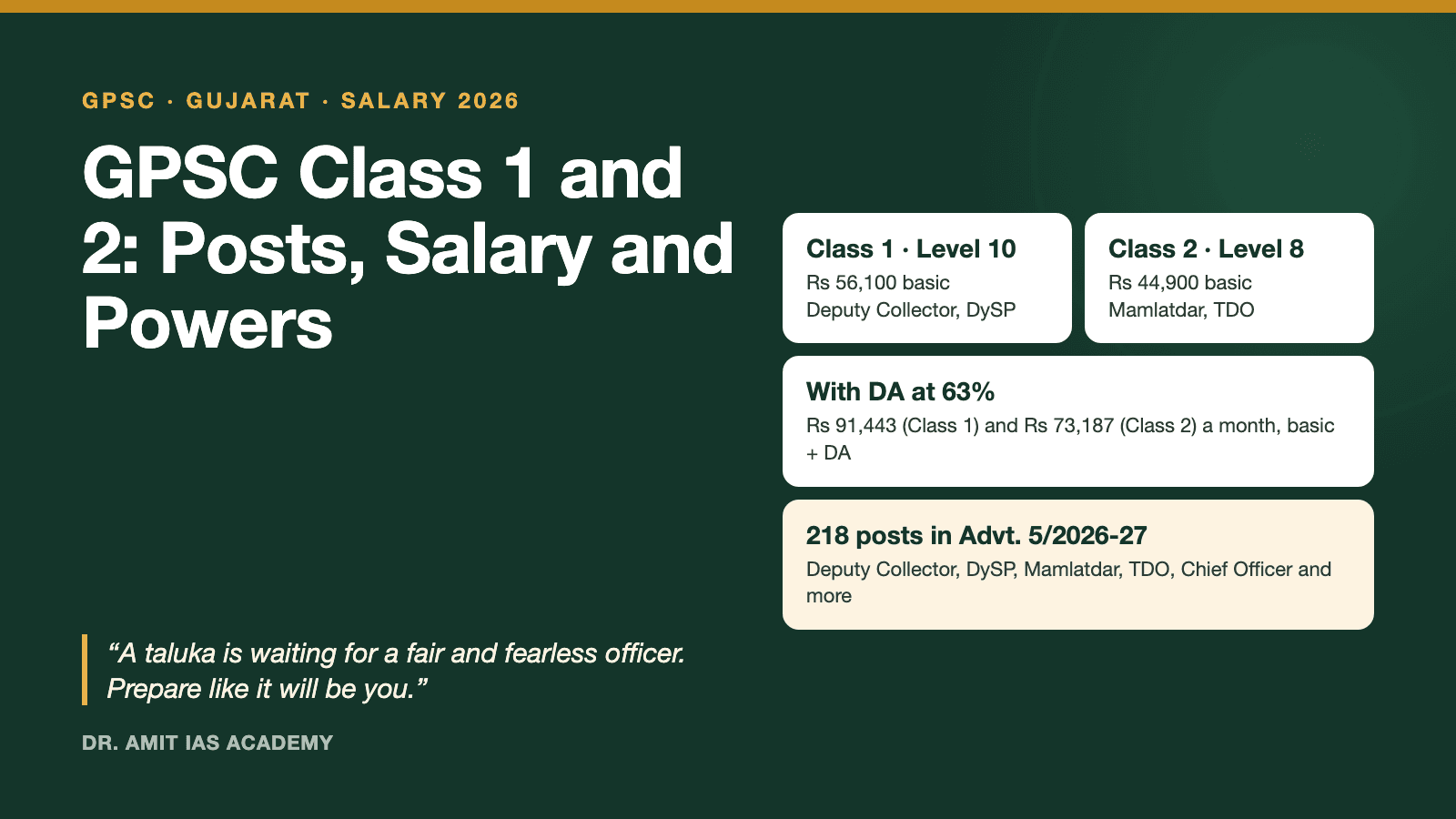
The latest cycle is Advertisement No. 5/2026-27, released on 2 April 2026. It began with 71 posts and, through addenda, grew to 218 posts. The Prelims was held on 7 June 2026. The Mains will be held after the Gujarat High Court decides petitions challenging the Prelims answer key; watch the GPSC website for the new date.
Posts You Can Get Through GPSC
Class 1 posts
- Deputy Collector (Gujarat Administrative Service, Junior Scale)
- Deputy Superintendent of Police (Unarmed)
- Deputy Commissioner, Cottage Industries
- District Registrar, Cooperative Societies
- Assistant Commissioner, Tribal Development
- Superintendent, Prohibition and Excise (Class 1)
Class 2 posts
- Taluka Development Officer (TDO)
- Mamlatdar
- Section Officer, Sachivalaya (and one in GPSC)
- Assistant Commissioner, Cottage Industries
- District Inspector of Land Records
- Government Labour Officer
- Superintendent, Prohibition and Excise
- Social Welfare Officer
- Assistant District Registrar
- Tribal Development Officer
- Assistant Director, Food and Civil Supplies
- Chief Officer, municipalities
- Assistant Director of Information
The 2026 advertisement had the most posts for TDO (30), Mamlatdar (25) and Section Officer (25), and 11 for Deputy Collector and 8 for Deputy SP. The posts change every year: the previous advertisement (No. 240/2024-25), for example, also had Assistant Commissioner of State Tax and State Tax Officer posts.
GPSC Salary in 2026
The advertisement gives the pay of both classes:
| Class | Pay level (7th Pay Commission) | Pay range | Example posts |
|---|---|---|---|
| Class 1 | Level 10 | Rs 56,100 – 1,77,500 | Deputy Collector, Deputy SP |
| Class 2 | Level 8 | Rs 44,900 – 1,42,400 | Mamlatdar, TDO, Section Officer |
Officers get the regular pay of their level from the start. Gujarat's well-known fixed-pay scheme for the first five years applies to Class 3 and Class 4 recruits, not to these Class 1 and Class 2 posts.
What a new officer earns
Gujarat raised its Dearness Allowance to 63% from 1 July 2026 (state cabinet decision of 4 November 2026).
| Item | Deputy Collector (Class 1) | Mamlatdar / TDO (Class 2) |
|---|---|---|
| Basic pay | Rs 56,100 | Rs 44,900 |
| Dearness Allowance (63%) | Rs 35,343 | Rs 28,287 |
| Basic + DA per month | Rs 91,443 | Rs 73,187 |
On top of this comes House Rent Allowance, which depends on the city of posting, unless the officer lives in a government house. Deductions such as the pension contribution and income tax bring the in-hand amount down.
Probation
New officers serve a probation of two years, which can be extended. During probation no annual increment is paid, and officers must pass the Hindi exam, pre-service training and departmental exams.
Powers of a Deputy Collector and a Mamlatdar
The Prant Officer (Deputy Collector as SDM)
A Deputy Collector's first field post is usually as Prant Officer, the head of a sub-division, who is also the Sub-Divisional Magistrate (SDM). District websites across Gujarat list each sub-division under a "Prant Officer and SDM". The Prant Officer holds revenue powers under the Gujarat Land Revenue Code, 1879, and supervises the Mamlatdars of the sub-division.
The Mamlatdar
The Mamlatdar heads the revenue administration of a taluka and is also an Executive Magistrate. Under the Mamlatdars' Courts Act, 1906, the Mamlatdar's court can decide suits about possession of land and the flow of water, when filed within six months. For land records, mutation entries and revenue collection, the Mamlatdar's office is where a citizen's work actually gets done.
Magisterial powers under the BNSS, 2023
The Bharatiya Nagarik Suraksha Sanhita, 2023 (BNSS) replaced the CrPC in July 2024. Its main provisions for Executive Magistrates are:
| Power | BNSS section | Old CrPC section |
|---|---|---|
| Executive Magistrates (including the SDM) | 14 | 20 |
| Security for keeping the peace | 126 | 107 |
| Dispersal of an unlawful assembly | 148 | 129 |
| Removal of a public nuisance | 152 | 133 |
| Urgent orders (the old Section 144) | 163 | 144 |
| Land or water disputes likely to breach the peace | 164 | 145 |
The Career Ladder: From Deputy Collector to IAS
A typical path for a Deputy Collector is:
- Prant Officer / SDM
- Senior posts such as Additional Collector or Resident Deputy Collector
- IAS by promotion
Under the IAS (Appointment by Promotion) Regulations, 1955, a State Civil Service officer can be considered for the IAS after at least eight years of continuous service as Deputy Collector or an equivalent post, and before turning 56. A Mamlatdar can also rise to Deputy Collector by promotion, and from there to the IAS.
A Deputy SP follows a similar route to the IPS under the IPS (Appointment by Promotion) Regulations, 1955.
Who Can Apply for GPSC?
From Advertisement No. 5/2026-27:
- Age: 20 to 35 years
- Education: a bachelor's degree; final-year students may apply if they have the degree by the Mains application date
- Relaxation (up to a maximum of 45 years): five years for SC, ST, SEBC and EWS candidates of Gujarat origin, ten years for women of these categories, five years for unreserved women and ten years for candidates with disabilities
How the Exam Works
| Stage | What it is | Marks |
|---|---|---|
| Prelims | General Studies, 3 hours (screening only) | 200 |
| Mains (qualifying) | Gujarati and English, 25% needed in each | 300 + 300 |
| Mains (counted) | Essay and four General Studies papers, 250 each | 1,250 |
| Interview | Personality test | 150 |
The final merit is out of 1,400. For the full syllabus see our GPSC syllabus, and for one-page notes on Gujarat's geography, history and economy, our Diagrams and Data Bank.
Frequently Asked Questions
What is the salary of a Deputy Collector in Gujarat?
A new Deputy Collector starts at Level 10, a basic pay of Rs 56,100. With DA at 63%, basic plus DA is Rs 91,443 a month, before HRA and deductions.
What is the salary of a Mamlatdar?
A Mamlatdar is a Class 2 officer at Level 8, starting at Rs 44,900. With DA at 63%, basic plus DA is Rs 73,187 a month.
Do GPSC Class 1 and Class 2 officers get fixed pay?
No. The advertisement gives regular Level 10 and Level 8 pay. Gujarat's five-year fixed-pay scheme covers Class 3 and Class 4 recruits.
What is the age limit for GPSC?
20 to 35 years under Advertisement 5/2026-27, with relaxations up to 45 years for reserved categories, women and candidates with disabilities.
Your Turn
The Mamlatdar who settles a farmer's land dispute today was a student with a borrowed book a few years ago.
"A taluka is waiting for a fair and fearless officer. Prepare like you already know it will be you."
Prepare for GPSC with a plan, Gujarat-focused material and regular tests. Explore Dr. Amit IAS Academy's courses.
Pay, DA and the posts on offer change with government orders and each year's advertisement. Figures here were checked on 16 November 2026; confirm with the latest GPSC advertisement and Gujarat government orders.