
UPPCS Officer: Posts, Salary, Career Ladder and Powers of an SDM (2026)
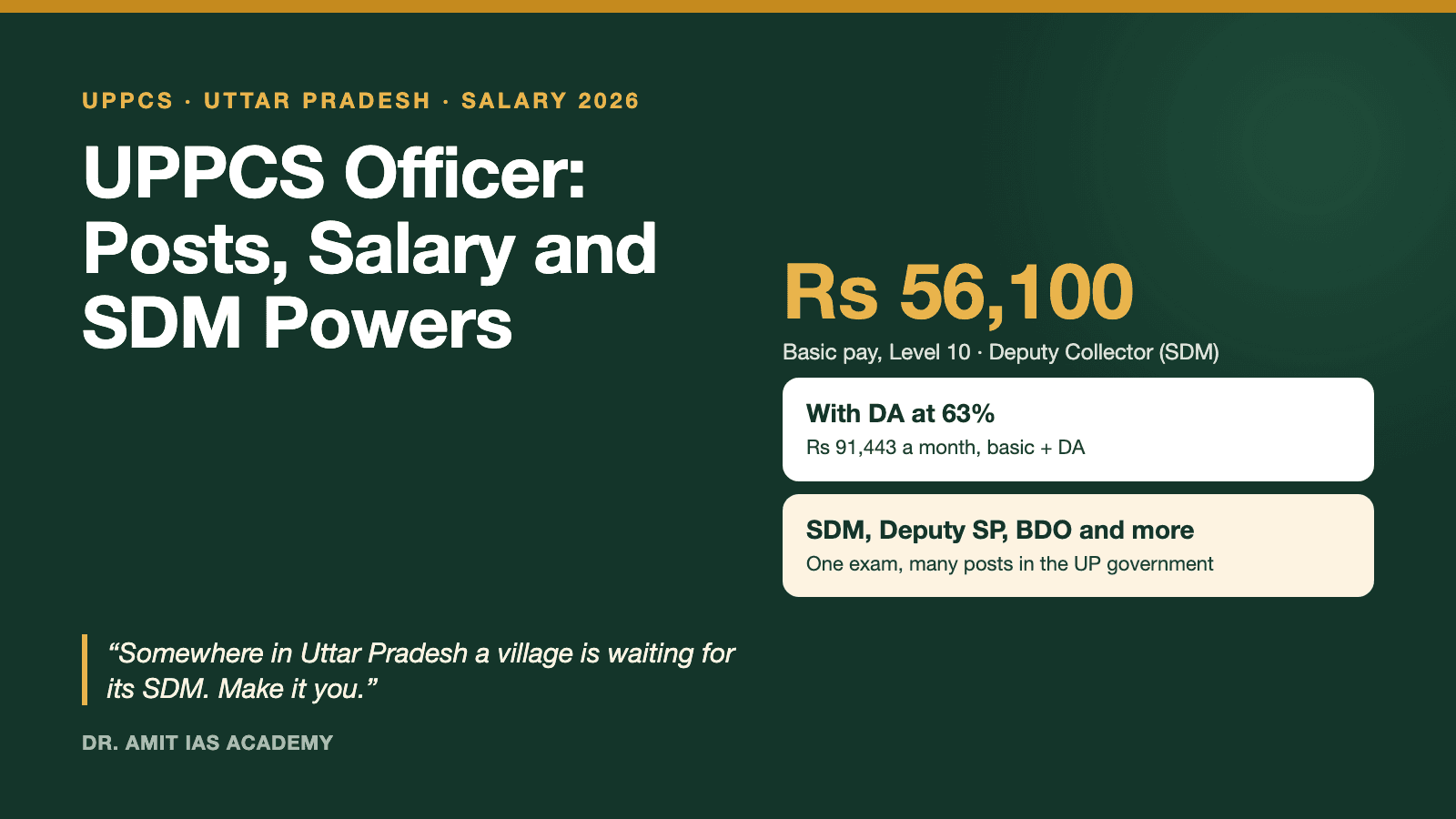
"Uttar Pradesh is home to nearly 24 crore people. Somewhere in that crowd is a village waiting for its SDM. Make it you."
Picture a monsoon night in a tehsil on the Ghaghra. The river is rising, two villages are cut off, and the phone of one officer will not stop ringing. Boats, relief camps, the police, the health team, the district headquarters: everyone is waiting for one decision. That officer is the Sub-Divisional Magistrate, and in Uttar Pradesh most SDMs reach that chair through one exam, the UPPSC Combined State/Upper Subordinate Services Examination, better known as UPPCS.
This post answers the three questions every UPPCS aspirant asks: which posts can I get, how much will I earn, and how much power will I really have?
What Is the UPPCS Exam?
The Uttar Pradesh Public Service Commission (UPPSC) holds the Combined State/Upper Subordinate Services Examination every year. One exam fills many posts in the state government, from Deputy Collector to Naib Tehsildar. The latest cycle is PCS 2026 (Advertisement No. A-1/E-1/2026, dated 25 June 2026).
Posts You Can Get Through UPPCS
The 2026 advertisement names posts such as:
- Deputy Collector (posted as Sub-Divisional Magistrate)
- Deputy Superintendent of Police (Deputy SP)
- Block Development Officer (BDO)
- Assistant Regional Transport Officer (ARTO)
- Assistant Commissioner, Commercial Tax
- Treasury Officer / Accounts Officer
- Superintendent, Jail
- District Basic Education Officer
- Naib Tehsildar
- Sub Registrar
- Excise Inspector
- Deputy Jailor
- Principal, Government Inter College
The number of posts changes every year and the commission can add posts after the advertisement, so always check the current notice on the UPPSC website.
Your post depends on your rank and your preferences. The top posts, Deputy Collector and Deputy SP, go to the highest ranks.
UPPCS Salary in 2026
The UPPCS advertisement gives the pay of its posts in the older pay band and grade pay terms, from grade pay Rs 4,200 (Naib Tehsildar) up to pay band Rs 15,600–39,100 with grade pay Rs 5,400 for the senior posts.
In the 7th Pay Commission pay matrix, grade pay 5,400 in that band is Level 10, which starts at Rs 56,100 a month and runs up to Rs 1,77,500. Deputy Collector is in this band.
What a new Deputy Collector earns
Uttar Pradesh raised its Dearness Allowance (DA) to 63% from 1 July 2026 (the state finance department's order of 7 November 2026). For a new Deputy Collector, that gives:
| Item | Amount per month |
|---|---|
| Basic pay (Level 10) | Rs 56,100 |
| Dearness Allowance at 63% | Rs 35,343 |
| Basic + DA | Rs 91,443 |
On top of this comes House Rent Allowance, which in Uttar Pradesh is a fixed amount that depends on the city and the pay, or a government house instead. Deductions such as the pension contribution (NPS, 10% of basic plus DA) and income tax bring the in-hand amount down.
DA rises about twice a year, and your basic pay rises by 3% every year with your annual increment. So the salary on your first day is the lowest it will ever be.
More than the salary
The pay is only part of the package. An SDM usually gets a government house, an official vehicle, office staff, medical cover and secure, pensionable service. More than any of these, the post comes with real responsibility for lakhs of people.
Powers of an SDM in Uttar Pradesh
An SDM is the government's chief officer in a sub-division (tehsil). They hold two kinds of power: magisterial power as an Executive Magistrate, and revenue power over land.
Magisterial powers under the BNSS, 2023
The Bharatiya Nagarik Suraksha Sanhita, 2023 (BNSS) replaced the Code of Criminal Procedure (CrPC) in July 2024. Its main provisions for an Executive Magistrate are:
| Power | BNSS section | Old CrPC section |
|---|---|---|
| Appointment of Executive Magistrates (an SDM is put in charge of a sub-division) | 14 | 20 |
| Security for keeping the peace | 126 | 107 |
| Security for good behaviour from habitual offenders | 129 | 110 |
| Dispersal of an unlawful assembly | 148 | 129 |
| Removal of a public nuisance | 152 | 133 |
| Urgent orders in cases of nuisance or apprehended danger | 163 | 144 |
| Disputes over land or water likely to cause a breach of the peace | 164 | 145 |
The best-known of these is Section 163 (the old Section 144): the power to stop gatherings, close an area or ban an activity when public peace is in danger.
Revenue powers under the UP Revenue Code, 2006
The SDM is also a revenue court. Under the Uttar Pradesh Revenue Code, 2006, an SDM decides boundary disputes between landholders (Section 24), and hears many other land cases. For a farmer, the SDM's court is often the place where a dispute over a field is finally settled.
And everything else
On a normal day an SDM may also be running an election as an Electoral Registration Officer, inspecting a hospital, clearing encroachments, checking ration distribution and handling a flood or a law-and-order situation, all before evening.
The Career Ladder: From SDM to IAS
A UPPCS officer does not stay an SDM. A typical path for a Deputy Collector is:
- SDM (Sub-Divisional Magistrate) in a tehsil
- City Magistrate or Additional District Magistrate (ADM)
- Special Secretary and similar posts in the state government
- IAS by promotion
Under the IAS (Appointment by Promotion) Regulations, 1955, a State Civil Service officer becomes eligible for promotion to the IAS after at least eight years of continuous service. In practice it takes longer in Uttar Pradesh: in July 2026, 29 PCS officers, mostly of the 2010 to 2012 batches, were promoted to the IAS.
A Deputy SP follows the same route to the IPS under the IPS (Appointment by Promotion) Regulations, 1955.
Who Can Apply?
From the 2026 advertisement:
- Age: 21 to 40 years (counted on 1 July 2026)
- Education: a bachelor's degree from a recognised university
- Relaxation: five years for SC, ST and OBC candidates of Uttar Pradesh, and more for some other categories, as the notice lists
How the Exam Works
| Stage | What it is | Marks |
|---|---|---|
| Prelims | GS Paper I (counted for screening) and GS Paper II (qualifying at 33%) | 200 + 200 |
| Mains | General Hindi, Essay, and six GS papers of 200 marks (GS V and VI are on Uttar Pradesh) | 1,500 |
| Interview | Personality test | 100 |
Two of the six GS papers are only about Uttar Pradesh: that is 400 Mains marks for UP knowledge alone. For the full syllabus, see our UPPCS syllabus, and for the strategy, read what decides your rank in UPSC, HCS, RAS, UPPCS and GPSC.
Frequently Asked Questions
What is the salary of an SDM in UP?
A new Deputy Collector (SDM) starts at Level 10, a basic pay of Rs 56,100. With DA at 63% (from 1 July 2026), basic plus DA is Rs 91,443 a month, before HRA and deductions.
Which is the highest post in UPPCS?
Deputy Collector (SDM) is the most sought-after post, along with Deputy SP. Both go to the top ranks.
Can a UPPCS officer become an IAS officer?
Yes. A State Civil Service officer becomes eligible for promotion to the IAS after at least eight years of service; in Uttar Pradesh the wait has usually been longer.
Is UPPCS easier than UPSC?
It is different, not easy. UPPCS has a large Uttar Pradesh component and counts General Hindi and the essay in the merit, so it needs its own preparation on top of the common UPSC base.
Start Your Journey
The SDM's chair in a flood-hit tehsil is not given; it is earned, one answer and one revision at a time.
"Your name on the UPPSC merit list starts with the page you read today."
Prepare with a plan, tests and answer evaluation built for Uttar Pradesh. Explore Dr. Amit IAS Academy's courses.
Pay, DA and the posts on offer change with government orders and each year's notice. Figures here were checked on 16 November 2026; confirm with the latest official order and the UPPSC advertisement.