
UPSC, HCS, RAS, UPPCS and GPSC Preparation Strategy: What Decides Your Rank in Each Exam
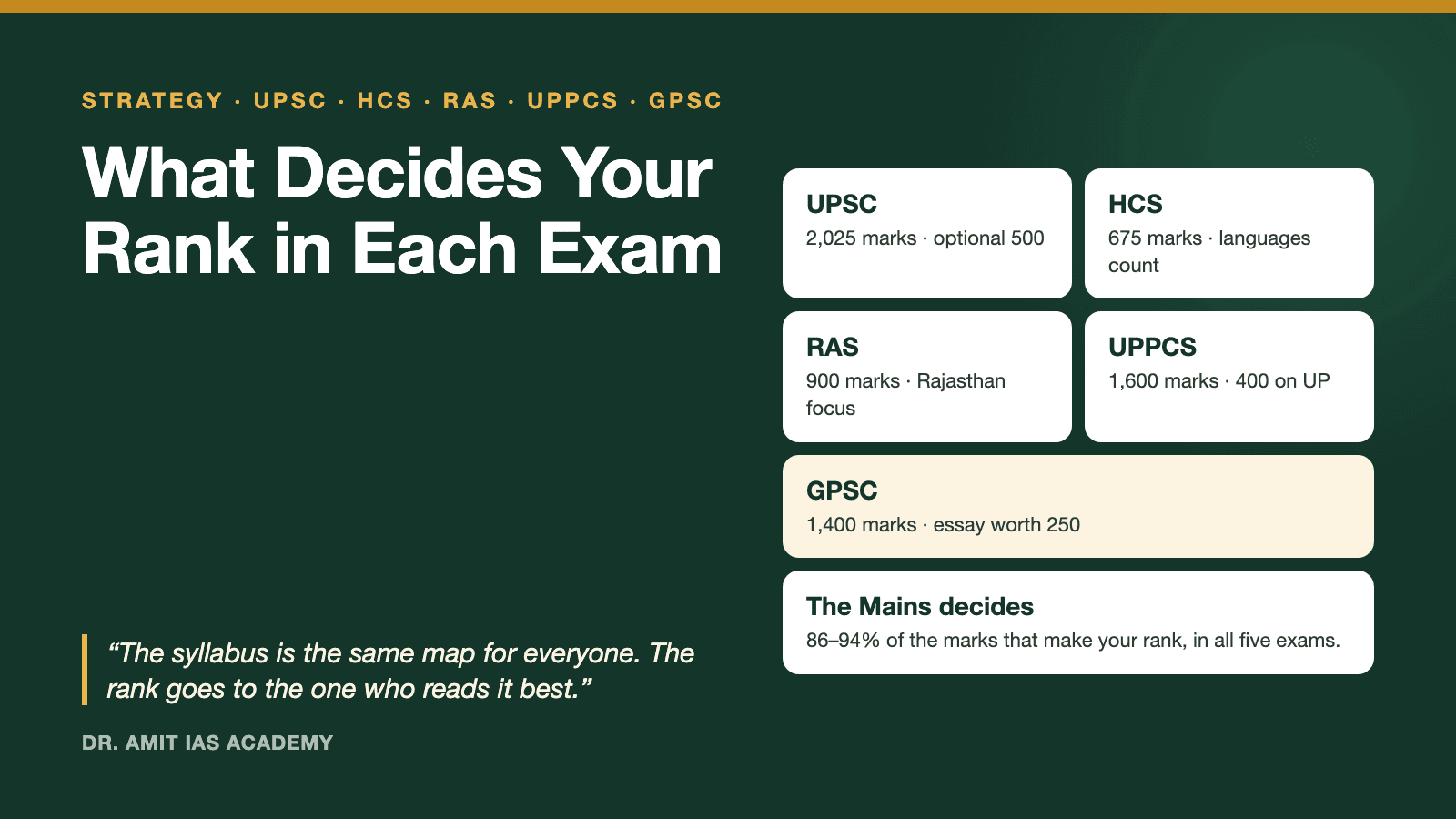
"The syllabus is the same map for everyone. The rank goes to the one who reads it best."
Every year lakhs of aspirants open the same books: Laxmikanth, Spectrum, the NCERTs. Yet only a few thousand reach the final list of UPSC or a state commission. The books are rarely the difference. What separates them is that toppers understand how their exam gives marks, and they put their hours exactly there.
This post looks at the five exams our students write most (the UPSC Civil Services Examination, HCS in Haryana, RAS in Rajasthan, UPPCS in Uttar Pradesh and GPSC in Gujarat) through one question: what actually decides your rank in each one? Then it turns the answer into a plan you can follow for a year.
If you want the full official syllabus of each exam, paper by paper, read our UPSC, HCS, RAS, GPSC and UPPCS syllabus and exam pattern first. This post is about strategy.
The Five Exams at a Glance
All five follow the same three steps: a Prelims that only screens you, a written Mains that decides most of your rank, and an interview. The marks are very different, though.
| Exam | Prelims | Mains marks counted | Interview | Total for merit | Optional subject |
|---|---|---|---|---|---|
| UPSC CSE | 2 papers (GS + CSAT, qualifying) | 1,750 | 275 | 2,025 | Yes, 500 marks |
| HCS | 2 papers (GS + CSAT, qualifying) | 600 | 75 | 675 | No |
| RAS | 1 paper, 200 marks | 800 | 100 | 900 | No |
| UPPCS | 2 papers (GS + CSAT, qualifying) | 1,500 | 100 | 1,600 | No |
| GPSC | 1 paper, 200 marks | 1,250 | 150 | 1,400 | No |
Based on each commission's latest scheme as checked on 11 November 2026. Always confirm with the current official notice.
Three things jump out of this table, and each one changes how you should prepare.
1. The Mains Decides Your Rank, Everywhere
In every one of the five exams, the Prelims marks do not count in the final merit. They only decide who writes the Mains. The Mains carries between 86% and 94% of the marks that make your rank.
So the biggest mistake an aspirant can make is to treat the Prelims as the "real" exam and start answer writing only after clearing it. By then you have a few months to learn a skill that takes a year to build. Start writing answers from your first month, even if it is one answer a day.
2. Language Papers Count in Three of the Five Exams
This is the point most aspirants miss.
- In UPSC CSE and GPSC, the language papers are only qualifying. You must pass them (25% in each) but the marks are not added to your total.
- In HCS, the English and Hindi papers are worth 100 marks each, and both count. You also need 33% in each to reach the interview.
- In RAS, Paper IV (General Hindi, General English and an essay) is worth 200 marks, the same as a GS paper.
- In UPPCS, General Hindi (150) and the Essay (150) both count, and Hindi has a minimum mark.
For an HCS aspirant, the two language papers are almost a third of the written marks. Grammar, precis and essay practice is not a side task there. It is a rank-maker.
3. Only UPSC Still Has an Optional
HCS dropped its optional subject under the Haryana amendment of December 2025. RAS, UPPCS and GPSC have none either. That has two effects:
- For state exams, your rank depends almost entirely on General Studies, state knowledge, language and essay. There is no "scoring optional" to rescue a weak GS paper.
- For UPSC, the optional is 500 of 1,750 written marks. Choose it early, and choose it by your interest and your graduation background, not by last year's toppers' list.
What Decides Your Rank: Exam by Exam
UPSC CSE: depth, the optional and the essay
UPSC rewards understanding over memory. GS papers ask you to analyse, not list. The optional, the essay (250) and Ethics (GS IV) together are more than half of the written marks. A candidate with average GS but a strong optional and essay often finishes higher than one with good GS and a weak optional.
Focus: a well-chosen optional, regular essay practice, and GS answers built on examples, data and committee reports.
HCS: small paper sizes, so every mark counts
Each HCS GS paper is worth only 100 marks, and the whole written exam is 600. That makes each answer heavier: a single weak answer moves your rank more than it would in UPSC. The Haryana-specific questions in GS (its history, geography, economy and schemes) are also where most candidates lose easy marks.
Focus: Haryana general knowledge in a separate notebook, the English and Hindi papers, and short, precise answers.
RAS: Rajasthan everywhere, and a detailed syllabus
The RAS syllabus is the most detailed of the five. It names institutions, schemes and topics one by one, and four of the Prelims headings are about Rajasthan alone. The single Prelims paper also includes reasoning and mental ability, which count towards your screening score.
Focus: Rajasthan history, art, culture, geography and economy studied from state sources; the syllabus used as a checklist line by line; Hindi and English grammar for Paper IV.
UPPCS: six GS papers and Hindi
UPPCS Mains has six GS papers of 200 marks each, two of them (GS V and GS VI) only on Uttar Pradesh. That is 400 marks for UP knowledge alone. The interview is just 100 of 1,600 marks, about 6%, the lowest weight of the five. Your written score decides almost everything.
Focus: UP-specific papers prepared like a full subject, General Hindi practice, and steady writing speed for eight three-hour papers.
GPSC: an essay worth 250 marks
GPSC Mains has an Essay paper and four GS papers of 250 marks each, and an interview worth 150. The Gujarati and English papers are qualifying, but they include a multiple-choice grammar part with negative marking, so do not take them lightly.
Focus: Gujarat's history, economy and geography, essay writing, and enough Gujarati to clear the language paper with ease.
The Common Core: One Base for All Five
Here is the good news. Most of what you study is common to all five exams: Indian Polity, Modern History, Indian and World Geography, the Indian Economy, Environment, Science and Technology, Ethics and current affairs. Build this core once, and you only need to add a state layer for each state exam.
| Layer | What it covers | Where it helps |
|---|---|---|
| Common core | Polity, History, Geography, Economy, Environment, Science, Ethics | All five exams |
| National depth | Optional subject, international relations, internal security | UPSC mainly |
| State layer | State history, geography, economy, schemes, art and culture | HCS, RAS, UPPCS, GPSC |
| Language | Hindi, English, Gujarati, essay | HCS, RAS, UPPCS (counted); UPSC, GPSC (qualifying) |
Our Diagrams and Data Bank has one-page visual notes for both layers, from Indian polity to the geography and history of Haryana, Rajasthan, UP and Gujarat.
A 12-Month Plan That Works for Any of the Five
Months 1 to 3: Build the base. Read NCERTs from Class 6 to 12 for history, geography, polity and economy. Start one standard book per subject. Read a newspaper daily, and from week two write one short answer a day.
Months 4 to 6: Go deeper and add your state. Finish the standard books. Start your state layer: one state topic for every national topic you study. If you are writing UPSC, start your optional now.
Months 7 to 9: Practise for the Prelims. Solve the last ten years' previous year questions of your exam, subject by subject. Take a full mock test every week. Keep writing two Mains answers a day.
Months 10 to 12: Revise and test. Revise from your own short notes, not from new books. Take full-length mocks for both Prelims and Mains, and work on the language papers if they count in your exam.
Keep current affairs running through all twelve months. Our daily current affairs is written for exactly this: national news with the state angle where it matters.
Five Mistakes That Cost Aspirants Their Rank
- Starting answer writing after the Prelims. The Mains decides your rank; train for it from day one.
- Collecting books instead of revising them. One book read five times beats five books read once.
- Ignoring the language papers. In HCS, RAS and UPPCS they carry real marks.
- Treating state GK as a last-month task. In UPPCS alone it is worth 400 Mains marks.
- Skipping previous year papers. They are the clearest signal of what the commission actually asks.
Frequently Asked Questions
Can I prepare for UPSC and a state PCS exam at the same time?
Yes, and most serious aspirants do. The common core is the same. Add your state layer and the language practice your state exam needs, and plan your revision around both exam calendars.
Which is the easiest of the five exams?
None of them is easy; they are different. State exams have fewer candidates but also far fewer posts. Choose by where you want to serve, and prepare with the same seriousness.
How many hours a day should I study?
Six to eight focused hours are enough for most aspirants. Consistency over a full year matters far more than fourteen-hour days that last two weeks.
Do I need coaching?
Not necessarily. You do need a clear plan, good material, answer evaluation and regular tests. Coaching helps most with the last two.
Your Next Step
Strategy only works when you start. Pick your exam, open its syllabus, and write your first answer today.
"The officer you want to become is built in the hours nobody sees. Start today."
If you want a structured plan with tests and answer evaluation for UPSC, HCS or any of these state exams, explore Dr. Amit IAS Academy's courses.