Monuments and Sculpture of Uttar Pradesh
From the Sarnath capital and Gupta temples to the Taj Mahal.
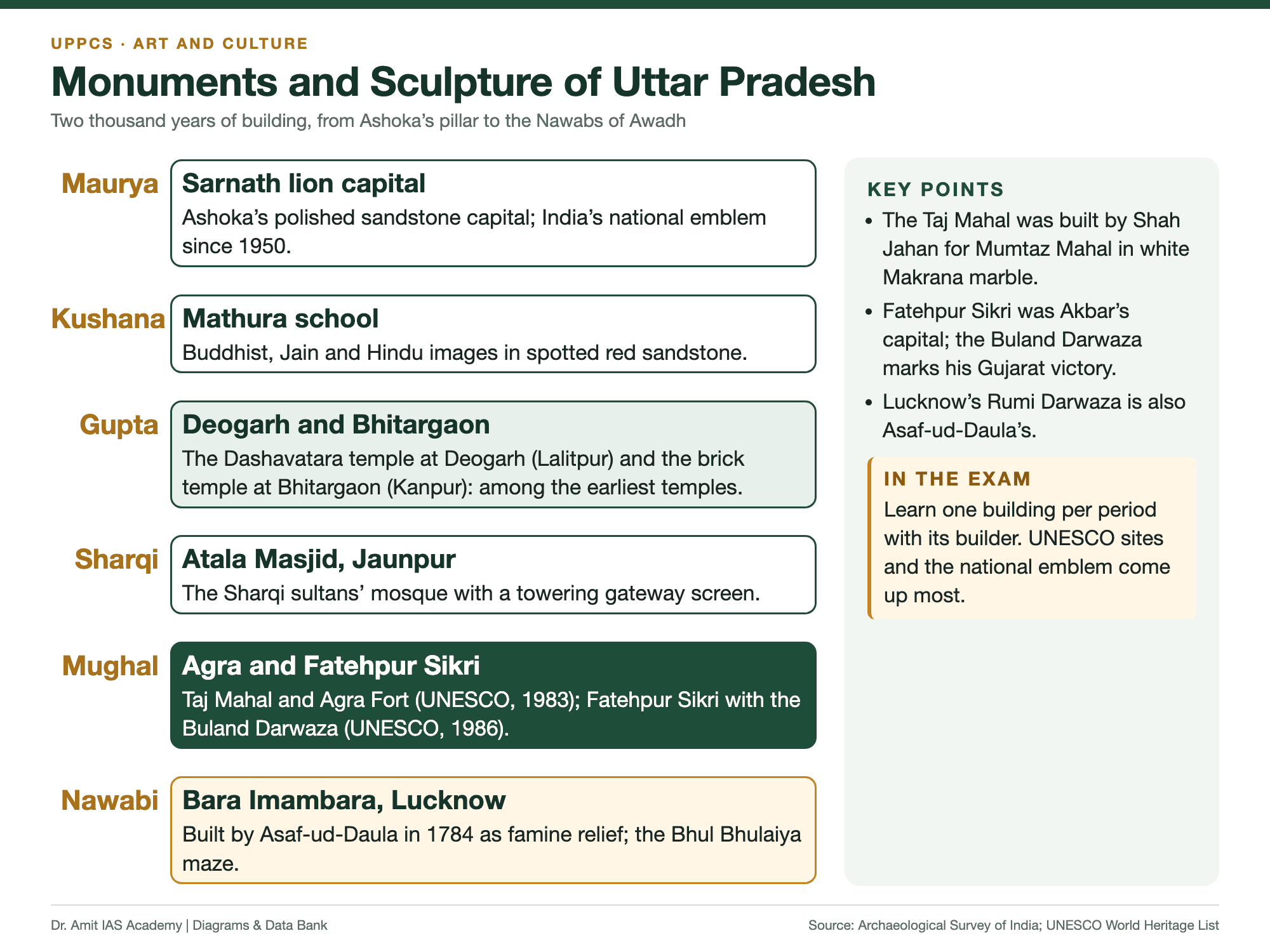
What the diagram shows
The chart runs down the page as a timeline of six periods, each with the buildings or school that stand for it. At the top is the Maurya period and the Sarnath lion capital; below it come the Kushana Mathura school, the Gupta temples of Deogarh and Bhitargaon, the Sharqi Atala Masjid at Jaunpur, the Mughal monuments of Agra and Fatehpur Sikri, and finally the Nawabi Bara Imambara of Lucknow. A side panel lists key points on the Taj Mahal, Fatehpur Sikri and Lucknow, and a note on what the exam tends to ask.
Ancient sculpture and early temples
- Sarnath lion capital (Maurya): carved for Ashoka in polished sandstone, with four lions seated back to back above an abacus bearing a wheel and animal figures. It was adopted as India's national emblem in 1950.
- Mathura school (Kushana): an indigenous school that produced Buddhist, Jain and Hindu images in the spotted red sandstone of the region. It is counted among the earliest schools to show the Buddha in human form, alongside Gandhara.
- Deogarh (Gupta): the Dashavatara temple in Lalitpur district, dedicated to Vishnu, is an early stone temple with fine panels such as Vishnu reclining on the serpent Shesha.
- Bhitargaon (Gupta): a brick temple in Kanpur district, valued as one of the oldest surviving brick temples, decorated with terracotta panels.
Sultanate and Mughal architecture
The Sharqi sultans of Jaunpur built a regional style of their own. The Atala Masjid is its best-known example, marked by a massive gateway screen in front of the prayer hall.
The Mughals left the state its most famous buildings:
- Taj Mahal: built by Shah Jahan as a tomb for Mumtaz Mahal in white Makrana marble.
- Agra Fort: listed with the Taj Mahal as a UNESCO World Heritage Site in 1983.
- Fatehpur Sikri: Akbar's capital city, a UNESCO site since 1986. Its Buland Darwaza commemorates his victory in Gujarat.
The Nawabs of Awadh
In Lucknow, Nawab Asaf-ud-Daula began the Bara Imambara in 1784, partly as a famine-relief work that gave employment to people. Its maze of passages is known as the Bhul Bhulaiya. The nearby Rumi Darwaza is also his work.
Why it matters for the exam
UPPCS Mains has General Studies papers specific to Uttar Pradesh that cover the history, culture and heritage of the state, and Prelims regularly asks about it too; Indian art and architecture is also in General Studies Paper I of Mains. Prelims questions usually ask the reader to match a monument with its builder, period or district, to identify the material of a sculpture school, or to pick out the UNESCO sites in the state. Mains questions can ask for a short note on the Mathura school, the features of Gupta temples or the contribution of the Nawabs of Awadh. Learning one building per period, together with its builder, gives a framework that answers most of these.
Quick revision
- Sarnath lion capital: Ashoka, polished sandstone, national emblem since 1950.
- Mathura school: Kushana period, spotted red sandstone, Buddhist, Jain and Hindu images.
- Gupta temples: Dashavatara temple at Deogarh (Lalitpur) and brick temple at Bhitargaon (Kanpur).
- Atala Masjid, Jaunpur: Sharqi sultans, with a towering gateway screen.
- UNESCO sites: Taj Mahal and Agra Fort (1983), Fatehpur Sikri (1986).
- Bara Imambara and Rumi Darwaza, Lucknow: Asaf-ud-Daula; the Imambara was begun in 1784 as famine relief.