Uttar Pradesh in the Freedom Struggle
1857, Chauri Chaura, Kakori, Ballia and the making of UP.
What the diagram shows
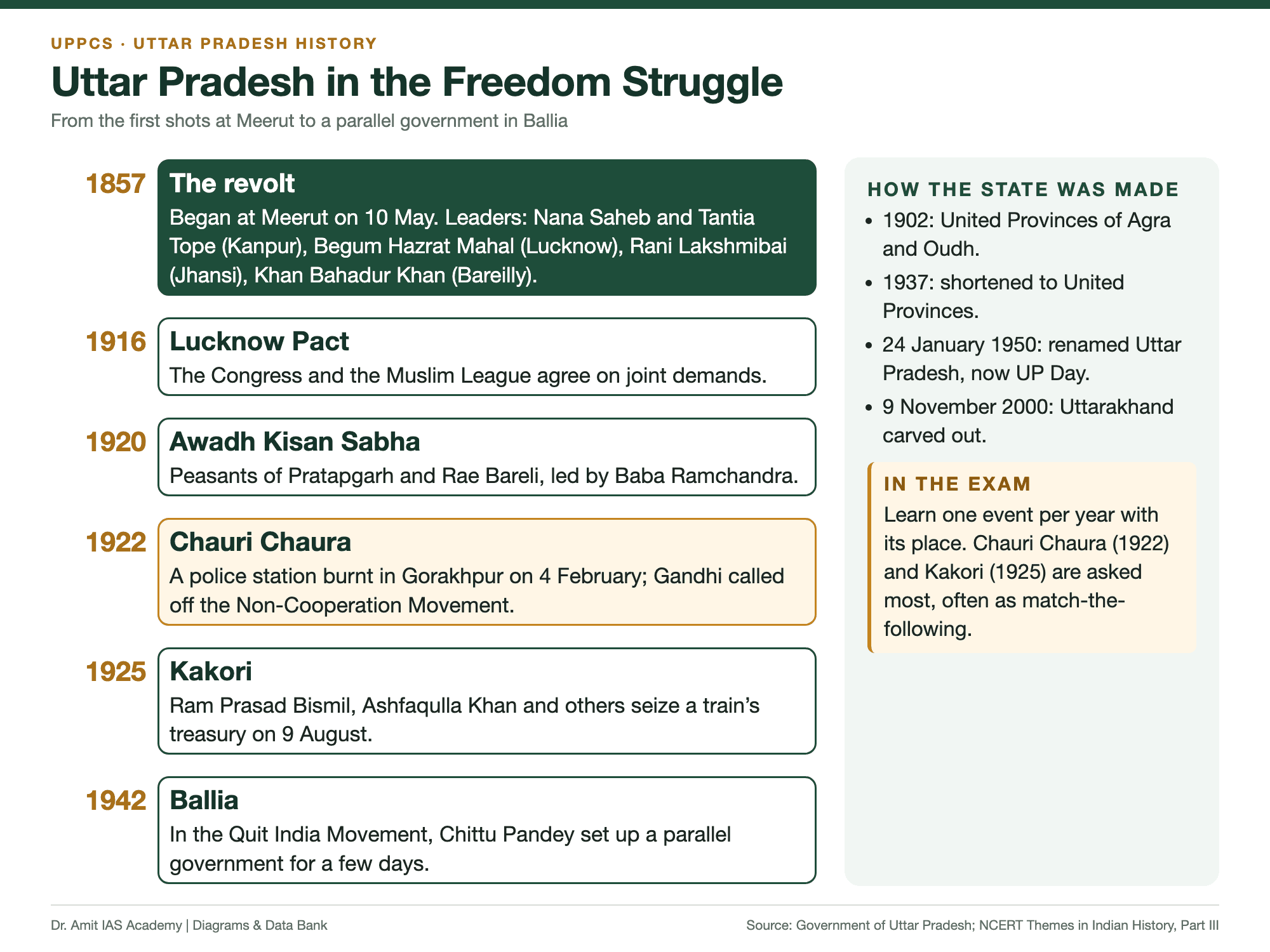
The diagram is a vertical timeline of six turning points in the freedom struggle that took place in what is now Uttar Pradesh, running from the first shots at Meerut to a parallel government in Ballia. Each year sits on the left beside a box naming the event and its key fact. The 1857 revolt is shaded dark as the starting point, and Chauri Chaura is highlighted because it changed the course of a national movement. A side panel, headed "How the state was made", traces the administrative story of the province from 1902 to 2000, and a note below it says that Chauri Chaura and Kakori are the events most often asked, usually as match-the-following.
From revolt to mass movement
- 1857, the revolt: it began at Meerut on 10 May. The region produced many of its leaders: Nana Saheb and Tantia Tope at Kanpur, Begum Hazrat Mahal at Lucknow, Rani Lakshmibai at Jhansi and Khan Bahadur Khan at Bareilly.
- 1916, Lucknow Pact: the Indian National Congress and the Muslim League agreed on joint constitutional demands, a rare moment of Hindu-Muslim political unity.
- 1920, Awadh Kisan Sabha: peasants of Pratapgarh and Rae Bareli organised against the exactions of taluqdars and landlords under Baba Ramchandra, linking agrarian grievances to the national movement.
Turning points of the Gandhian and revolutionary phases
- 1922, Chauri Chaura: on 4 February a crowd set fire to the police station at Chauri Chaura in Gorakhpur district, killing a number of policemen. Gandhi, holding that the movement had turned violent, called off the Non-Cooperation Movement.
- 1925, Kakori: on 9 August revolutionaries of the Hindustan Republican Association, among them Ram Prasad Bismil and Ashfaqulla Khan, seized government treasury money from a train near Kakori, close to Lucknow. The trial that followed ended with death sentences for Bismil, Ashfaqulla and others.
- 1942, Ballia: during the Quit India Movement, Chittu Pandey set up a parallel government in Ballia that held power for a few days before British control was restored.
How the state was made
The side panel explains the name and shape of the state. In 1902 the region became the United Provinces of Agra and Oudh. In 1937 the name was shortened to the United Provinces. On 24 January 1950 it was renamed Uttar Pradesh, and that date is now celebrated as UP Day. On 9 November 2000 the hill districts were carved out to form a new state, then called Uttaranchal and now Uttarakhand.
Why it matters for the exam
For UPPCS, this topic falls in General Studies Paper I (history and the national movement) and in the Mains General Studies papers on Uttar Pradesh, which cover the state's history and its role in the freedom struggle. Prelims questions usually test the pairing of an event with its year and place, or a leader with the centre of 1857 he or she led. Mains questions ask about the significance of events such as Chauri Chaura or Kakori, peasant movements in Awadh, or the contribution of Uttar Pradesh to the national movement as a whole.
Quick revision
- 1857 revolt began at Meerut on 10 May; Lucknow was led by Begum Hazrat Mahal.
- Lucknow Pact, 1916: Congress and Muslim League agree on joint demands.
- Awadh Kisan Sabha, 1920: Pratapgarh and Rae Bareli peasants under Baba Ramchandra.
- Chauri Chaura, 4 February 1922, Gorakhpur: Non-Cooperation Movement withdrawn.
- Kakori, 9 August 1925: Bismil and Ashfaqulla; Ballia, 1942: Chittu Pandey's parallel government.
- United Provinces of Agra and Oudh (1902), United Provinces (1937), Uttar Pradesh (24 January 1950).