Schools of Rajasthani Painting
Mewar, Marwar, Dhundhar and Hadoti, and each one’s best work.
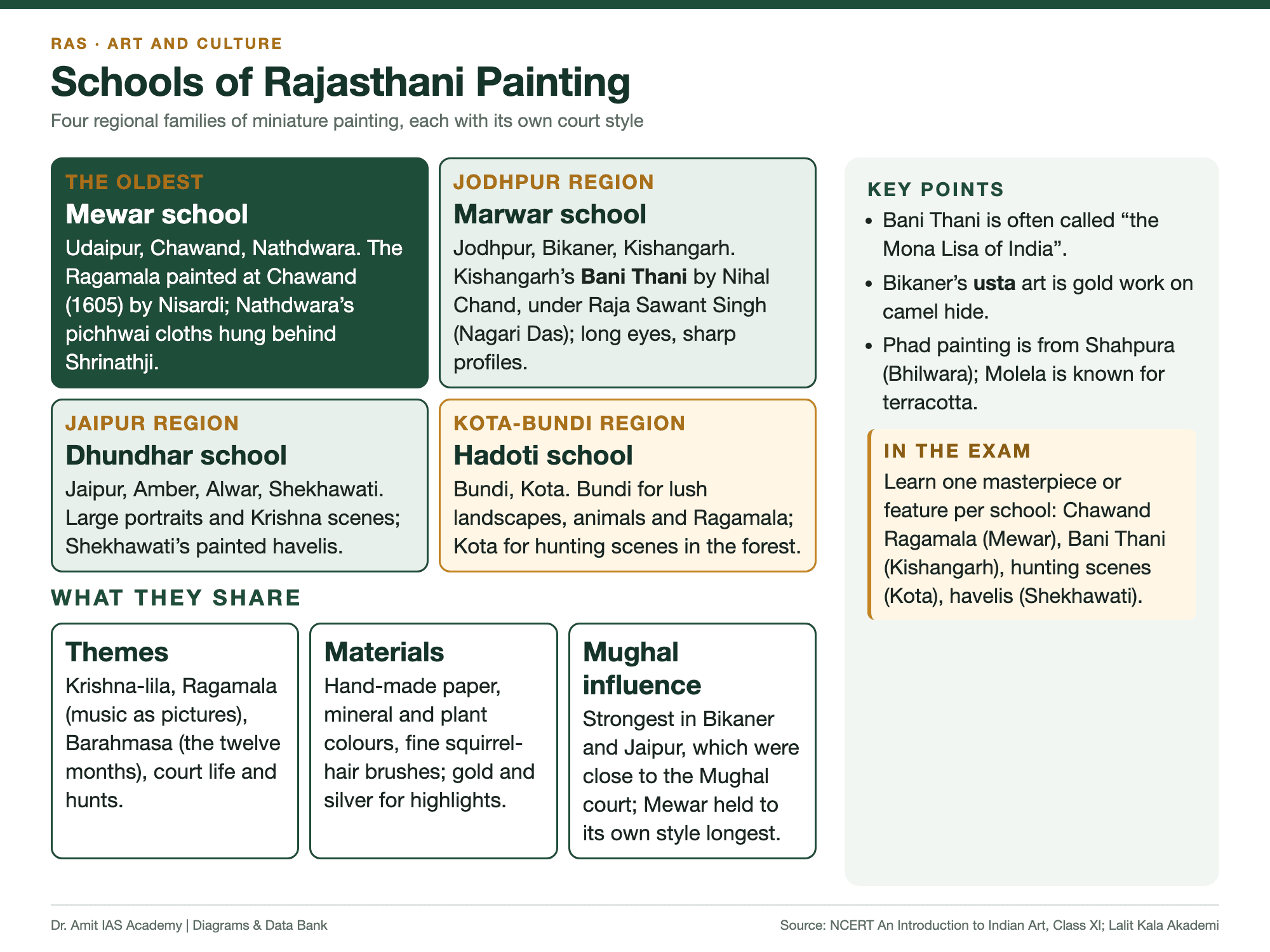
What the diagram shows
The chart sorts the miniature painting of Rajasthan into four regional families, each tied to a group of princely courts. The dark box at the top left is the Mewar school, marked as the oldest. Beside it is the Marwar school of the Jodhpur region. Below them sit the Dhundhar school of the Jaipur region and the Hadoti school of the Kota-Bundi region. Each box names the main centres and one or two works or features to remember. A row at the bottom, headed "What they share", lists the common themes, materials and the degree of Mughal influence. A side panel adds key points on Bani Thani, Bikaner's usta art, Phad painting and Molela terracotta, with a short note on how to prepare for the exam.
The four schools and their centres
- Mewar (Udaipur, Chawand, Nathdwara): the Ragamala set painted at Chawand in 1605 by Nisardi is its landmark work. Nathdwara is known for pichhwai, painted cloths hung behind the image of Shrinathji.
- Marwar (Jodhpur, Bikaner, Kishangarh): Kishangarh produced Bani Thani, painted by Nihal Chand under Raja Sawant Singh, the poet known as Nagari Das. Its figures have long, curved eyes and sharp profiles.
- Dhundhar (Jaipur, Amber, Alwar, Shekhawati): large portraits and Krishna scenes; Shekhawati is famous for the wall paintings on its havelis.
- Hadoti (Bundi, Kota): Bundi is admired for lush landscapes, animals and Ragamala sets, Kota for hunting scenes set in forests.
What the schools have in common
Across the four families the subjects are much the same: Krishna-lila, Ragamala (musical modes turned into pictures), Barahmasa (the twelve months of the year), court life and the hunt. Artists worked on hand-made paper with colours ground from minerals and plants, used fine brushes of squirrel hair, and added gold and silver for highlights.
Mughal influence was not even. It was strongest in Bikaner and Jaipur, whose rulers were closely linked with the Mughal court, while Mewar kept its own bold, flat style the longest. This contrast is a useful way to tell the schools apart.
The side panel also notes related arts of the state: Bani Thani is often called the Mona Lisa of India; Bikaner's usta art is gold work on camel hide; Phad, the long painted scroll of folk deities, comes from Shahpura in Bhilwara; and Molela is known for terracotta plaques.
Why it matters for the exam
Rajasthani painting belongs to the art and culture of Rajasthan, which is part of the RAS Preliminary syllabus and of Mains General Studies Paper I (history, art, culture and heritage of Rajasthan). Questions usually ask you to match a school with its centre, a painting with its artist or patron, or a craft such as usta, Phad or pichhwai with its place. Mains may ask for a short note on a school or a comparison of styles. As the chart advises, learn one masterpiece or feature for each school.
Quick revision
- Four schools: Mewar, Marwar, Dhundhar and Hadoti; Mewar is the oldest.
- Chawand Ragamala (1605) by Nisardi is the landmark of the Mewar school.
- Bani Thani of Kishangarh was painted by Nihal Chand under Sawant Singh (Nagari Das).
- Kota is known for hunting scenes; Bundi for landscapes, animals and Ragamala.
- Shekhawati havelis, Nathdwara pichhwai, Bikaner usta, Shahpura Phad, Molela terracotta.
- Mughal influence was strongest in Bikaner and Jaipur, weakest in Mewar.