The Integration of Rajasthan, 1948 to 1956
Seven stages, from the Matsya Union to the 1956 changes.
What the diagram shows
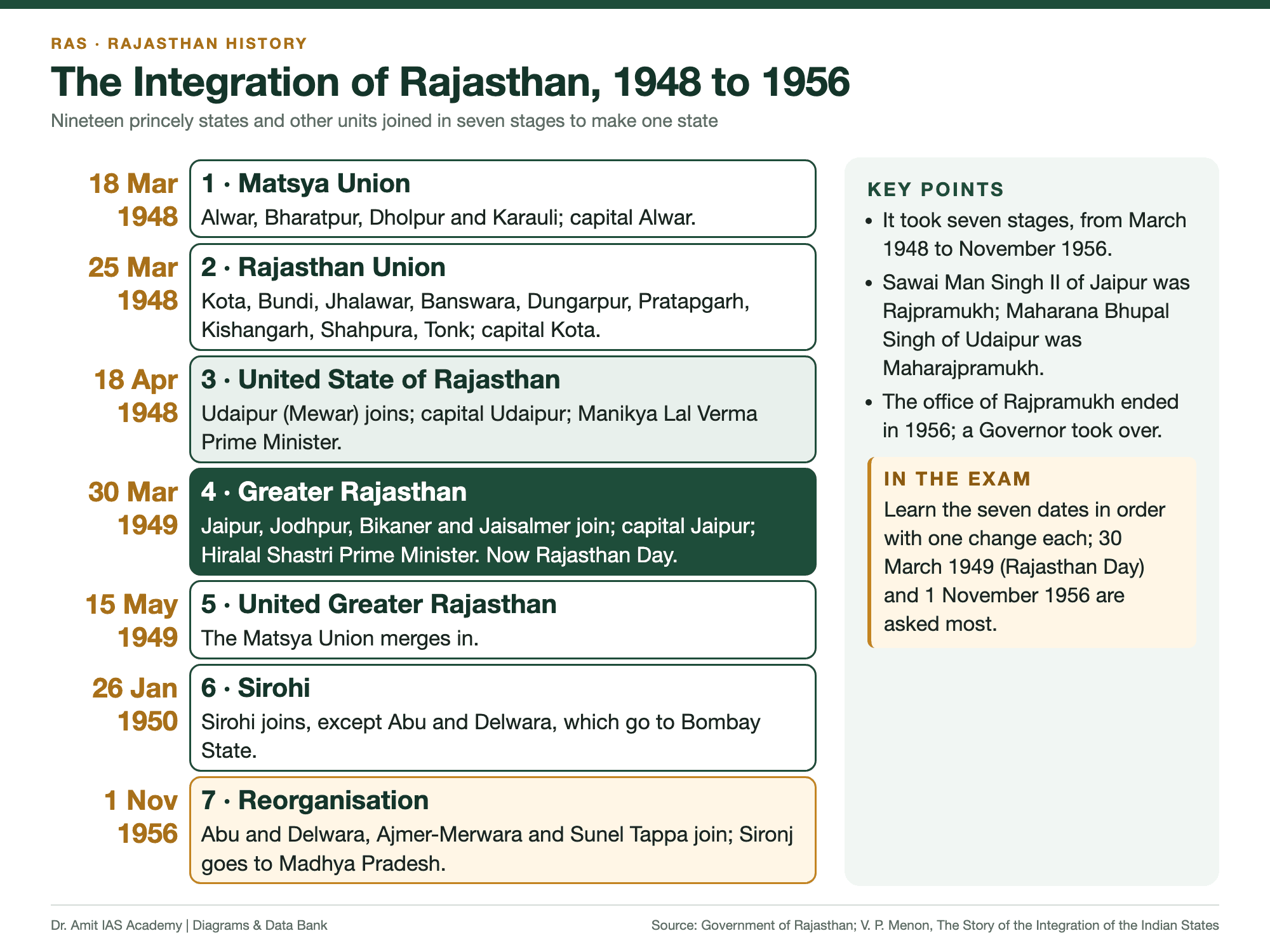
The diagram is a vertical timeline of how Rajasthan was put together after Independence. Its subtitle sums up the story: nineteen princely states and other units joined in seven stages to make one state. Down the left margin run seven dates, from 18 March 1948 to 1 November 1956, each paired with a numbered box naming the stage and what changed. Stage 3, the United State of Rajasthan, is lightly shaded; stage 4, Greater Rajasthan, is picked out in dark green because its date is now celebrated as Rajasthan Day; and stage 7, the Reorganisation, is shaded in amber. A side panel lists key points on the Rajpramukh and the Maharajpramukh, and an “In the exam” note names the two dates asked most often.
The seven stages in order
- Matsya Union (18 March 1948): Alwar, Bharatpur, Dholpur and Karauli, with Alwar as capital.
- Rajasthan Union (25 March 1948): the south-eastern states of Kota, Bundi, Jhalawar, Banswara, Dungarpur, Pratapgarh, Kishangarh, Shahpura and Tonk, with Kota as capital.
- United State of Rajasthan (18 April 1948): Udaipur (Mewar) joined, the capital moved to Udaipur and Manikya Lal Verma became Prime Minister.
- Greater Rajasthan (30 March 1949): the large states of Jaipur, Jodhpur, Bikaner and Jaisalmer joined; Jaipur became the capital and Hiralal Shastri the Prime Minister. Sardar Vallabhbhai Patel inaugurated this union.
- United Greater Rajasthan (15 May 1949): the Matsya Union merged in.
- Sirohi (26 January 1950): Sirohi joined, except Abu and Delwara, which went to Bombay State.
- Reorganisation (1 November 1956): under the States Reorganisation Act, 1956, Abu and Delwara, Ajmer-Merwara and the Sunel Tappa of Madhya Bharat joined, while the Sironj area went to Madhya Pradesh.
Heads of state and the end of the Rajpramukh
Each union of princely states had a ruler as its formal head, called the Rajpramukh. In the enlarged state, Sawai Man Singh II of Jaipur was Rajpramukh, while Maharana Bhupal Singh of Udaipur was given the special title of Maharajpramukh, a mark of Mewar's standing among the Rajput houses. The day-to-day government was run by a popular ministry headed by a Prime Minister, a title later replaced by Chief Minister. Rajasthan was a Part B state under the Constitution of 1950. The Seventh Constitutional Amendment of 1956 abolished the Part A, B and C classification, the office of Rajpramukh ended, and a Governor took over as head of the state.
The whole process was steered by the States Ministry under Sardar Patel, with V. P. Menon as its secretary, whose account of the integration is one of the sources the diagram cites.
Why it matters for the exam
The integration of Rajasthan is a core topic in the History of Rajasthan section of the RAS Preliminary examination and in Mains General Studies Paper I. Prelims questions usually test the order of the stages, the date of a given stage, the capital or Prime Minister of a union, or which states joined at which step. Matching dates with stage names is a common format. Mains questions ask candidates to trace the stages briefly or to explain the role of the Rajpramukh and the 1956 reorganisation.
Quick revision
- Seven stages, from 18 March 1948 to 1 November 1956.
- Matsya Union: Alwar, Bharatpur, Dholpur and Karauli; capital Alwar.
- 30 March 1949, Greater Rajasthan with Jaipur as capital, is Rajasthan Day.
- Sawai Man Singh II was Rajpramukh; Maharana Bhupal Singh was Maharajpramukh.
- Abu and Delwara went to Bombay in 1950 and came back in 1956.
- 1956: Ajmer-Merwara and Sunel Tappa joined; Sironj went to Madhya Pradesh.