The Indian National Movement, 1885 to 1947
Three phases, the key events and each Viceroy, from 1885 to 1947.
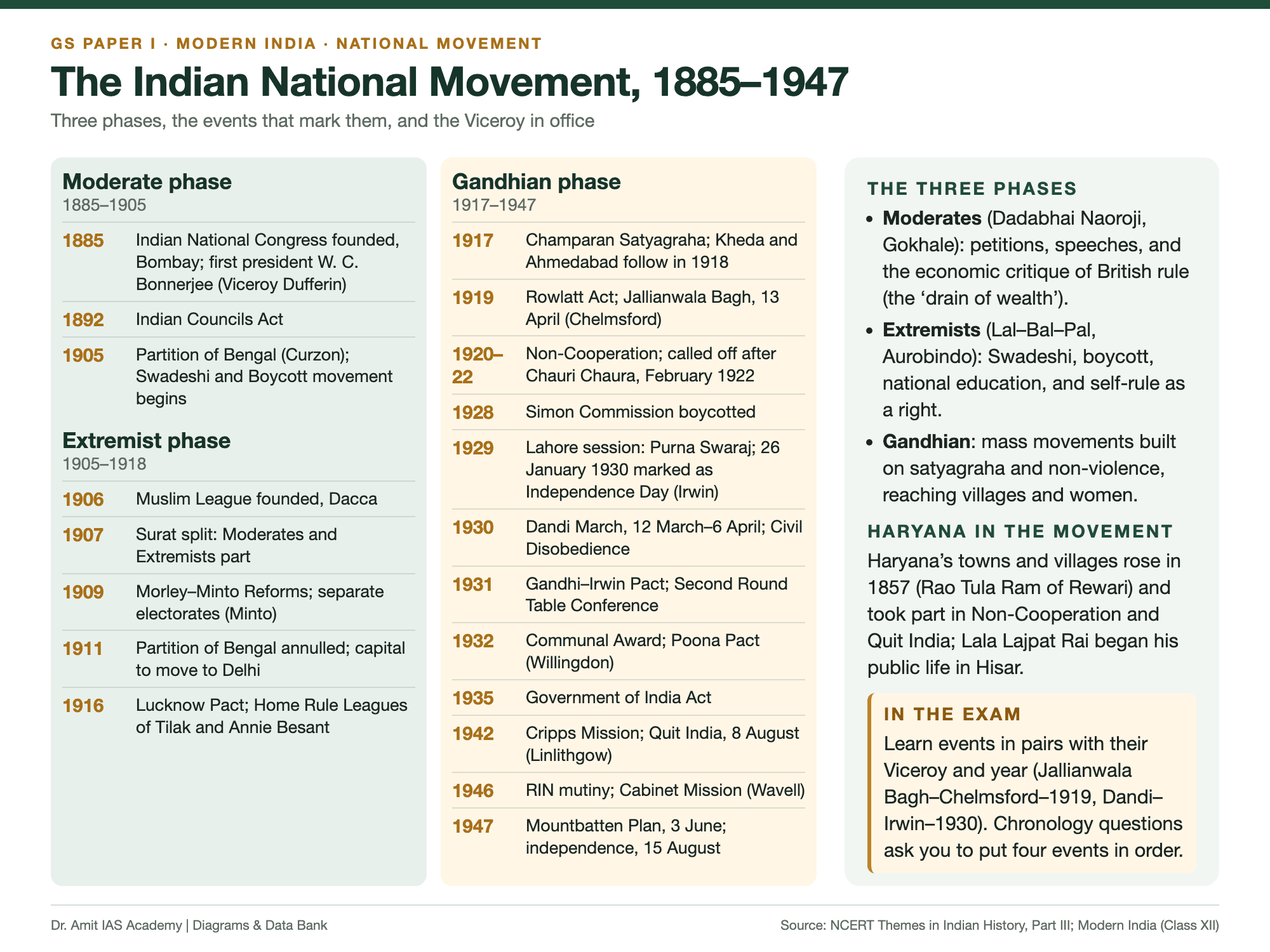
What the diagram shows
The diagram splits the national movement into three phases and gives each a column of dated events. The first column holds the Moderate phase (1885 to 1905) and, below it, the Extremist phase (1905 to 1918). The second column is given wholly to the Gandhian phase (1917 to 1947), the longest stretch. Beside many events, the Viceroy in office is named in brackets, so Dufferin sits with the founding of the Congress and Chelmsford with Jallianwala Bagh. A side panel sums up each phase's method, notes Haryana's part and gives an exam tip.
Moderates and Extremists, 1885 to 1918
The Indian National Congress met first at Bombay in 1885 under W. C. Bonnerjee. Moderates such as Dadabhai Naoroji and Gopal Krishna Gokhale relied on petitions, speeches and an economic critique of British rule, best known as the drain of wealth. Their main constitutional gain was the Indian Councils Act of 1892.
Curzon's Partition of Bengal in 1905 changed the tone. The Swadeshi and Boycott movement that followed was led by the Extremists, Lal, Bal and Pal along with Aurobindo, who stressed self-reliance, national education and self-rule as a right. Its key events:
- 1906: the Muslim League founded at Dacca.
- 1907: the Surat split between Moderates and Extremists.
- 1909: the Morley–Minto Reforms brought separate electorates for Muslims (Minto).
- 1911: the partition annulled and the capital to move from Calcutta to Delhi.
- 1916: the Lucknow Pact between Congress and League, and the Home Rule Leagues of Tilak and Annie Besant.
The Gandhian phase, 1917 to 1947
Gandhi's local struggles at Champaran (1917), Kheda and Ahmedabad (1918) were followed by the Rowlatt Act and the Jallianwala Bagh massacre of 13 April 1919. Mass action then came in waves:
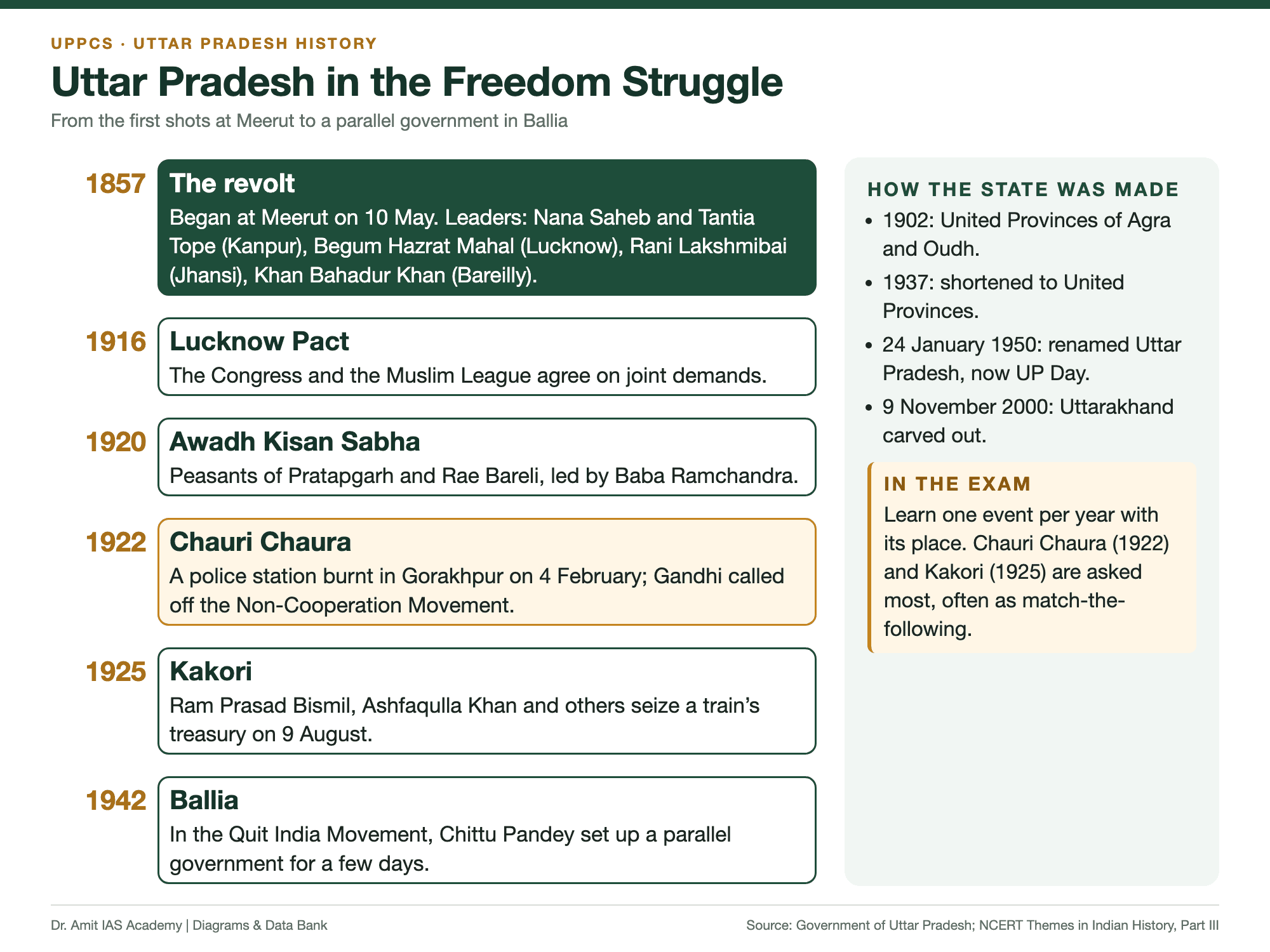
- Non-Cooperation (1920 to 1922), withdrawn after the violence at Chauri Chaura in February 1922.
- Purna Swaraj adopted at the Lahore session of 1929, with 26 January 1930 marked as Independence Day (Irwin).
- Civil Disobedience, opened by the Dandi March of 12 March to 6 April 1930, paused by the Gandhi–Irwin Pact of 1931 and the Second Round Table Conference.
- Quit India, launched on 8 August 1942 after the failure of the Cripps Mission (Linlithgow).
In between came the boycott of the Simon Commission (1928), the Communal Award and Poona Pact (1932, Willingdon) and the Government of India Act of 1935. The last years brought the Royal Indian Navy mutiny and the Cabinet Mission (1946, Wavell), then the Mountbatten Plan of 3 June 1947 and independence on 15 August 1947.
Why it matters for the exam
The national movement is a core part of Modern Indian History in General Studies Paper I of the UPSC Mains and in the history section of the Prelims; HCS, RAS, UPPCS and GPSC set similar questions. Prelims often asks you to arrange four events in order or to match an event with its year or Viceroy. Mains asks analytical questions, such as how the Moderates' methods differed from the Extremists' or why Gandhi's movements drew in peasants and women. HCS aspirants should also note Haryana's role, from Rao Tula Ram of Rewari in 1857 to Lala Lajpat Rai's early public life in Hisar.
Quick revision
- Three phases: Moderate (1885 to 1905), Extremist (1905 to 1918), Gandhian (1917 to 1947).
- Congress founded at Bombay, 1885, under Viceroy Dufferin.
- Partition of Bengal 1905 (Curzon), annulled 1911.
- Jallianwala Bagh, 13 April 1919, under Chelmsford.
- Dandi March 1930 under Irwin; Quit India, 8 August 1942, under Linlithgow.
- Mountbatten Plan 3 June 1947; independence 15 August 1947.