Historic Places of Haryana
Temples, tombs, gardens and forts, district by district.
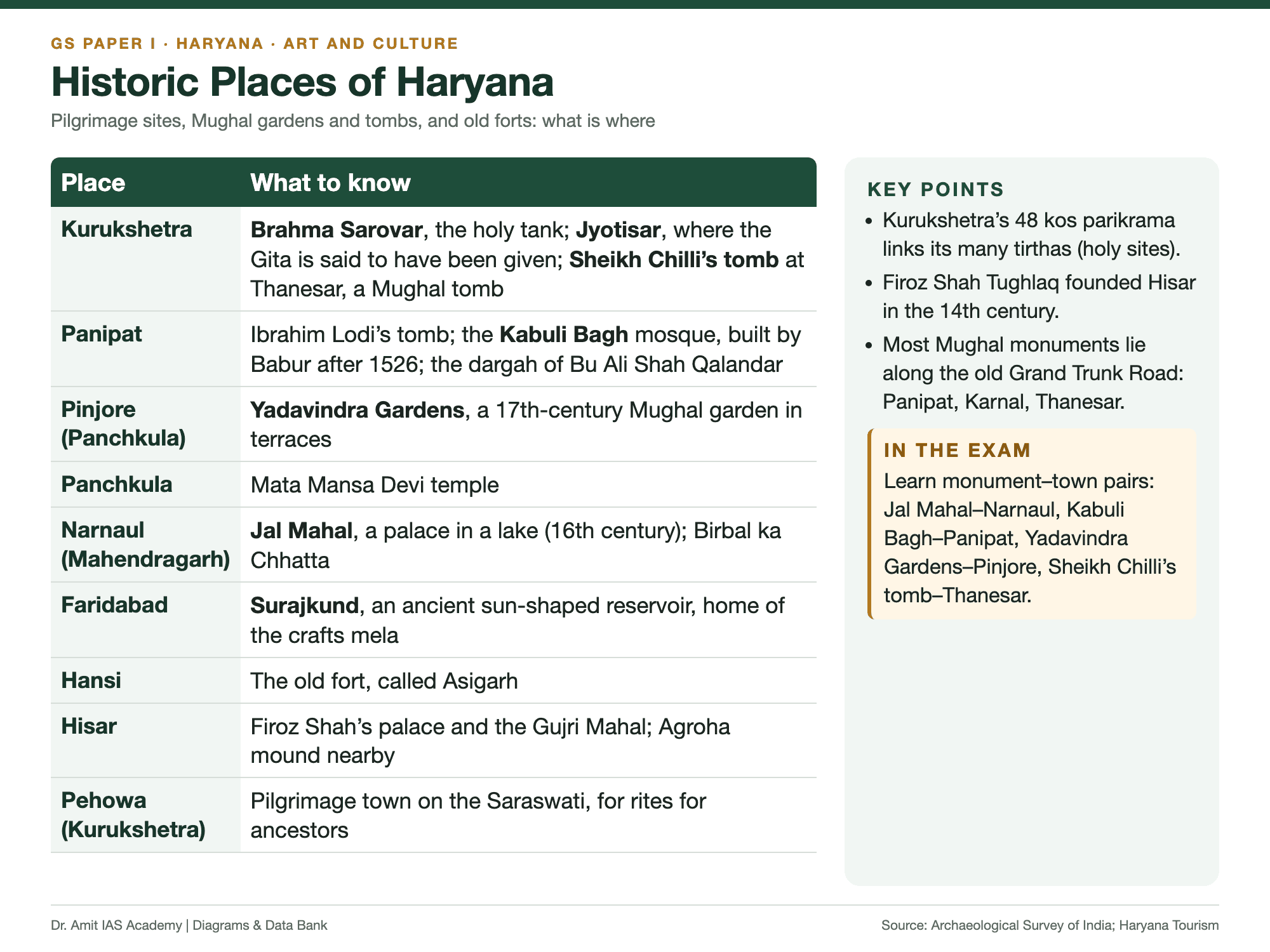
What the diagram shows
The chart is a two-column table headed Place and What to know. It lists nine places, each with the monuments or sites an aspirant should link to it, running from the pilgrimage centres of Kurukshetra down to Pehowa. A side panel of key points adds three general facts: the 48 kos parikrama of Kurukshetra, the founding of Hisar by Firoz Shah Tughlaq in the 14th century, and the way many Mughal-era monuments sit along the old Grand Trunk Road through Panipat, Karnal and Thanesar. A small box at the bottom of the panel reminds the reader to learn monument-town pairs.
Pilgrimage and sacred sites
Kurukshetra is the heart of Haryana's sacred geography. Brahma Sarovar is its great holy tank, and Jyotisar is the spot where, by tradition, Krishna gave the Bhagavad Gita to Arjuna. The 48 kos parikrama is the pilgrim circuit that links the many tirthas (holy sites) spread around the town.
- Pehowa (Kurukshetra district): a pilgrimage town on the Saraswati, known for rites performed for ancestors.
- Mata Mansa Devi temple (Panchkula): one of the best-known shrines of the state.
- Agroha (near Hisar): an ancient mound, an important archaeological site.
Sultanate and Mughal monuments
Panipat, the site of the battles that shaped north Indian history, holds the tomb of Ibrahim Lodi, who fell in the first battle in 1526, and the Kabuli Bagh mosque built by Babur after that victory. The town is also known for the dargah of Bu Ali Shah Qalandar, a revered Sufi saint. At Thanesar stands Sheikh Chilli's tomb, a Mughal tomb close to the Kurukshetra tirthas.
- Pinjore: the Yadavindra Gardens, a 17th-century Mughal garden laid out in terraces.
- Narnaul (Mahendragarh): Jal Mahal, a 16th-century palace built in the middle of a lake, and Birbal ka Chhatta, a multi-storeyed building.
- Hisar: founded by Firoz Shah Tughlaq in the 14th century; it keeps the remains of his palace and the Gujri Mahal.
Forts and ancient reservoirs
The old fort at Hansi, called Asigarh, guarded the route through the region for centuries. At Faridabad, Surajkund is an ancient reservoir whose curved, stepped form recalls the rising sun. It now gives its name to the well-known Surajkund crafts mela, which showcases handicrafts from across India.
Why it matters for the exam
For HCS, this topic falls under the Haryana-specific part of General Studies: the art, culture and heritage of the state, which appears in both Prelims and Mains. The commonest Prelims format is matching a monument with its town or district, or picking the wrongly matched pair. Questions also ask which ruler founded a town, which garden belongs to which period, or which pilgrimage site lies on which river. In Mains, the same facts support short answers on Haryana's heritage, tourism circuits and the conservation of monuments. For UPSC, Kurukshetra, Panipat and Surajkund carry over into Indian culture and medieval history.
Quick revision
- Brahma Sarovar and Jyotisar: Kurukshetra; Sheikh Chilli's tomb: Thanesar.
- Ibrahim Lodi's tomb, Kabuli Bagh mosque, Bu Ali Shah Qalandar's dargah: Panipat.
- Yadavindra Gardens: Pinjore, a 17th-century terraced Mughal garden.
- Jal Mahal and Birbal ka Chhatta: Narnaul (Mahendragarh).
- Hisar founded by Firoz Shah Tughlaq (14th century); Asigarh fort at Hansi.
- Surajkund in Faridabad; Pehowa on the Saraswati for ancestral rites.