The Hill Forts of Rajasthan
The six UNESCO hill forts, their builders and their stories.
What the diagram shows
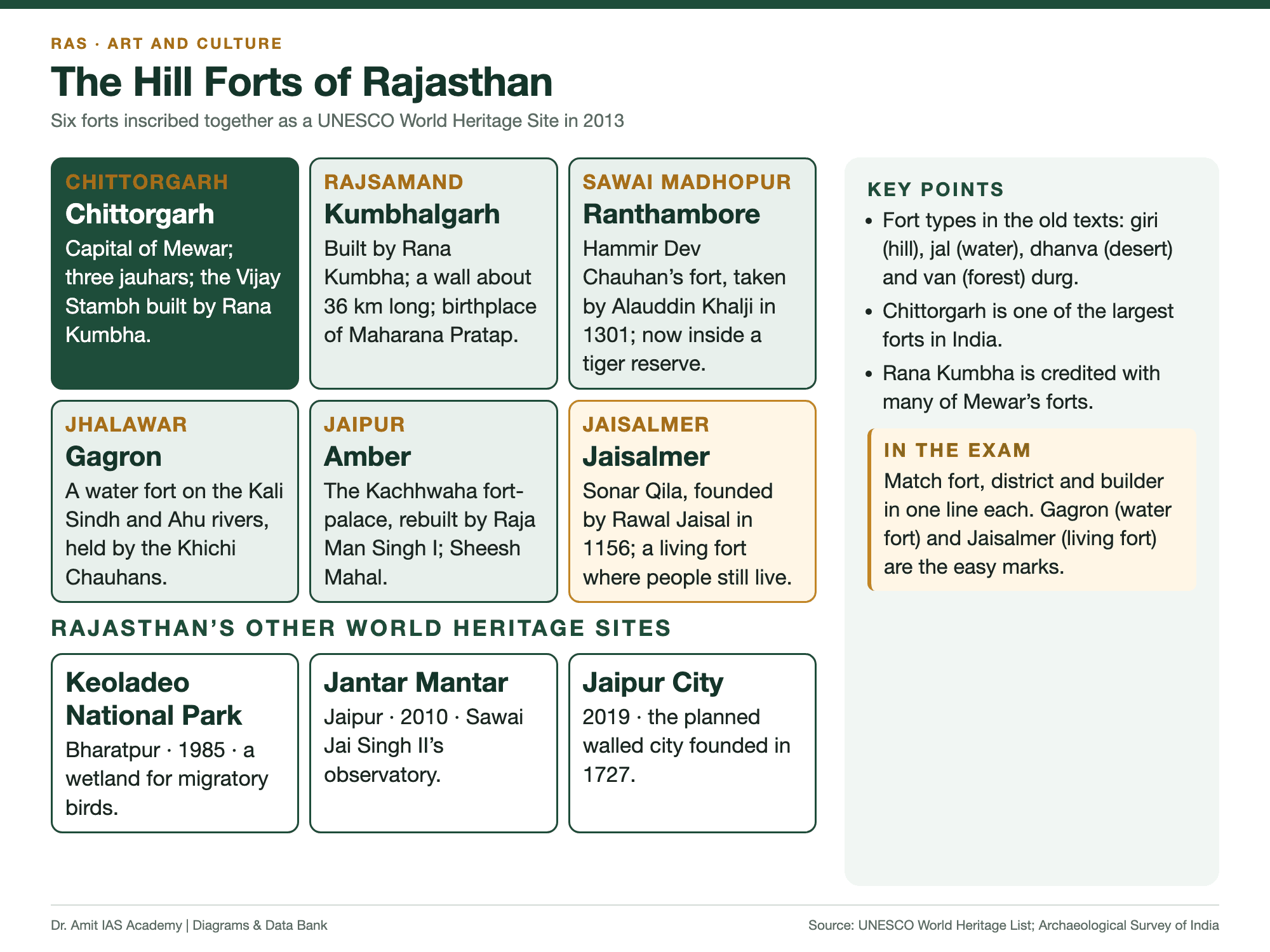
The picture arranges the six forts that UNESCO inscribed together in 2013 as one World Heritage Site, the Hill Forts of Rajasthan. Each fort sits in its own card, with the district written in small capitals above its name and a one-line story below. The top row holds Chittorgarh, Kumbhalgarh (Rajsamand) and Ranthambore (Sawai Madhopur); the second row holds Gagron (Jhalawar), Amber (Jaipur) and Jaisalmer. Below them a separate row lists Rajasthan's three other World Heritage Sites. A side panel gives key points and a short note on how the topic is tested.
The six forts at a glance
- Chittorgarh: the old capital of Mewar and one of the largest forts in India. It saw three jauhars, and its Vijay Stambh (Tower of Victory) was built by Rana Kumbha.
- Kumbhalgarh: built by Rana Kumbha, with an outer wall about 36 km long. It is remembered as the birthplace of Maharana Pratap.
- Ranthambore: the fort of Hammir Dev Chauhan, taken by Alauddin Khalji in 1301. It now stands inside the Ranthambore tiger reserve.
- Gagron: a water fort on the Kali Sindh and Ahu rivers, held by the Khichi Chauhans.
- Amber: the fort-palace of the Kachhwahas, rebuilt by Raja Man Singh I; its Sheesh Mahal (mirror palace) is the best-known part.
- Jaisalmer: the Sonar Qila (golden fort) of yellow sandstone, founded by Rawal Jaisal in 1156. It is a living fort, where people still live inside the walls.
Fort types and the wider heritage list
The side panel recalls some of the fort types named in old Indian texts: giri durg (hill fort), jal durg (water fort), dhanva durg (desert fort) and van durg (forest fort). The six forts show this variety well. Gagron is the classic water fort, protected by rivers on three sides; Jaisalmer rises from the Thar desert; Ranthambore is ringed by forest; Chittorgarh and Kumbhalgarh crown steep hills. Together they show how Rajput rulers used terrain for defence. The panel also notes that Rana Kumbha of Mewar is credited with building or strengthening many of Mewar's forts.
The bottom row lists Rajasthan's other World Heritage Sites:
- Keoladeo National Park, Bharatpur (1985): a wetland famous for migratory birds; a natural site.
- Jantar Mantar, Jaipur (2010): the astronomical observatory of Sawai Jai Singh II.
- Jaipur City (2019): the planned walled city founded in 1727.
Why it matters for the exam
For RAS, the forts belong to the Rajasthan art, culture and heritage part of the syllabus: the General Knowledge and General Science paper in Prelims and General Studies Paper I in Mains. Questions usually ask the candidate to match a fort with its district, builder or ruling clan, to pick the odd one out from a list of UNESCO sites, or to identify a fort from a clue such as "water fort" or "living fort". Mains may ask for a short note on Rajasthan's hill forts or on the types of forts in Rajput architecture. For UPSC and other state exams the same facts appear under Indian heritage and World Heritage Sites.
Quick revision
- Six forts, one UNESCO World Heritage Site, inscribed in 2013.
- Chittorgarh, Kumbhalgarh, Ranthambore, Gagron, Amber, Jaisalmer.
- Rana Kumbha built Kumbhalgarh and the Vijay Stambh at Chittorgarh.
- Gagron is a water fort; Jaisalmer is a living fort founded in 1156.
- Ranthambore fell to Alauddin Khalji in 1301.
- Other Rajasthan sites: Keoladeo (1985), Jantar Mantar (2010), Jaipur City (2019).