Heritage Sites of Gujarat
The four UNESCO sites and the temples, stepwells and mosques.
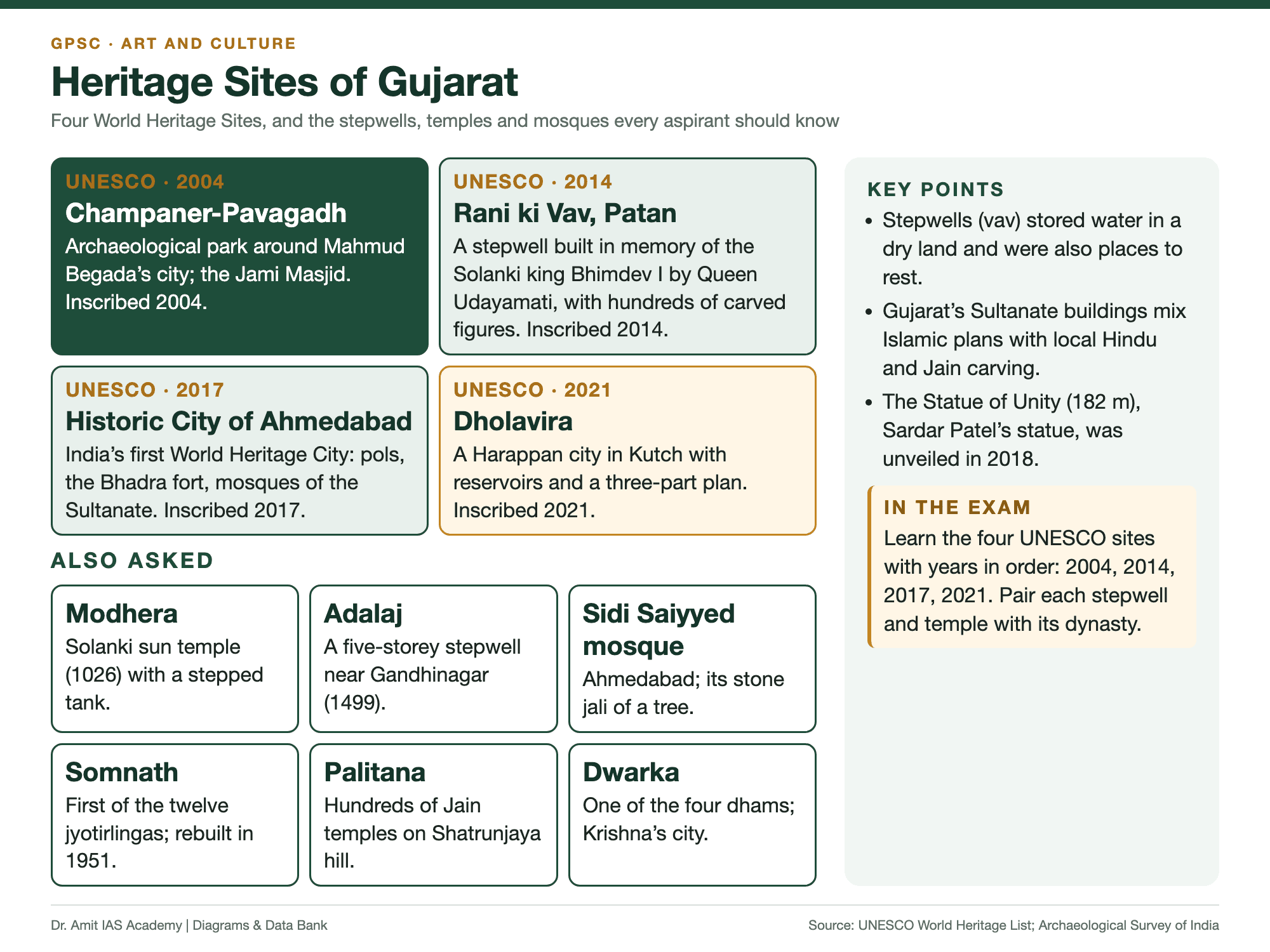
What the diagram shows
The diagram is in two parts. The upper block has four cards for Gujarat's UNESCO World Heritage Sites, placed in the order they were inscribed: Champaner-Pavagadh (2004), Rani ki Vav at Patan (2014), the Historic City of Ahmedabad (2017) and Dholavira (2021). Below them, an "Also asked" grid of six cards covers monuments that appear often in questions: the Modhera sun temple, the Adalaj stepwell, the Sidi Saiyyed mosque, Somnath, Palitana and Dwarka. A side panel adds key points and an exam tip: learn the four inscription years in order.
The four World Heritage Sites
- Champaner-Pavagadh Archaeological Park (2004): built around the city of Sultan Mahmud Begada at the foot of Pavagadh hill in Panchmahal district. Its Jami Masjid is a fine example of the Gujarat Sultanate style.
- Rani ki Vav, Patan (2014): a stepwell built by Queen Udayamati in memory of the Solanki (Chalukya) king Bhimdev I. Its walls carry hundreds of carved figures. It appears on the back of the lavender hundred-rupee note.
- Historic City of Ahmedabad (2017): founded by Sultan Ahmad Shah I in 1411 and India's first World Heritage City. The listing covers the walled city with its pols (gated residential lanes), the Bhadra fort and the mosques and tombs of the Sultanate period.
- Dholavira (2021): a Harappan city on Khadir island in the Rann of Kutch. It is known for its system of water reservoirs and for a three-part plan of citadel, middle town and lower town.
Temples, stepwells and mosques
Gujarat's stepwells (vav) stored water in a dry land and also served as cool resting places for travellers. Adalaj, near Gandhinagar, is a five-storey stepwell completed in 1499. The Solanki rulers built the Modhera sun temple in 1026, with a large stepped tank (Surya Kund) in front of it.
The Sultanate buildings of Gujarat combine Islamic plans with the carving traditions of local Hindu and Jain craftsmen. The Sidi Saiyyed mosque in Ahmedabad is famous for its stone jali showing an intertwined tree, often called the tree of life.
Among pilgrimage centres, Somnath is regarded as the first of the twelve jyotirlingas; the present temple was rebuilt after Independence and consecrated in 1951. Palitana has hundreds of Jain temples on Shatrunjaya hill, and Dwarka, the city of Krishna, is one of the four dhams. The Statue of Unity, a 182-metre statue of Sardar Vallabhbhai Patel near the Narmada dam, was unveiled in 2018.
Why it matters for the exam
For GPSC Class 1 and 2, this topic belongs to the culture and heritage of Gujarat, which is tested in the Prelims general studies paper and in the Mains general studies paper that covers history and cultural heritage. Typical questions ask you to match a monument with its dynasty or ruler, arrange the UNESCO sites in order of inscription, name the district or town where a site lies, or identify a stepwell or mosque from a feature such as a jali or a stepped tank. Mains answers may ask you to explain the Indo-Islamic style of the Gujarat Sultanate.
Quick revision
- UNESCO sites in order: Champaner-Pavagadh 2004, Rani ki Vav 2014, Ahmedabad 2017, Dholavira 2021.
- Rani ki Vav: built by Queen Udayamati for the Solanki king Bhimdev I.
- Ahmedabad: India's first World Heritage City, founded by Ahmad Shah I.
- Dholavira: Harappan city in Kutch with reservoirs and a three-part plan.
- Modhera sun temple (Solanki, 1026); Adalaj stepwell (five storeys, 1499).
- Sidi Saiyyed mosque: tree jali; Somnath rebuilt 1951; Palitana on Shatrunjaya hill.