Rivers and Canals of Haryana
The Yamuna, the Ghaggar, the southern streams and the canals.
What the diagram shows
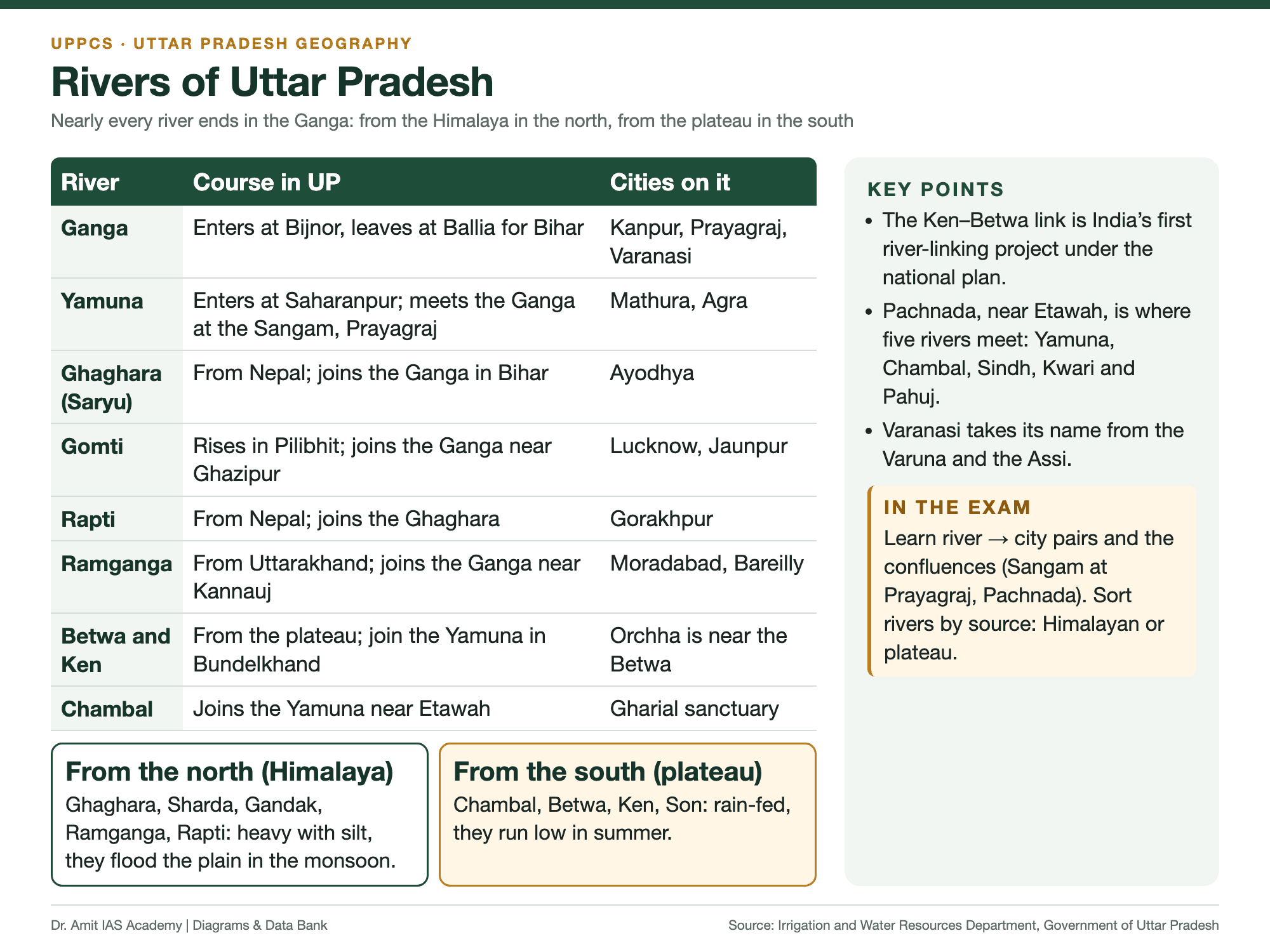
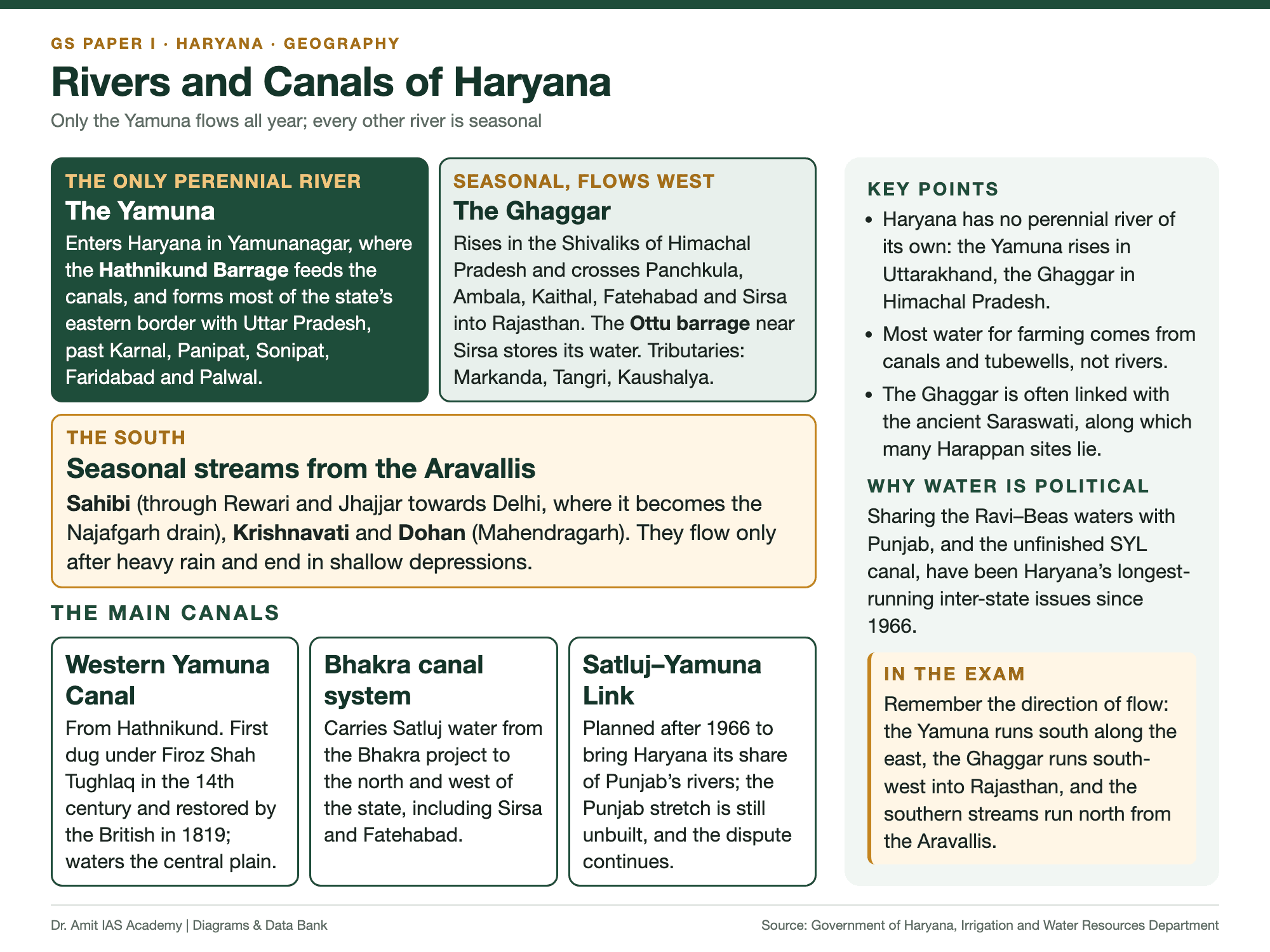
The diagram sorts Haryana's surface water into four groups. The first panel is the Yamuna, the only perennial river, which enters in Yamunanagar at the Hathnikund Barrage and runs past Karnal, Panipat, Sonipat, Faridabad and Palwal. The second is the seasonal Ghaggar, which crosses Panchkula, Ambala, Kaithal, Fatehabad and Sirsa into Rajasthan. The third panel covers the southern streams from the Aravallis: the Sahibi, Krishnavati and Dohan. The bottom row shows the three main canal systems, and a side panel adds key points, the politics of water and an exam tip on the direction of flow.
The rivers: one perennial, the rest seasonal
- Yamuna: rises in Uttarakhand, so Haryana has no perennial river that begins inside the state.
- Ghaggar: fed by monsoon rain in the Shivaliks, it flows south-west across the northern and western districts and carries little water outside the monsoon. It is often identified with the ancient Saraswati, and many Harappan sites lie along its course.
- Sahibi: enters from the Aravalli side, crosses Rewari and Jhajjar and reaches Delhi, where it becomes the Najafgarh drain.
- Krishnavati and Dohan: seasonal streams of the Mahendragarh area that carry water only after heavy rain.
Remember the direction of flow: the Yamuna runs south, the Ghaggar south-west and the southern streams north. Because only one river is perennial, farming in Haryana depends mainly on canals and tubewells rather than on rivers.
The canal systems
- Western Yamuna Canal: takes off from Hathnikund. It was first dug under Firoz Shah Tughlaq in the fourteenth century and restored by the British in the nineteenth; it waters the central plain.
- Bhakra canal system: carries Satluj water from the Bhakra project to the north and west of the state, including Sirsa and Fatehabad.
- Satluj-Yamuna Link (SYL): planned after Haryana was formed in 1966 to bring the state its share of the Punjab rivers. The Haryana portion was built, but the Punjab stretch remains unbuilt.
Why water is political
When Haryana was carved out of Punjab in 1966, the waters of the Ravi and Beas had to be shared between the two states. The incomplete SYL canal has kept this dispute alive for decades, through tribunals, agreements and Supreme Court proceedings, and it remains one of Haryana's longest-running inter-state issues.
Why it matters for the exam
For HCS, this falls under the geography of Haryana in the Preliminary General Studies paper and the Haryana-specific part of Mains General Studies. Typical questions ask which river is perennial, which districts a river crosses, where a barrage or canal takes off, which streams drain the south, or which river is linked with the Saraswati. Mains questions may ask for a note on the SYL dispute or on irrigation in Haryana. For UPSC, the SYL canal and inter-state river water disputes come up under GS Paper II, and the Ghaggar-Saraswati link under ancient history.
Quick revision
- The Yamuna is Haryana's only perennial river and forms most of the eastern border with Uttar Pradesh.
- The Ghaggar rises in the Shivaliks of Himachal Pradesh and flows south-west into Rajasthan; the Ottu barrage is near Sirsa.
- Markanda, Tangri and Kaushalya are tributaries of the Ghaggar.
- Sahibi, Krishnavati and Dohan are seasonal streams from the Aravallis; the Sahibi becomes the Najafgarh drain in Delhi.
- The Western Yamuna Canal starts at Hathnikund; the Bhakra system serves the north and west.
- The Punjab stretch of the SYL canal is unbuilt, and the dispute continues.