Haryana in the Revolt of 1857
Ambala, Rao Tula Ram, Nasibpur and what followed in 1858.
What the diagram shows
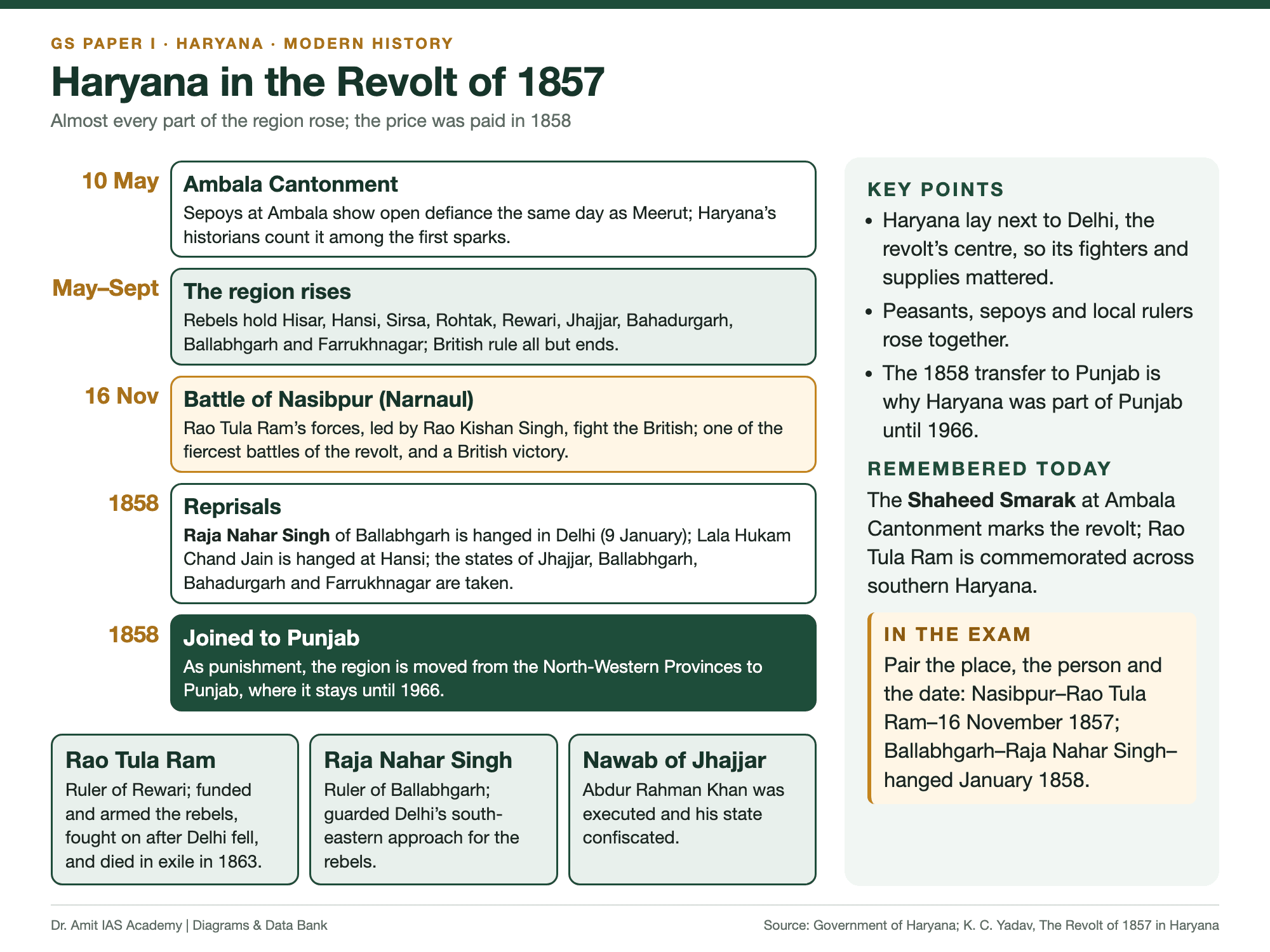
The diagram is a timeline of the revolt in Haryana, with the subtitle that almost every part of the region rose and that the price was paid in 1858. Down the left margin run five dates: 10 May, May–Sept, 16 Nov, 1858 and 1858 again. Each is paired with a box: Ambala Cantonment, The region rises, Battle of Nasibpur (Narnaul) in amber, Reprisals, and Joined to Punjab in dark green as the final outcome. Below the timeline, three cards profile Rao Tula Ram, Raja Nahar Singh and the Nawab of Jhajjar. A side panel gives key points, notes how the revolt is remembered today and ends with an “In the exam” tip on pairing place, person and date.
How the revolt spread
Sepoys at Ambala Cantonment showed open defiance on 10 May 1857, the same day as the outbreak at Meerut, and historians of Haryana count Ambala among the first sparks. Because the region lay next to Delhi, the centre of the revolt, its fighters and supplies mattered to both sides.
Between May and September the rising became general. Rebels held Hisar, Hansi, Sirsa, Rohtak, Rewari, Jhajjar, Bahadurgarh, Ballabhgarh and Farrukhnagar, and British rule all but ended in the region. The diagram stresses that this was not a sepoy affair alone: peasants, soldiers and local rulers rose together.
Leaders and the Battle of Nasibpur
- Rao Tula Ram, ruler of Rewari, funded and armed the rebels and kept fighting after Delhi fell to the British in September. He later left India and died in exile in 1863.
- Raja Nahar Singh of Ballabhgarh guarded the south-eastern approach to Delhi for the rebels.
- Abdur Rahman Khan, the Nawab of Jhajjar, was executed and his state confiscated.
On 16 November 1857 Rao Tula Ram's forces, led in the field by Rao Kishan Singh, met the British at Nasibpur near Narnaul. It was one of the fiercest battles of the revolt in this region and ended in a British victory.
The price paid in 1858
Reprisals followed. Raja Nahar Singh was hanged in Delhi on 9 January 1858, and Lala Hukam Chand Jain was hanged at Hansi. The states of Jhajjar, Ballabhgarh, Bahadurgarh and Farrukhnagar were taken over. As a punishment for the whole region, the British moved it in 1858 from the North-Western Provinces to Punjab. That decision explains why Haryana remained part of Punjab until it became a separate state in 1966. The Shaheed Smarak at Ambala Cantonment marks the revolt today, and Rao Tula Ram is remembered across southern Haryana.
Why it matters for the exam
For HCS, this topic belongs to the history of Haryana in the General Studies papers and the Haryana-specific part of the Preliminary syllabus; for UPSC GS Paper I it adds regional depth to the Revolt of 1857 in modern Indian history. Expect matching questions that pair a leader with a place, chronology questions on the order of events, statement-based questions on the 1858 transfer to Punjab, and Mains answers on the regional character and consequences of the revolt.
Quick revision
- Ambala sepoys defied the British on 10 May 1857, the same day as Meerut.
- Battle of Nasibpur near Narnaul: 16 November 1857, Rao Tula Ram's forces, British victory.
- Rao Tula Ram of Rewari died in exile in 1863.
- Raja Nahar Singh of Ballabhgarh was hanged in Delhi on 9 January 1858.
- Jhajjar, Ballabhgarh, Bahadurgarh and Farrukhnagar were confiscated.
- In 1858 the region moved from the North-Western Provinces to Punjab, where it stayed until 1966.