Haryana in the Freedom Struggle
Lajpat Rai, Neki Ram Sharma, Chhotu Ram and the road to 1947.
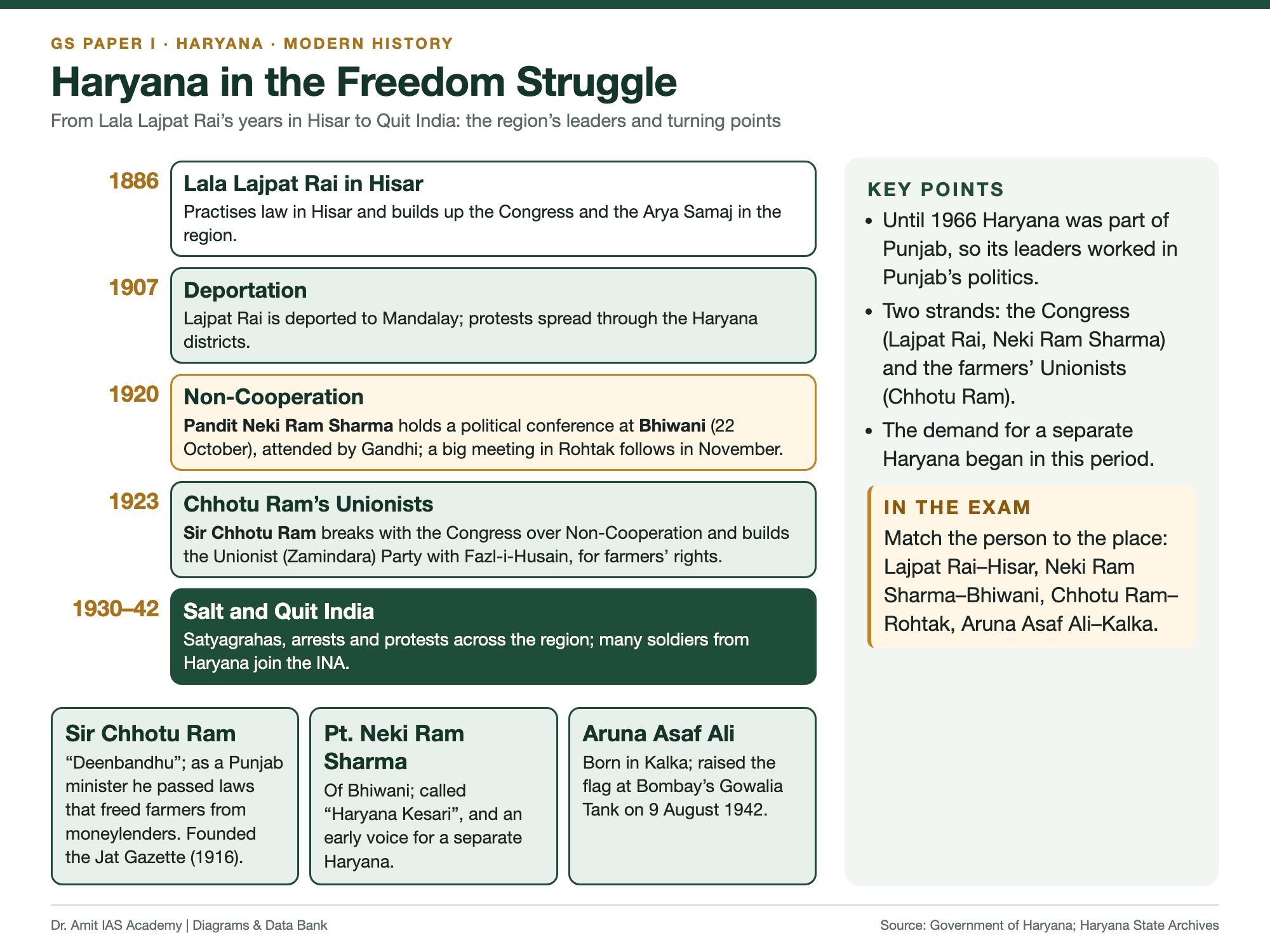
What the diagram shows
The diagram is a vertical timeline with five dated cards, read from top to bottom. It opens in 1886 with Lala Lajpat Rai practising law in Hisar and building up the Congress and the Arya Samaj in the region. The 1907 card records his deportation to Mandalay and the protests that followed in the Haryana districts. The highlighted 1920 card covers Non-Cooperation: Pandit Neki Ram Sharma's political conference at Bhiwani, attended by Gandhi. The 1923 card shows Sir Chhotu Ram, who had broken with the Congress over Non-Cooperation, building the Unionist Party with Fazl-i-Husain. The last card, 1930–42, sums up the Salt Satyagraha and Quit India years, when many soldiers from the region also joined the INA.
Below the timeline are three profile cards on Chhotu Ram, Neki Ram Sharma and Aruna Asaf Ali. A side panel lists the key points and a tip for the exam: match each person to a place.
Two strands of politics
Until 1966 Haryana was part of Punjab, so its leaders worked within Punjab's politics. The diagram separates two strands.
- The Congress strand: Lajpat Rai, who made Hisar his base before moving to Lahore, and Neki Ram Sharma of Bhiwani, remembered as "Haryana Kesari". This strand brought the national movements of Gandhi into the towns and villages of the region.
- The Unionist strand: Chhotu Ram did not accept Non-Cooperation and left the Congress. With Fazl-i-Husain he built the Unionist Party, a cross-community party of rural landholders and peasants that became the leading force in the Punjab legislature.
The leaders to remember
Sir Chhotu Ram
Known as "Deenbandhu", he came from the Rohtak area. In 1916 he founded the Jat Gazette to speak for the peasantry. As a minister in the Punjab government he pushed through laws that protected indebted farmers from moneylenders and from losing their land.
Pandit Neki Ram Sharma
A Congress leader of Bhiwani who organised the region during Non-Cooperation. He was among the early voices asking for a separate Haryana, a demand the diagram traces back to this period.
Aruna Asaf Ali
Born in Kalka, she hoisted the national flag at Gowalia Tank in Bombay on 9 August 1942, the day the Quit India Movement began after the arrest of the Congress leaders.
Why it matters for the exam
For HCS, this topic falls under the history of Haryana and the Indian national movement in General Studies, at both Prelims and Mains. Questions usually test links: a leader with a town, a newspaper with its founder, a title such as "Deenbandhu" or "Haryana Kesari" with the right person, or an event with its year. Mains questions may ask about the region's role in the national movement or Chhotu Ram's agrarian reforms. For UPSC, Lajpat Rai's deportation, the Unionist Party and Aruna Asaf Ali at Gowalia Tank are national topics in modern Indian history.
Quick revision
- 1886: Lajpat Rai practises law in Hisar; 1907: deported to Mandalay.
- 1920: Neki Ram Sharma's Bhiwani conference, attended by Gandhi, during Non-Cooperation.
- Chhotu Ram broke with the Congress and built the Unionist Party with Fazl-i-Husain.
- Chhotu Ram: "Deenbandhu", founder of the Jat Gazette (1916), farmers' debt laws in Punjab.
- Neki Ram Sharma: "Haryana Kesari", an early voice for a separate Haryana.
- Aruna Asaf Ali of Kalka hoisted the flag at Gowalia Tank on 9 August 1942.