Haryana's Folk Culture and Dialects
Saang, Ragini, six folk dances, fairs and the five dialects.
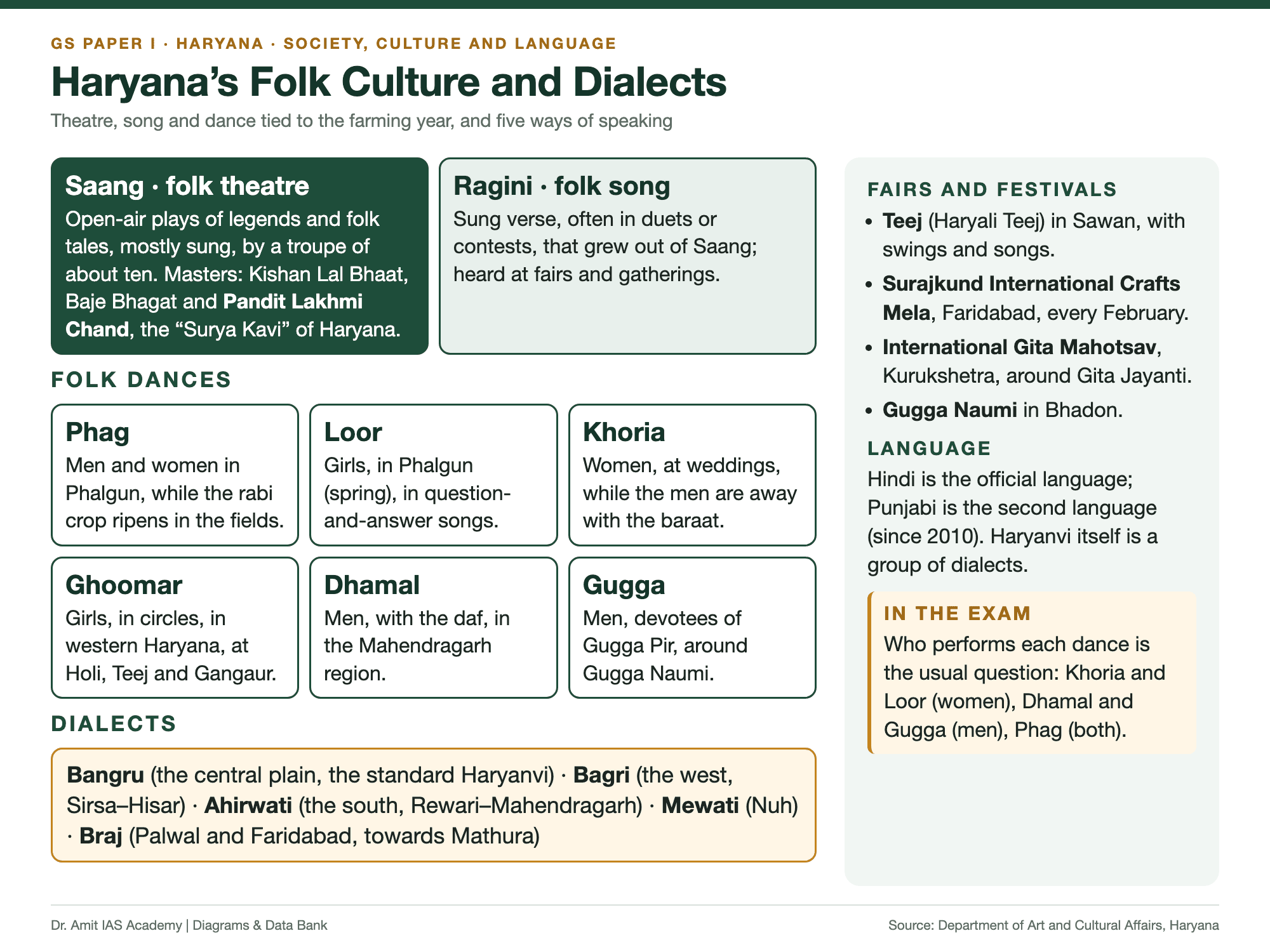
What the diagram shows
The diagram is a one-page summary of Haryana's living folk traditions, under the subtitle that ties theatre, song and dance to the farming year. At the top left sit two boxes: Saang, the folk theatre (in dark green), and Ragini, the folk song that grew out of it. Below them, six cards set out the main folk dances, each with who performs it and when. A highlighted strip at the bottom names the five dialects and the districts where each is spoken. A side panel lists four fairs and festivals, the state's languages and an “In the exam” note on who performs which dance.
Saang and Ragini
Saang is open-air theatre in which a small troupe, of about ten performers, acts out legends, folk tales and moral stories, mostly through song, in the open air before a village audience. The diagram names three masters of the form: Kishan Lal Bhaat, Baje Bhagat and Pandit Lakhmi Chand, honoured as the “Surya Kavi” of Haryana. Ragini is sung verse that developed from the songs of Saang. It is often performed as a duet or a contest between singers and is a regular feature of village fairs and gatherings.
The six folk dances
- Phag: men and women together in Phalgun, while the rabi crop ripens in the fields.
- Loor: girls in Phalgun (spring), dancing to question-and-answer songs.
- Khoria: women at weddings, while the men are away with the baraat.
- Ghoomar: girls dancing in circles in western Haryana at Holi, Teej and Gangaur.
- Dhamal: men with the daf, a frame drum, in the Mahendragarh region.
- Gugga: men who are devotees of Gugga Pir, around Gugga Naumi.
Fairs, festivals and language
The fairs follow the seasons. Teej (Haryali Teej) in Sawan is marked by swings and songs; Gugga Naumi falls in Bhadon. Two large modern events draw visitors from India and abroad: the Surajkund International Crafts Mela at Faridabad every February, and the International Gita Mahotsav at Kurukshetra around Gita Jayanti.
Hindi is the official language of Haryana, and Punjabi has been the second language since 2010. Haryanvi is not one uniform speech but a set of regional dialects:
- Bangru: the central plain; treated as standard Haryanvi.
- Bagri: the west, around Sirsa and Hisar.
- Ahirwati: the south, around Rewari and Mahendragarh.
- Mewati: Nuh district.
- Braj: Palwal and Faridabad, towards Mathura.
Why it matters for the exam
Haryana's culture is a regular source of Haryana-specific questions in the HCS Preliminary General Studies paper and in HCS Mains General Studies on Haryana's society and culture. Typical questions ask which group performs a dance, match dances or dialects with regions, identify the “Surya Kavi”, or place a fair in its district and month. As the diagram notes, the performer of each dance is the usual trap: Khoria and Loor are danced by women, Dhamal and Gugga by men, and Phag by both. Mains answers on folk theatre or regional identity gain from naming Saang, Ragini and the dialect belts.
Quick revision
- Saang is Haryana's folk theatre; Pandit Lakhmi Chand is its “Surya Kavi”.
- Ragini, sung in duets or contests, grew out of Saang.
- Women: Khoria and Loor; men: Dhamal and Gugga; both: Phag.
- Dialects: Bangru (centre), Bagri (west), Ahirwati (south), Mewati (Nuh), Braj (Palwal–Faridabad).
- Surajkund Crafts Mela, Faridabad, every February; Gita Mahotsav, Kurukshetra.
- Hindi is the official language; Punjabi the second language since 2010.