Haryana in Census 2011
Population, sex ratios, literacy and density in one view.
What the diagram shows
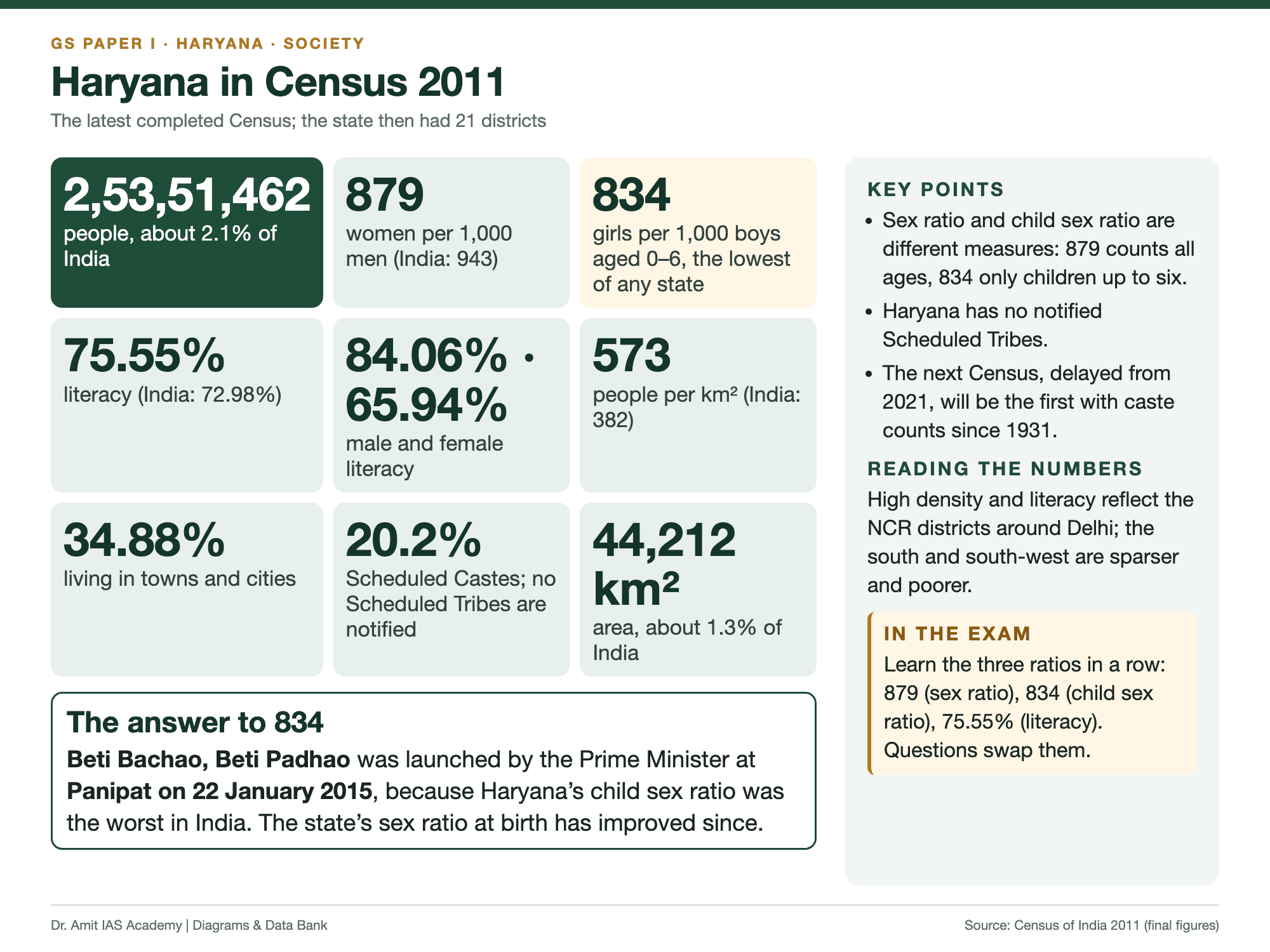
The diagram is a data card of Haryana as counted in Census 2011, the latest completed Census, when the state had 21 districts. Nine tiles sit in a three-by-three grid. The first row gives the people: a population of 2,53,51,462 (about 2.1% of India), a sex ratio of 879 women per 1,000 men against India's 943, and a child sex ratio of 834 girls per 1,000 boys aged 0–6, highlighted because it was the lowest of any state. The second row covers literacy and crowding: overall literacy of 75.55% (India 72.98%), male and female literacy of 84.06% and 65.94%, and a density of 573 people per square kilometre (India 382). The third row shows that 34.88% lived in towns and cities, that Scheduled Castes formed 20.2% of the population with no Scheduled Tribes notified, and that the area is 44,212 km², about 1.3% of India. A box below the grid, “The answer to 834”, links the child sex ratio to Beti Bachao, Beti Padhao, and a side panel adds key points, a note on reading the numbers and an exam tip.
The three ratios that define Haryana
The sex ratio counts females per 1,000 males across all ages; the child sex ratio counts girls per 1,000 boys in the 0–6 age group only. Haryana stood well below the national average on both, and the gap was sharper among children, a sign of sex-selective practices and a strong son preference. Literacy (75.55%) was above the national average, yet the gap of about 18 percentage points between men and women shows that the disadvantage of girls continues into schooling.
Density, towns and social groups
With about 1.3% of India's area but about 2.1% of its people, Haryana is far more crowded than the country as a whole. The diagram notes that high density and literacy reflect the NCR districts around Delhi, such as Gurugram and Faridabad, while districts farther from Delhi are generally less crowded. Just over a third of the people lived in urban areas, a share higher than the national figure.
Scheduled Castes made up about a fifth of the population. Haryana has no notified Scheduled Tribes.
The answer to 834
The Prime Minister launched Beti Bachao, Beti Padhao at Panipat on 22 January 2015, choosing Haryana because its child sex ratio was the worst in the country. The diagram notes that the state's sex ratio at birth has improved since. The side panel also records that the next Census, delayed from 2021, will be the first since 1931 to count castes.
Why it matters for the exam
For HCS, these figures belong to the Haryana-specific portion of the Preliminary general studies paper and to Haryana's society and demography in the Main examination. Questions usually ask for the sex ratio, child sex ratio or literacy rate, compare Haryana with the national figure, or test statements such as the absence of Scheduled Tribes. As the diagram warns, options often swap 879, 834 and 75.55%. For UPSC GS Paper I, Haryana is a common example in answers on declining child sex ratios and government responses.
Quick revision
- Population 2,53,51,462, about 2.1% of India; area 44,212 km², about 1.3%.
- Sex ratio 879 and child sex ratio 834, the lowest child sex ratio of any state.
- Literacy 75.55%: male 84.06%, female 65.94%.
- Density 573 per km² against India's 382; 34.88% urban.
- Scheduled Castes 20.2%; no notified Scheduled Tribes.
- Beti Bachao, Beti Padhao launched at Panipat on 22 January 2015.