Harappan Sites in Haryana
Rakhigarhi, Banawali, Bhirrana and more, and why each matters.
What the diagram shows
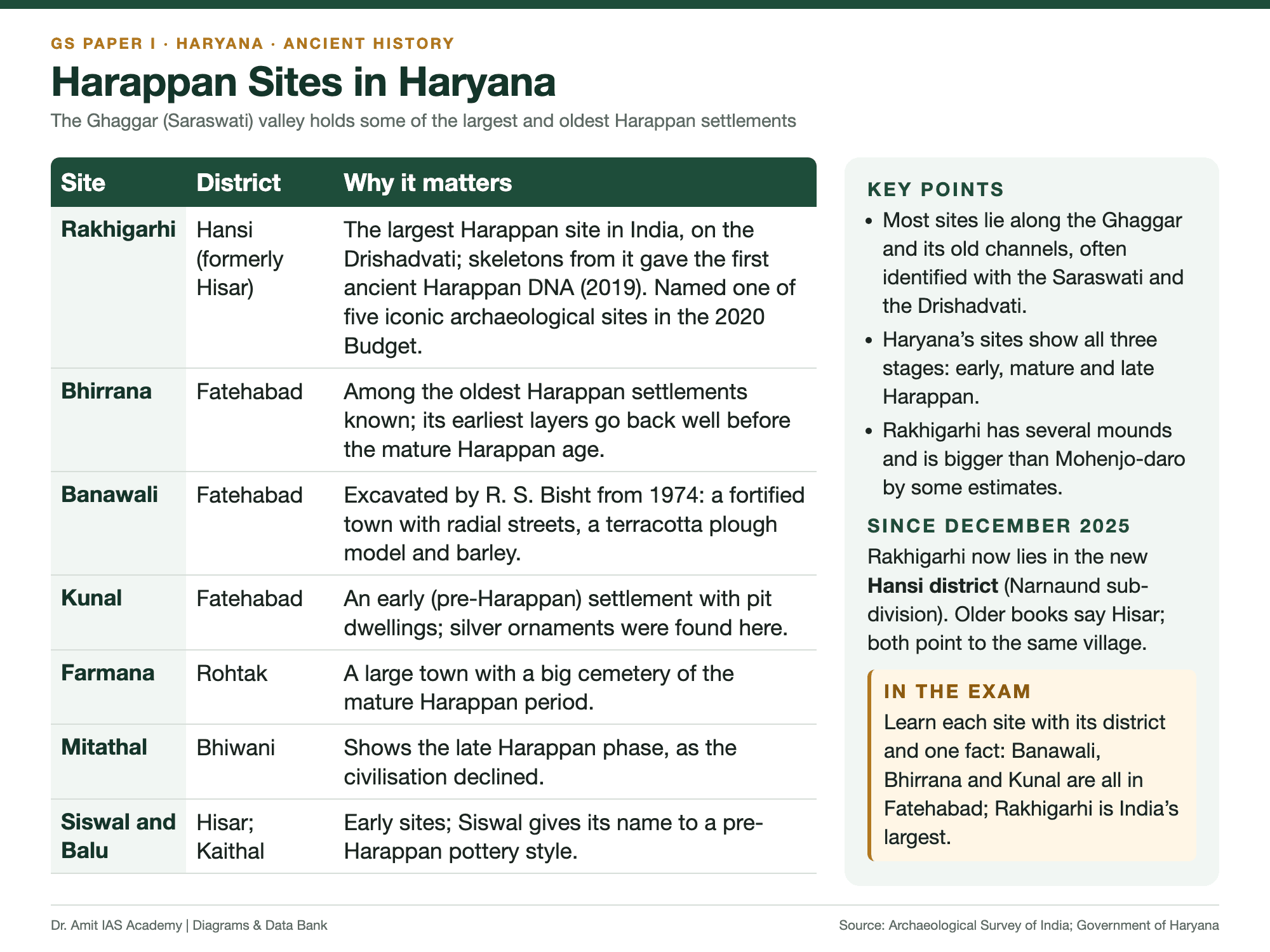
The diagram is a table of eight Harappan sites in Haryana, with a side panel of key points. Its subtitle sets the theme: the Ghaggar (Saraswati) valley holds some of the largest and oldest Harappan settlements. The table has three columns: the site, its district and why it matters. The rows run Rakhigarhi, Bhirrana, Banawali, Kunal, Farmana, Mitathal, and finally Siswal and Balu together. The side panel lists three key points, a note on Rakhigarhi's district (older books place it in Hisar; the picture records it under the newer Hansi district, in the Narnaund sub-division, and both mean the same village) and an amber "In the exam" box with a memory hook.
The big sites: Rakhigarhi, Bhirrana and Banawali
- Rakhigarhi is the largest Harappan site in India, a cluster of several mounds on the Drishadvati; by some estimates it is bigger than Mohenjo-daro. Skeletons from its cemetery yielded the first ancient Harappan genome, published in 2019, and the Union Budget of 2020 named it one of five iconic archaeological sites to be developed.
- Bhirrana (Fatehabad) is among the oldest Harappan settlements known. Its lowest layers go back well before the mature Harappan age, which makes it central to the debate on where and when the civilisation began.
- Banawali (Fatehabad) was excavated by R. S. Bisht from 1974. It was a fortified town whose streets ran in a radial pattern rather than the usual grid, and it gave a terracotta model of a plough and evidence of barley.
The other sites and the three stages
Haryana's sites show all three stages of the civilisation, early, mature and late, which is why the state is so useful for studying its growth and decline.
- Kunal (Fatehabad): an early, pre-Harappan settlement with pit dwellings, where silver ornaments were found.
- Siswal (Hisar) and Balu (Kaithal): sites with early Harappan levels; Siswal gives its name to a pre-Harappan pottery style.
- Farmana (Rohtak): a large town with a big cemetery of the mature Harappan period.
- Mitathal (Bhiwani): shows the late Harappan phase, as the civilisation declined.
Most of these sites lie along the Ghaggar and its old channels, which many scholars identify with the Saraswati and the Drishadvati of the Rigveda. The density of settlements here shows that the Harappan world extended well east of the Indus, into the plains between the Sutlej and the Yamuna.
Why it matters for the exam
For HCS, this topic sits in General Studies under the history of Haryana and in ancient Indian history, where the Indus Valley Civilisation is a standard area. Questions usually pair a site with its district, ask which site is the largest or the oldest, or test a find such as the plough model of Banawali or the pottery named after Siswal. Statement-based questions may mix early, mature and late sites. For UPSC, Rakhigarhi is the site of national importance, through the ancient DNA study and the iconic-sites plan, and the Ghaggar–Saraswati link appears in questions on the spread of the civilisation.
Quick revision
- Rakhigarhi: largest Harappan site in India, on the Drishadvati; first Harappan ancient DNA (2019).
- Banawali, Bhirrana and Kunal are all in Fatehabad district.
- Banawali: R. S. Bisht, radial streets, terracotta plough model, barley.
- Bhirrana: among the oldest Harappan settlements; Kunal: pit dwellings and silver ornaments.
- Farmana (Rohtak): mature Harappan cemetery; Mitathal (Bhiwani): late Harappan.
- Siswal (Hisar) names a pre-Harappan pottery style; Balu is in Kaithal.