Gujarat Through the Ages: Harappans to Mughals
Dholavira, Lothal, the Junagadh rock, Solankis and Sultans.
What the diagram shows
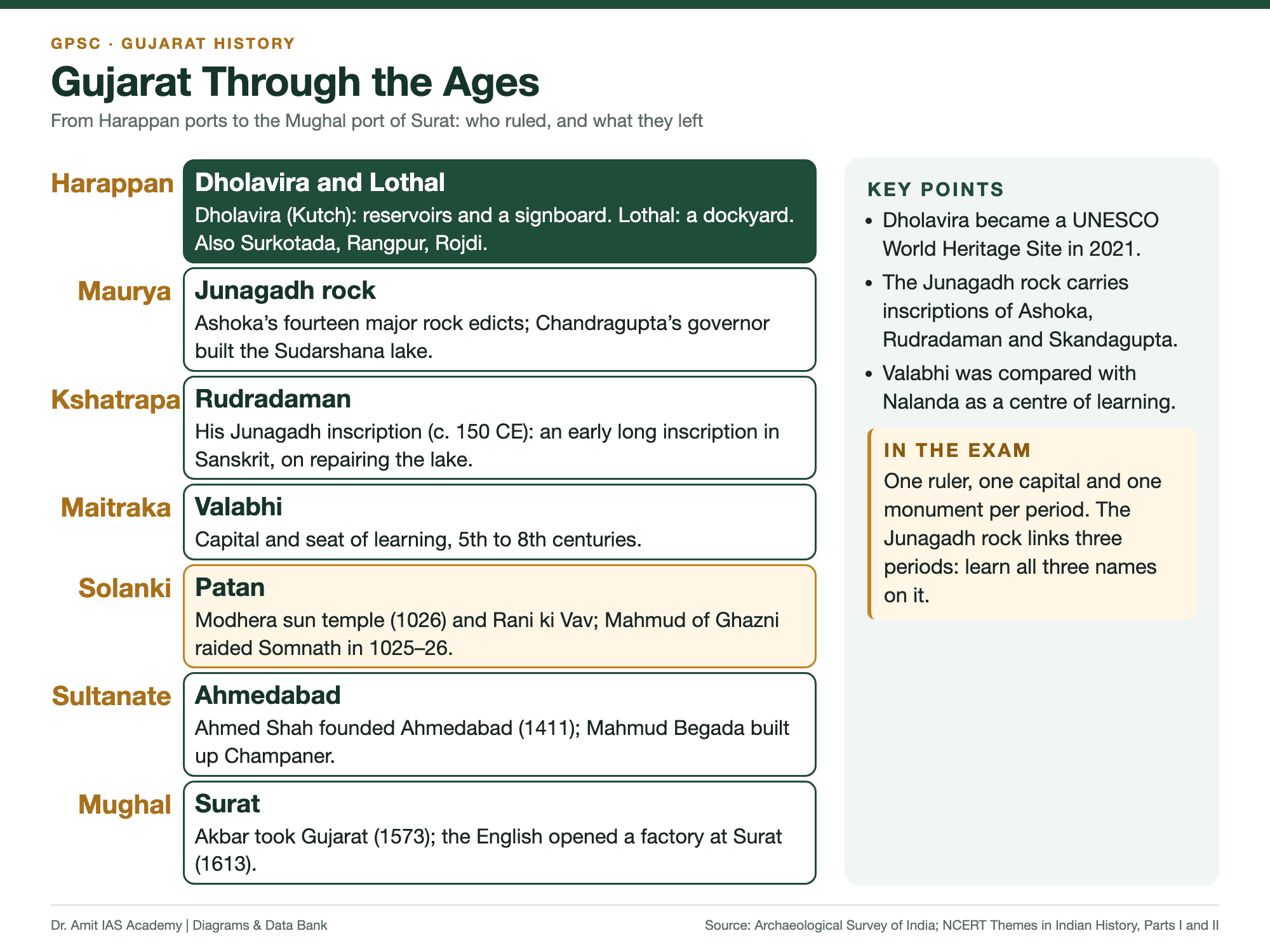
The diagram is a vertical timeline of Gujarat from the Harappan age to the Mughals. Each row names a period on the left and, on the right, one place or person that sums it up. It opens with Dholavira and Lothal for the Harappans, moves to the Junagadh rock for the Mauryas and to Rudradaman for the Kshatrapas, then to Valabhi under the Maitrakas and Patan under the Solankis. It closes with Ahmedabad for the Sultanate and Surat for the Mughals. A side panel lists key points and an exam tip: learn one ruler, one capital and one monument per period, and remember that the Junagadh rock links three periods.
Ancient Gujarat: Harappan sites to Valabhi
- Harappan: Dholavira in Kutch is known for its water reservoirs and a large signboard in the Harappan script; it became a UNESCO World Heritage Site in 2021. Lothal had a dockyard, a sign of sea trade. Surkotada, Rangpur and Rojdi are other Harappan sites in the state.
- Maurya: the Junagadh (Girnar) rock carries Ashoka's fourteen major rock edicts. The Sudarshana lake nearby was built by Pushyagupta, the governor of Chandragupta Maurya.
- Kshatrapa: the Western Kshatrapa ruler Rudradaman left his Junagadh inscription around 150 CE. It records the repair of the Sudarshana lake and is regarded as an early long inscription in Sanskrit.
- Gupta: Skandagupta's inscription on the same rock records a later repair of the lake, so one rock carries three dynasties.
- Maitraka: Valabhi in Saurashtra was their capital from the 5th to the 8th century and a seat of learning often compared with Nalanda.
Medieval Gujarat: Solankis, Sultans and Mughals
The Solankis (Chaulukyas) ruled from Anahilavada Patan. Their age gave Gujarat the Modhera sun temple (1026) and the stepwell Rani ki Vav at Patan, now a World Heritage Site. In 1025–26 Mahmud of Ghazni raided the Somnath temple.
Under the independent Gujarat Sultanate, Ahmed Shah founded Ahmedabad in 1411 on the Sabarmati. Mahmud Begada later took Champaner and built it up; the Champaner-Pavagadh park is also a World Heritage Site.
Akbar annexed Gujarat in 1573, giving the Mughals the busy port of Surat. In 1613 the English East India Company opened a factory there, its first important base on the west coast.
Why it matters for the exam
History and culture of Gujarat is a distinct part of the GPSC Class 1 and 2 syllabus, in the history and culture portions of general studies at both the Prelims and the Mains stages. Questions usually ask the reader to match a site with its feature (Lothal with the dockyard, Dholavira with reservoirs), a ruler with a city he founded, or an inscription with its dynasty. The Junagadh rock suits such questions because one statement-based question can test Ashoka, Rudradaman and Skandagupta together. Mains answers on Gujarat's heritage and maritime trade gain from the chronology this diagram gives.
Quick revision
- Dholavira (Kutch): reservoirs and signboard; UNESCO site since 2021. Lothal: dockyard.
- Junagadh rock: Ashoka, Rudradaman (c. 150 CE, Sanskrit) and Skandagupta.
- Sudarshana lake: built under Chandragupta Maurya, repaired by Rudradaman.
- Valabhi: Maitraka capital, 5th to 8th centuries, a centre of learning.
- Solankis: Patan capital, Modhera sun temple, Rani ki Vav; Somnath raided 1025–26.
- Ahmedabad founded 1411; Akbar took Gujarat 1573; English factory at Surat 1613.